Should We Be Optimistic or Pessimistic about Our Country’s Future?

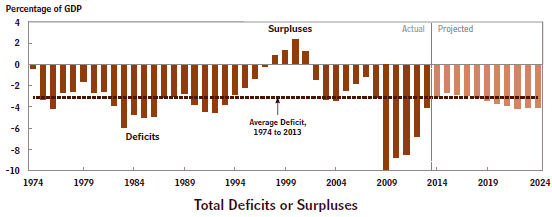
Last month the Congressional Budget Office issued the report “The Budget and Economic Outlook: 2014 to 2024”, giving an updated prediction on economic performance.  It predicts continued slow growth of GDP leveling off in the next few years at a rate of about 2.2% per year.  The public debt (on which we pay interest) will be 74% of GDP this year and increase to 79% of GDP by 2024.  Federal revenues will grow this year to 17.5% of GDP while federal spending will be 20.5% of GDP.  The problem is that the gap between revenue and spending will get worse as indicated by the chart below.
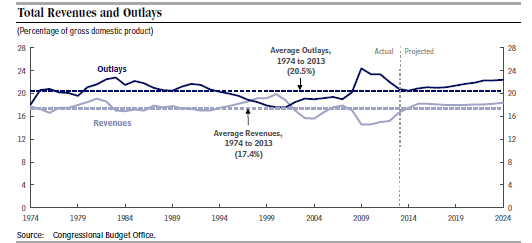
CaptureCBO estimates that interest rates on three month Treasury bills will rise from 0.1% today to 3.7% in 2018, and higher in subsequent years, which means that interest payments on our public debt will increase dramatically as shown in the chart below.  Inflation is predicted to average about 2% over this time period.  Unemployment will slowly drop to 5.8% in 2017 and not reach 5.5% until 2024.
Capture1In an article two days ago, an economics reporter for the New York Times, Floyd Norris, writes that this is “A Dire Economic Forecast Based on New Assumptions”.  Mr. Floyd argues that it is unlikely that we will continue to have both anemic growth and high interest rates at the same time.  Of course, if the economy does grow more quickly, then government revenues will also grow faster which will slow down the growth of the debt.  But CBO predicts that our recovery from the Great Recession will continue to be tortuously slow.
The problem is that when interest rates do go up, as they will sooner or later, interest payment on the national debt will rise quickly, as shown in the CBO chart.  This is going to happen and will be unpleasant to deal with.  Are we going to have slow growth in the meantime, with high unemployment along with it, and then also have expensive debt payment later?  This is indeed a pessimistic prospect!
We have a continuum of choices:

  • Do nothing until the big crunch hits in a few years (like Greece)
  • Cut spending dramatically, including for entitlements (politically infeasible)
  • Raise taxes dramatically (also politically infeasible)
  • Both cut spending and raise taxes (perhaps doable as we get closer to the big crunch)
  • Grow the economy faster which would both lower unemployment and raise revenue

I know what my choice is, how about you?
Truth and Myth about Inequality


Two of my favorite columnists are the Brooking Institution’s William Galston, a social economist who has a weekly column in the Wall Street Journal and the economics journalist Robert Samuelson who writes for the Washington Post.  
Most people agree that income inequality in the U.S. is steadily getting worse.  Mr. Galston make a good case (see my last post) that it is primarily caused by the large gap between the rising productivity of American workers and the stagnant level of their pay which has developed since 1973.  He thinks that we need a fundamentally new social contract which links worker compensation to productivity.  This, of course, is a tall order and it is not at all clear how such a new order would be achieved.
CaptureMr. Samuelson has a different perspective: “Myth-making about Economic Inequality”.  For example:

  • The poor are not poor because the rich are rich
  • Most of the poor will not benefit from an increase in the minimum wage because only 6% of the 46 million poor people have full time jobs
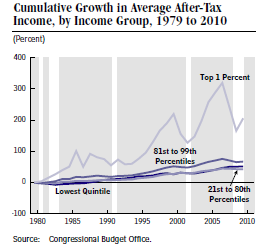
  • All income groups have gained in the past three decades, even though the top 1% has gained the most (see the above chart from the CBO, December 2013)
  • Widening economic inequality did not cause the Great Recession

These two perspectives on inequality are quite different but not contradictory.  Basically what Mr. Samuelson is saying is that we have to be careful in how we address this problem or we’ll just make it worse.  Raising taxes on the rich is unlikely to help and might hurt if it slows down the economy.  Raising the minimum wage will only raise a fairly small number of people out of poverty and may cause a lot of unemployment along the way.
My solution: focus on boosting the economy to create more jobs in the short run (tax reform, immigration reform, trade expansion) and improved educational outcomes for the long run (early childhood education, increasing high school graduation rates, better career education).
But I agree with Mr. Galston that it is imperative to lessen income inequality, one way or another.  Otherwise as a society we’ll have big trouble on our hands.

Inequality, Productivity and Compensation

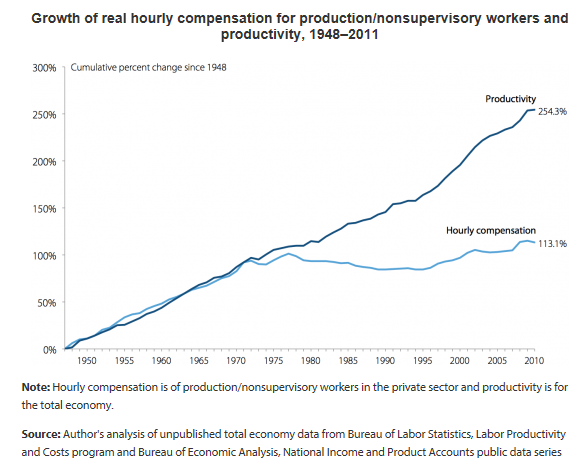
The Brookings Institution social economist, William Galston, has an interesting column in yesterday’s Wall Street Journal, “The U.S. Needs a New Social Contract”, deploring the fact that worker compensation (i.e. wages + benefits) has not kept up with gains in worker productivity since the 1970s.  Here is a chart published by the Economic Policy Institute showing the divergence between productivity and compensation for a “typical” ( i.e. in the middle) worker beginning in the 1970s:
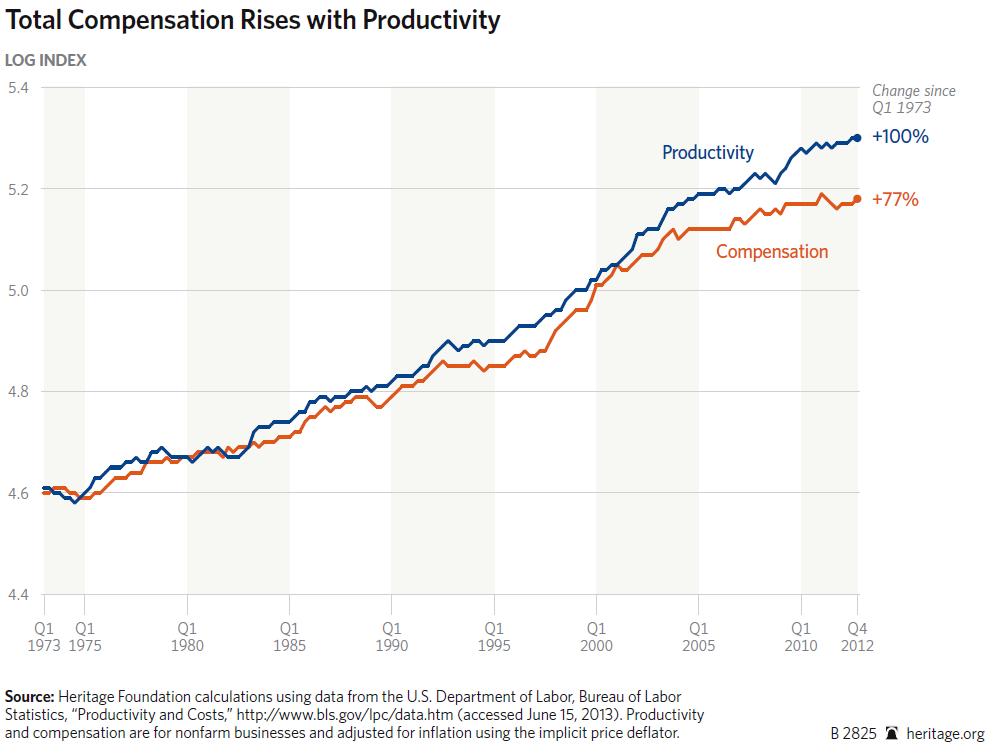
CaptureThe Heritage Foundation’s James Sherk has addressed this same question in a recent report “Productivity and Compensation: Growing Together” and shows that the “average” compensation of an American worker does track productivity very closely as shown in the chart below:
Capture1What is the explanation for this apparent discrepancy?  In fact, it is the difference between the average earnings of U.S. workers and the earnings of the median or middle worker.  The very high earnings of the top 10% and the even higher earnings of the top 1% raise average worker compensation way above the income level of the median worker.  In other words it is the result of the skewed and unequal distribution of incomes which is heavily weighted toward those at the top of the scale.  The typical or median worker is falling behind and is not benefitting from the steady rise in the overall productivity of the American economy.  This is what income inequality is all about.
The question is what to do about it.  Faster economic growth will create more opportunity by creating more jobs and better paying jobs.  Raising high school graduation rates as well as creating high quality technical training programs will also help.
Mr. Galston insists that this is not enough.  Too many workers will continue to lag farther and farther behind.  We could raise the Earned Income Tax Credit for low income workers but this would be very expensive in our currently tight fiscal situation which is likely to continue indefinitely.
Do we need a new social contract?  If so, what form will it take?  How will we pay for it?  These are indeed very difficult questions to answer!

The Economic Outlook: 2014 – 2024 II. How Can We Grow Faster?

Last week I summarized the latest economic report from the Congressional Budget Office which very clearly describes both the slow rate of growth of our economy since the end of the recession, the enormous buildup of our national debt in the past five years and also the likelihood that it will continue getting worse for the foreseeable future unless big changes are made.
CaptureAbout a week ago the two economists Edward Prescott and Lee Ohanian had an Op Ed in the Wall Street Journal, “U.S. Productivity Growth Has Taken a Dive”, pointing out that the productivity of U.S. workers has grown at an average annual rate of only 1.1% since 2011, much lower than the average annual rate of about 2.5% since 1948 (see the above chart).  They also point out that the rate of new business creation is 28% below where it was in the 1980s (see the chart just below).  Growth of worker productivity and growth of new business formation are the two main forces which drive economic growth.
Capture1“Why is the startup rate so low?  The answer lies in Washington and the policies implemented in the wake of the 2008 financial crisis that were, ironically, intended to grow and stabilize the economy.” Mr. Prescott and Mr. Ohanian continue that it is the “explosion in federal regulation, intervention and subsidies (which) has retarded productivity growth by protecting incumbents at the expense of more efficient producers, including startups.”
It is easy to be pessimistic about the prospects for change in the government policies which are retarding economic growth.  Unfortunately, many political and social leaders have the point of view that it is income inequality which is “the defining issue of our time.”
The best response to this pervasive attitude is to shift the conversation towards equality of opportunity rather than dwelling on income inequality.  By far the best way to increase opportunity for those who desire it and are willing to work for it is to grow the economy faster in order to create more and better jobs. If we are able to do this, we’ll all be much better off.

The Economic Effect of ObamaCare

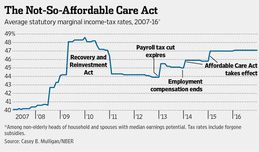
Last week’s report from the Congressional Budget Office “The Economic Outlook: 2014 – 2024” (which I discussed in my last post) caused a big stir with its prediction that ObamaCare will cause a loss of 2,000,000 mostly low wage jobs by 2017 and 2,500,000 such jobs by 2024.  The lost jobs aren’t necessarily from workers being fired or fewer workers being hired but rather the overall decreased incentive for individuals to find work.  The CBO analysis is based on the research of the economist Casey Mulligan featured in yesterday’s Wall Street Journal as “The Economist Who Exposed ObamaCare”.
CaptureThe above chart of Mr. Mulligan interprets several recent government subsidy programs as a new marginal tax rate, i.e. the “extra taxes paid and government benefits foregone as a result of earning an extra dollar of income.”  The 2009 stimulus, the Recovery and Reinvestment Act, had an effect like this but it was temporary.  The marginal tax increase of the Affordable Care Act will last as long as it remains in effect.
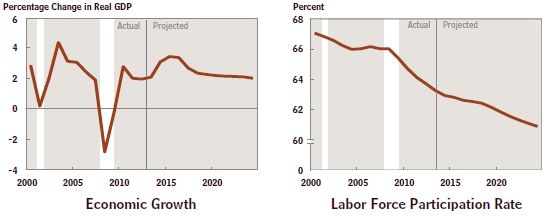
Capture1The above chart from the same CBO report, showing the steady decline in the Labor Force Participation Rate from the year 2000 onward, demonstrates the critical nature of this problem.  Lower labor force participation means lower growth in overall labor productivity which in turn means slower economic growth.  Since the Great Recession ended in June 2009, GDP growth has averaged only about 2% annually.
Slow GDP growth means, in addition to a higher unemployment rate, that America’s standard of living will not increase very rapidly if at all.  But the problem is really much worse than this.  We have an enormous debt problem which is only getting worse every year that we continue to have large deficits.  The CBO report predicts increasing growth in the size of our national debt.  By far the least painful way of shrinking our debt (relative to the size of the economy) is to grow the economy as fast as we reasonably can.  But our economy is actually slowing down, not speeding up!
This is a very serious problem which many of our national leaders are much too complacent about!

The Economic Outlook: 2014 – 2024 I. The Basic Data


The Congressional Budget Office has just issued the report ”The Budget and Economic Outlook: 2014 to 2024”, giving its usual objective and nonpartisan look at our prospects for the next ten years.  My purpose today is to give a simple interpretation of its basic data.  In my next post I will address the implications of this interpretation.
CaptureCapture1The first chart above shows a forty year history of government deficit spending.  The average deficit for this time period is 3% of GDP.  From 1982 – 1987 the deficits were worse than this and from 2009 – 2013 they were much worse.  The real problem is the accumulated deficits, i.e. the debt.  The second chart above shows the public debt (what we pay interest on) all the way back to 1940 as a percent of GDP.  As recently as 2008, the public debt was below 40% of GDP.  Now it is 73% and climbing.  This is very serious for two reasons.  Right now our public debt is almost free money because interest rates are so low.  But when interest rates return to their normal level of about 5%, interest payments will explode and be a huge drain on the economy.  In addition, these CBO predictions assume continued steady growth of the economy.  If and when we have a new recession or some other financial crisis, there will be much less flexibility available for dealing with it.
Capture2Now look at the last two charts.  The first one shows the rate of GDP growth since 2000 which has averaged about 2% since the end of the recession in June 2009 and is projected by the CBO to level off at this same rate over the next 10 years.  This is an historically low rate of growth for our economy. The final chart shows the gradual decrease of the labor force participation rate over this same time period.  These two graphs are related!  When fewer people are working, the economy simply will not grow as fast.
High debt and slow growth are big problems for an economy.  We’re falling more deeply into this perilous state of affairs all the time.  We need to take strong measures to break out of this dangerous trap!

Invested in America


The Business Roundtable, an association of chief executive officers of leading U.S. companies, has just issued a new report, “Invested in America: A Growth Agenda for the U.S. Economy”, describing four actions which policymakers can take to rejuvenate the U.S. economy.
CaptureThey are:

  • Restore Fiscal Stability: constrain federal spending in a manner that reduces long-term spending growth, making both Medicare and Social Security more progressive and less expensive.
  • Enact Comprehensive Tax Reform: adopt a competitive, pro-growth tax framework that levels the playing field for U.S. companies competing in global markets.  Several studies estimate that cutting the U.S. corporate tax rate by 10 % (e.g. from 35% to 25%) would boost GDP by 1% or more.
  • Expand U.S. Trade and Investment Opportunities: pass updated Trade Promotion Authority legislation and use TPA to complete many new trade agreements which are already pending.
  • Repair America’s Broken Immigration System: increase the number of visas for higher skilled workers and provide legal status for the millions of undocumented immigrants currently living in the U.S.

These are the same “big four” policy changes which many progressive business leaders as well as evenhanded think tank experts often recommend.  They are really just common sense ideas which reasonable people should be able to come together on.
Isn’t it obvious that we’ll soon be in big trouble if we don’t get our enormous budget deficits under control?  And that controlling entitlement spending is key to getting this done?
Isn’t it just as obviously commonsensical that even U.S. based multinational corporations will try to avoid locating business operations in countries like the United States with very high corporate tax rates?
Isn’t it likewise obvious that foreign trade is just an extension of domestic trade and that the world is better off with as much trade as possible?
Finally, the secret of a vibrant, growing economy is to encourage as much initiative and innovation as possible.  Who take more initiative than the immigrants who figure out how to get here in the first place?
We don’t have to accept a sluggish economy, high unemployment and massive debt!  But we do need to take intelligent action to extricate ourselves from the predicament we are in!

What Is the State of the U.S. Economy?


On the eve of the President’s State of the Union address, the New York Times gives an answer to this question in today’s paper, “Obama’s Puzzle: Economy Rarely Better, Approval Rarely Worse”.  The charts below do show the basic trends all moving in the right direction.  But is this good enough?
CaptureThe unemployment rate is moving steadily downward but it is still a high 6.7% almost five years after the recession ended in June 2009.  And this is with a labor participation rate of only 58.6%, which is historically very low.
The budget deficit is dropping but is still unsustainably high.  In the five years, 2009 – 2013, deficits have totaled $6 trillion dollars.  As soon as interest rates return to their historical average of 5%, interest on this $6 trillion in new debt alone will total $300 billion per year, forever!  Furthermore, the Congressional Budget Office, the most credible source of budget information, predicts that the deficit is likely to resume an inexorable climb within a few years as baby boomers retire in ever greater numbers, rapidly driving up entitlement costs.
Economic growth was stronger than expected in the last quarter of 2013 and this is a good sign.  But it has averaged only about 2% since the recession ended which is very low by historical standards, in a post recessionary period.
The point is, do we really need to settle for such mediocre performance: a stagnant economy, high unemployment and massively accumulating debt?  Should we just declare that in a highly competitive global economy with an ever higher premium on information and technology, that we just can’t do any better than we already are?  Isn’t there some way to make our economy grow faster in order to provide more and higher paying jobs?
I think that the answer to this last question is an emphatic yes!  In fact, this is what my blog is all about.  Just read some of the other recent posts and let me know if you disagree with what I am saying!

A Global Perspective on Income Inequality II. Where Are the Jobs?


My last post on January 23 shows vividly what the challenges are in restoring the American middle class to the prosperity which existed up until the Great Recession hit in late 2007.  The problem, of course, is the gale strength force of globalization which is lifting up low wage workers all over the developing world and creating huge competition for the many low-skilled workers in the United States.
In today’s New York Times, the former Obama Administration car czar, Steven Rattner, writes about “The Myth of Industrial Rebound” in the United States, explaining why manufacturing jobs are coming back much more slowly than other jobs.  “Manufacturing would benefit from the same reforms that would help the broader economy: restructuring of our loophole-ridden corporate tax code, new policies to bring in skilled immigrants, added spending on infrastructure and, yes, more trade agreements to encourage foreign direct investment.”
CaptureThe above chart shows the huge decline in manufacturing jobs relative to other parts of the economy such as the education and health sector as well as the professional and business sector.  Of course, these more rapidly growing service sectors are the ones benefitting from the information technology revolution.  In manufacturing, on the other hand, the low skill jobs are going overseas while the high skill jobs, using technology such as robots, are much fewer in number.
Conclusion: in order to increase manufacturing jobs in the U.S., we better government policies, as outlined above by Mr. Rattner.  But we also need to recognize that there aren’t going to be as many high skilled manufacturing jobs in the future.  We are going to need much better K-12 and post-secondary educational outcomes to prepare the middle class for the high skilled service jobs which will predominate in the future.

Who Are the Enemies of the Poor?


In his usual provocative fashion, New York Times columnist Paul Krugman says that Republicans are “Enemies of the Poor” because “they’re deeply committed to the view that efforts to aid the poor are actually perpetuating poverty, by reducing incentives to work.”
CaptureBut the Heritage Foundation’s Robert Rector has recently pointed out in the Wall Street Journal, “How the War on Poverty Was Lost”, that “the typical American living below the poverty line in 2013 lives in a house or apartment that is in good repair, equipped with air conditioning and cable TV.  He has a car, multiple color TVs and a DVD player.  The overwhelming majority of poor Americans are not undernourished and did not suffer from hunger for even one day of the previous year.”  In fact we are now spending $600 billion a year of our $3.4 trillion federal budget and another $230 billion by the states to fight poverty.  The poverty rate was 19% in 1964 and is 16% today (when government benefits are included).
Mr. Rector reminds us that “LBJ’s original aim (in initiating his antipoverty program) was to give poor Americans ‘opportunities, not doles’.  It would attack not just the symptoms of poverty but, more important, remove the causes.  By that standard, the war on poverty has been a catastrophe.  The root ‘causes’ of poverty have not shrunk but expanded as family structure disintegrated and labor force participation among men dropped.”
So what should our poverty agenda look like going forward?  We are already providing the basic necessities of life.  Our future efforts should therefore be focused on improving the quality of life for the poor.  This means more effective education and job training.  It means more effort to keep families together by reducing marriage penalties.  But most of all it means providing more opportunities for employment and job advancement.  This requires faster economic growth.  There are many ways to accomplish this.  Back to square one!
The true enemies of the poor are those who refuse to accept the progress which has been made in the War on Poverty and the need to change our approach in order to make further progress.