Does Tax Reform Have a Future?


My post on February 27, “A Breath of Fresh Air” praises the new tax reform proposal from the House Ways and Means Committee which both lowers and consolidates tax rates in a revenue neutral way as well as greatly simplifying the tax code.  It would be a big step in the right direction.  But the Washington Post’s Robert Samuelson makes a good case in ”Does Tax Reform Have a Future?” that the House bill does not go far enough.

CaptureMr. Samuelson argues that if we’re going to eliminate tax deductions and loopholes, and thereby alienate lots of special interest groups, in order to get lower tax rates, then we should avoid half measures and eliminate virtually all deductions in order to get the lowest possible rates.  In other words, eliminate the mortgage interest deduction rather than just limiting it, eliminate deductions for charitable contributions as well as deductions for state and local taxes.  Eliminate the deduction for employer provided healthcare (which by itself would go a long way towards reforming healthcare.)
Mr. Samuelson would retain only the Earned Income Tax Credit (which encourages low-income people to work) and also the tax preference for contributions to retirement accounts (without which most Americans wouldn’t save for retirement.)
We badly need broad based tax reform to stimulate our economy.  Douglas Holtz-Eakin, the former director of the Congressional Budget Office, has estimated “Reforming Taxes, Goosing the Economy”, that even the imperfect House tax reform proposal would raise GDP by .5% annually for 10 years and create 500,000 new jobs each year over this time period.
Full-fledged tax reform, a la Samuelson, would provide an even greater stimulus but let’s at least do something to put the millions of unemployed and underemployed people back to work and reduce our staggering budget deficits!
The Economic Outlook: 2014 – 2024 I. The Basic Data


The Congressional Budget Office has just issued the report ”The Budget and Economic Outlook: 2014 to 2024”, giving its usual objective and nonpartisan look at our prospects for the next ten years.  My purpose today is to give a simple interpretation of its basic data.  In my next post I will address the implications of this interpretation.
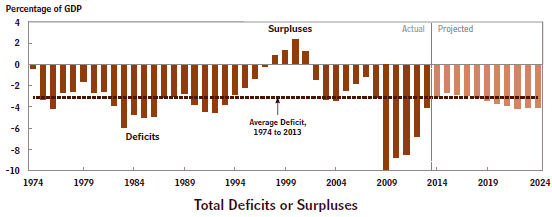
CaptureCapture1The first chart above shows a forty year history of government deficit spending.  The average deficit for this time period is 3% of GDP.  From 1982 – 1987 the deficits were worse than this and from 2009 – 2013 they were much worse.  The real problem is the accumulated deficits, i.e. the debt.  The second chart above shows the public debt (what we pay interest on) all the way back to 1940 as a percent of GDP.  As recently as 2008, the public debt was below 40% of GDP.  Now it is 73% and climbing.  This is very serious for two reasons.  Right now our public debt is almost free money because interest rates are so low.  But when interest rates return to their normal level of about 5%, interest payments will explode and be a huge drain on the economy.  In addition, these CBO predictions assume continued steady growth of the economy.  If and when we have a new recession or some other financial crisis, there will be much less flexibility available for dealing with it.
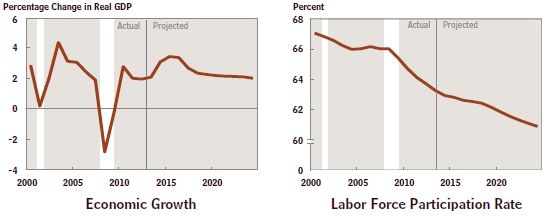
Capture2Now look at the last two charts.  The first one shows the rate of GDP growth since 2000 which has averaged about 2% since the end of the recession in June 2009 and is projected by the CBO to level off at this same rate over the next 10 years.  This is an historically low rate of growth for our economy. The final chart shows the gradual decrease of the labor force participation rate over this same time period.  These two graphs are related!  When fewer people are working, the economy simply will not grow as fast.
High debt and slow growth are big problems for an economy.  We’re falling more deeply into this perilous state of affairs all the time.  We need to take strong measures to break out of this dangerous trap!

More on Inequality: What Does the Data Mean?

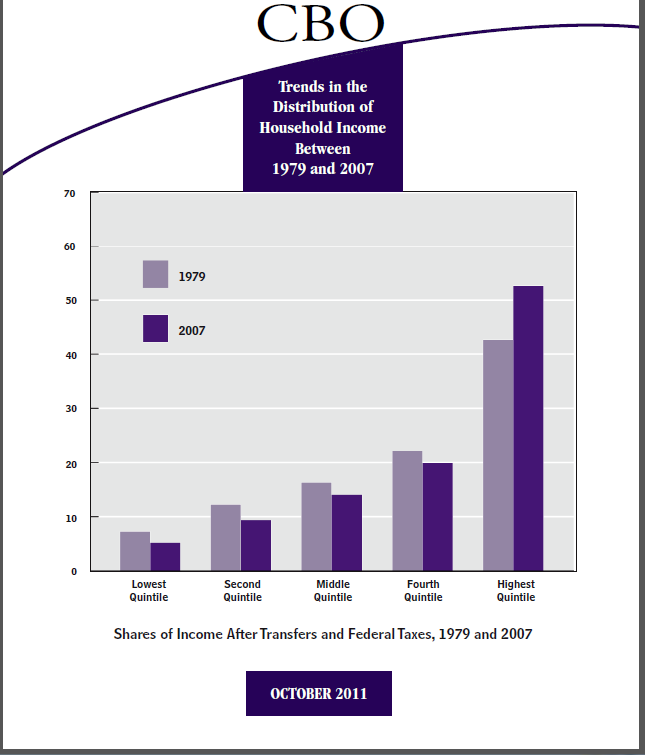
In yesterday’s Wall Street Journal, the economist Robert Grady addresses “Obama’s Misguided Obsession With Inequality”.  The basic problem is that an important Congressional Budget Office report in 2011, “ Trends in the Distribution of Household Income Between 1979 and 2007”, is easy to misrepresent and misinterpret.  Here are three basic pieces of data from the CBO report:
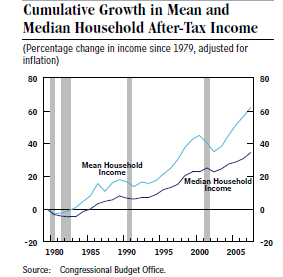
Capture3CaptureCapture1The first chart shows that yes, between 1979 and 2007 the rich did indeed get richer relative to the rest of the population.  The second chart shows, however, that median household income increased by 62% during this same time period.  And the third chart shows that all five income groups made substantial gains at the same time.
As Mr. Grady says, “Here is the bottom line.  In periods of high economic growth, such as the 1980s and 1990s, the vast majority of Americans gain and have the opportunity to gain.  In periods of slow growth, such as the past four and a half years since the recession officially ended, poor people and the middle class are hurt the most, and opportunity is curbed. … The point is this: If the goal is to deliver higher incomes and a better standard of living for the majority of Americans, then generating economic growth – not income inequality or the redistribution of wealth – is the defining challenge of our time.”
So then, what is the best way to address income inequality?  Should we concentrate on raising taxes on the rich and increasing spending on social programs like we have done in the last five years?  Or should we rather concentrate on speeding up economic growth, as Mr. Grady says, in order to create more jobs and more opportunities for advancement?
Compare the enormous growth in the period from 1979 to 2007 with the stagnation of the past five years.  Isn’t it obvious which is the better way to proceed?

Global Warming Is For Real. What Should We Do About It?

Although the threat of global warming is vastly overhyped, it is happening nonetheless.  Perhaps the best single indication of this is the shrinking of the north-pole ice cap.  The New York Times reported just a few days ago, “Large Companies Prepared to Pay Price on Carbon”, that at least 29 major companies “are incorporating a price on carbon into their long-range financial plans.”  This includes five big oil companies ExxonMobil, ConocoPhillips, Chevron, BP and Shell.  Specifically, these major companies have all come to accept the reality of global warming and are preparing for a carbon tax to be levied before long.
The Congressional Budget Office has recently released a report “Effects of a Carbon Tax on the Economy and the Environment”, which concludes that a tax of $20 to emit a ton of CO2 would raise a total of $1.2 trillion over a decade.  Such a tax would, for example, raise the price of gasoline by 10 to 15 cents per gallon.
Once we admit that global warming is for real, and that we need to address it in a serious way, a carbon tax is almost certainly the most efficient, and least economically harmful, way to do it.  A tax on carbon output would do many things.  It would give a big boost to renewable energy (solar and wind) with, or without, special subsidies for renewables.  It would speed up the transformation from the use of coal to natural gas, since natural gas only contains half as much carbon as coal does.  And it would create an economic incentive to speed up the development of carbon capture in order to make the burning of coal more cost competitive.
Of course, a new $120 billion per year carbon tax will affect the economy.  But it will do the least damage if the proceeds are used entirely for deficit reduction.  So we can address a serious environmental problem which effects life on earth and can do so in a way which also addresses a very serious fiscal problem.
I believe that the American people are up to making a sacrifice like this if the consequences of inaction are clearly explained to them.

The Mess in Detroit: A Stern Warning for the Whole Country


An article in yesterday’s New York Times, “Detroit Ruling Lifts a Shield on Pensions”, reports a ruling by bankruptcy judge Steven W. Rhodes that Detroit “could formally enter bankruptcy and that Detroit’s obligations to pay pensions in full is not inviolable.”
The article goes on to say “that most here agree that the city’s situation is dire:  annual operating deficits since 2008, a pattern of new borrowing to pay for old borrowing, miserably diminished city services, and the earmarking of about 38 percent of tax revenues for debt service.  A city that was once the nation’s fourth largest has dropped to 18th, losing more than half of its population since 1950.  The city was once home to 1.8 million people but now has closer to 700,000.”
The parallels and analogies between what has happened in Detroit and what is now happening in the U.S. are striking.  The U.S. has had huge annual deficits for five years in a row and the accumulated debt is enormous, the Federal Reserve is holding interest rates down to make borrowing cheaper, and our country’s infrastructure is deteriorating much faster than it is being repaired.
Right now interest on the national debt is small ($223 billion in 2013, or 8% of federal revenues).  But interest rates will inevitably return before long to their average historical rate of about 5%.  Right now the public debt (on which we pay interest) is just over $12 trillion.  This means that in the near future interest on the national debt will be at least $600 billion per year and probably much larger because the debt is still growing so rapidly.  This will take a huge bite out of revenue and leave far less of it for other purposes.
This problem will continue to exist even if the budget were to be miraculously balanced from now on but it would at least lessen over time as the economy continues to grow.  Without budget restraint the problem will never go away and will be a perpetual drag on our national welfare.
This is, of course, exactly the condition in which Detroit finds itself at the present time.  Detroit has the option to declare bankruptcy and make its creditors and pensioners take big losses.  Once it does this it can make a fresh start and perhaps recover its former status.
But are we prepared to let the whole country suffer a similar fate?  The consequences would be enormous.  If the U.S. goes down, the whole western world could come down with it.  Democracy and human progress would be severely threatened.  This is really too terrible a tragedy to even contemplate.  Let’s turn things around before they get any worse!

The Floundering of America


In yesterday’s Wall Street Journal, columnist William Galston talks about “The Floundering of America”.  Based on recent reports from the Congressional Budget Office, Mr. Galston says that “Today we are hurtling toward a less dynamic economy, a meaner society and a riskier world.”
His argument is based on these observations:

  • For the past 40 years, 1970-2010, the labor force expanded at an average rate of 1.6% per year.  It will soon slow to only .4% annual growth, because of more retirements and a plateauing of women’s labor-force participation. This means that growth in GDP will slow down to about 2% annually from its historical average of over 3%.
  • America is aging very fast.  Today there are 57 million Social Security beneficiaries which will increase to 76 million in 2023.  Obviously this will rapidly increase entitlement spending on retirees.
  • America already spends 18% of GDP on healthcare costs and the CBO projects that this will grow to 22% by 2038.

“In sum, current trends and policies will yield lower rates of economic growth, painfully slow gains in real incomes, huge increases in outlays for expenses related to an aging population, and a health sector that devours more and more of the national product”, he says.
These trends are all contributing to an explosion of the national debt.  The only current strategy to keep this debt even roughly stable during the next decade, let alone reduce it, is to shrink discretionary spending through sequestration.  This will lead to a decline in discretionary spending to 5.3% of GDP by 2023.  This means roughly 2.6% of GDP for national defense with an equal share or all other domestic purposes.
“This is pure folly”, says Mr. Galston. “The country needs a new national strategy for a viable future.”
How do we achieve a new strategy?  Immigration reform will increase the size of the workforce.  Tax reform could boost the economy by encouraging business expansion, risk taking and entrepreneurship.  True (consumer-driven) healthcare reform could dramatically lower the cost of healthcare.  In other words there are potential policies out there that address our national floundering. We simply need leaders who are capable of going beyond partisanship in order to help create a better future!

Nowhere to Cut? II. Are You Really Trying?

The New York Times has a story today, “A Dirty Secret Lurks in the Struggle Over a Fiscal ‘Grand Bargain’”, suggesting that there are really two reasons why the House-Senate Budget Conference Committee, chaired by Representative Paul Ryan and Senator Patty Murray, is unlikely to accomplish very much.  The simple reason is that the Republicans will not support tax increases, on which the Democrats insist, and the Democrats will not support major changes to entitlement programs, on which the Republicans insist.
But the “dirty secret” (according to the NYT) is that Republicans don’t really want to trim either Social Security or Medicare, which many Tea Partiers receive, and Democrats don’t really want to raise taxes on the upper income individuals who support them.  Furthermore, the deficit for 2013 was “only” $680 billion, and is expected to drop further in the next few years, while interest rates are so low that borrowing hundreds of billions of dollars each year is not expensive.  In other words, just kick the can down the road.  Let somebody else worry about the problem in the future.
My previous post “Nowhere to Cut”, based on the report from the Congressional Budget Office, “Options for Reducing the Deficit: 2014 – 2023”, picks 14 possible budget cuts or revenue enhancements out of a total of 103 such items listed.  Just these 14 items alone amount to a savings of $566 billion over ten years, more than enough to offset half of the entire sequester amount.
For example, raising the eligibility age for Medicare to 67 would save $23 billion (over 10 years), using the ‘chained’ CPI to measure inflation for all mandatory programs would save $162 billion, tightening eligibility for food stamps would save $50 billion, taxing carried interest as ordinary income would save $17 billion, limiting highway funding to expected highway revenues would save $65 billion, reducing the size of the federal workforce through attrition would save $43 billion, limiting medical malpractice torts would save $57 billion, and modifying Tricare fees for working-age military retirees would save $71 billion.  Just these eight savings total $456 billion and would offset almost half of the entire sequester.
What is so difficult about making a tradeoff deal like this?  Isn’t this what we send people to Washington to do?

Nowhere to Cut?

After five years of enormous deficits, our national debt now stands at over $17 trillion.  The only spending restraint that Congress has been able to achieve so far is an approximately one trillion dollar “sequester” over ten years, therefore amounting to about $100 billion per year in spending cuts.  Federal expenditures have actually dropped for two years in a row now so the sequester really does work.  Of course, almost everyone complains about cutting spending in such a “dumb” way.  Why not make intelligent budget cuts by eliminating the least effective programs instead of having to make small percentage cuts in all discretionary spending, good and bad alike?  Well, this really should not be all that difficult to do if Congress would try a little harder.
The Congressional Budget Office has just released a helpful report, “Options for Reducing the Deficit:  2014 to 2023”, which lists 103 ways for either decreasing spending or increasing revenues over the next decade.  Amazingly, enacting all of these proposals would amount to a budget savings of $13 trillion over 10 years, ten times what is required by the sequester!  Here are some examples of what could be done (along with the 10 year savings):

  • Eliminate direct payments to agricultural producers                             $25 billion
  • Increase federal insurance premiums for private pensions                    $5 billion
  • Reduce the amounts of federal pensions                                               $6 billion
  • Tighten eligibility for food stamps                                                          $50 billion
  • Use more accurate measure of inflation for all mandatory programs  $162 billion
  • Replace some military personnel with civilian employees                     $19 billion
  • Limit highway funding to expected highway revenues                           $65 billion
  • Eliminate grants to large and medium sized airports                               $8 billion
  • Eliminate subsidies for Amtrak                                                               $15 billion
  • Reduce the size of the federal workforce through attrition                     $43 billion
  • Tax carried interest as ordinary income                                                 $17 billion
  • Limit medical malpractice torts                                                               $57 billion
  • Raise the age of eligibility for Medicare to 67                                         $23 billion
  • Modify Tricare fees for working-age military retirees                              $71 billion
  • Total                                                                                                      $566 billion

Right here is more than enough to offset half of the sequester.  You don’t like these cuts?  Then replace them with others from the CBO report.  There are lots of options to choose from!

Are Deficit Fears Overblown?


In yesterday’s Wall Street Journal columnist David Wessel responds too mildly in “Why It’s Wrong to Dismiss the Deficit” to Larry Summers’ view that we should not worry about the deficit.  Mr. Summers says, “Let me be clear.  I am not saying that fiscal discipline and economic growth are twin priorities.  I am saying that our priority must be on increasing demand.”  According to Mr. Wessel, here is the essence of Mr. Summers’ argument:

  • The deficit isn’t an immediate problem; growth is.
  • We’ve done enough (about the deficit) already.
  • The future is so uncertain that acting now is unwise.

Granted that the deficit for fiscal year 2013 is “only” $680 billion after four years in a row of deficits over a trillion dollars each and that interest rates are at an historically low level at the present time.  The problem is that the public debt is now at the very high level of 73% of GDP and is projected by the Congressional Budget Office to continue climbing indefinitely.  Interest on the debt was $415 billion for fiscal year 2013 which represents 2.5% of GDP of $16.8 trillion.  With GDP growth increasing at about 2% per year since the end of the recession in June 2009, this means that interest on the debt is already slowing down the economy and it’s just going to keep getting worse as interest rates inevitably return to higher historical levels.
Growth is very definitely an immediate problem.  But increased government spending is the wrong way to address it.  The right way to address it is with broad based tax reform (lowering tax rates in return for closing loopholes) to stimulate investment and risk taking by businesses and entrepreneurs.  Significant relaxing of the regulatory burden would also help, especially for the small businesses which are responsible for much of the growth of new jobs.  So would immigration reform to boost the number of legal workers.
As uncertain as the future is, we can be quite sure that entitlement spending (Social Security, Medicare and Medicaid) will be going up fast in the very near future as more and more baby boomers retire and the ratio of workers to retirees continues to decline.  It would be very risky indeed to assume that economic growth will increase fast enough to pay for increased entitlement spending.
Conclusion:  large deficits are a very urgent and immediate problem which we ignore at our peril!   Furthermore the best ways of boosting the economy don’t require increased government spending.

The Intergenerational Financial Obligations Reform (INFORM) Act

On page nine of today’s New York Times is published a full page letter to Congress and President Obama, “Enact The Inform Act”, signed by over one thousand economists as well as former government officials.  It would require “the Congressional Budget Office, the Government Accountability Office and the Office of Management and Budget to do fiscal gap and generational accounting on an annual basis to assess the sustainability of fiscal policy and measure, on a comprehensive basis, the fiscal obligations facing our children and future generations.
“Unlike the measurement of the official federal debt, fiscal gap and generational accounting are comprehensive.  They leave nothing off the books, be it defense spending, Medicare expenditures, or the profits of the Federal Reserve, in assessing the sustainability of fiscal policy and the size of the fiscal bills being left to our own children.”
The INFORM Act is sponsored by a nonpartisan and millennial driven organization which goes by the name, The Can Kicks Back . This is very significant because it is precisely the younger generation of Americans who should be most concerned about the fiscal irresponsibility of so many of our national leaders.  They are the ones who will be stuck with the huge national debt which is being generated by the profligacy of federal spending and also the ones who may have their own retirement benefits greatly curtailed because of it.
Young people should be especially incensed by such irresponsible behavior which will affect them so greatly.  We should support their efforts to turn around this ugly situation!