Which Nebraska Senate Candidate Is Most Serious about the National Debt?


“The single biggest threat to our national security is our debt”
Admiral Mike Mullen, former Chairman of the Joint Chiefs of Staff

My last blog, “Why the National Debt Is Such a Threat to the U.S.” observes that our debt is very large by historical standards and will just keep getting worse under current policies now in effect.  This has many severe consequences for the well-being of our country.
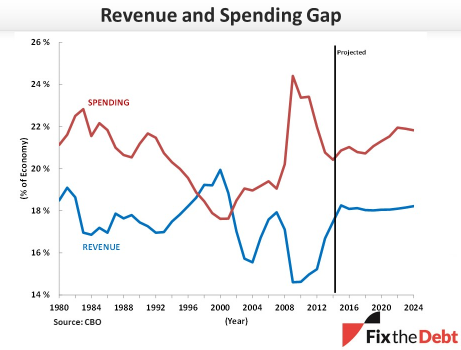
What do we do about it?  We have to shrink the size of our annual deficits which are continuing to make the debt bigger and bigger.  The deficit for the 2014-2015 budget year just ended is $483 billion which is 2.8% of GDP.  Since our economy has been growing at a rate of only 2.2% for the past five years, this means that the debt is still growing faster than the economy.  We have to do better than this.
CaptureThe above chart from the Congressional Budget Office shows that the main contributors to the deficit, and therefore also the debt, over the next 20 years, will be entitlements (Social Security, Medicare and Medicaid) and interest payments on the debt.  All other programs, i.e. almost all of traditional federal spending, will decrease as a percentage of GDP.
This means that there are just two basic ways to solve our debt problem: trim entitlement spending and/or increase government revenue.  We’ll need to do both.  Furthermore, it is unrealistic to expect middle-income and lower-income people to pay higher taxes when their wages have been stagnant for many years.  New tax revenue will have to come from the wealthy including upper-income wage earners.  The best way to do this is by cutting back on the annual $1.2 trillion in loopholes and deductions built into the tax code.

CaptureOnly one Senate candidate from Nebraska is willing to both trim entitlement spending and raise additional tax revenue: Jim Jenkins, a registered independent from Calloway.  The Democratic candidate, David Domina, will not support any significant reining in of entitlement spending.  The Republican candidate, Ben Sasse, is too beholden to wealthy contributors to be willing to raise their taxes by cutting back on their tax deductions.
We badly need elected representatives in Washington who will make it their top priority to “fix the debt.”  Jim Jenkins is such a person.  I hope you will vote for him!

Why the National Debt Is Such a Threat to the U.S.


In my last post I discussed several commonly held myths about the national debt, along the line that it is a fairly minor problem that can easily be solved sometime in the future if we decide that it is important enough to do so.
CaptureThe above chart shows that the debt is already very large by historical standards and that it is projected (by the Congressional Budget Office) to just keep getting worse if we continue on our current path of excessive borrowing to pay our bills.
The national organization, “Fix the Debt” lays out very clearly the reasons why our ever-growing debt level is so harmful:

  • It causes lower wages and fewer job opportunities. The debt will “crowd out” productive investments in people, technology and new ventures. The CBO estimates that wages will grow more slowly if debt is on an upward path compared to a downward path. This will amount to an average $7000 wage cut 25 years from now in the year 2040.
  • It leaves less room for investment in infrastructure, research and the next generation. A growing debt means higher interest payments. The CBO projects that interest payments could nearly quadruple from $220 billion in 2013 to about $800 billion in 2024. That leaves far less for investments in education, infrastructure, research, etc.
  • It increases the likelihood of a fiscal crisis. Failure to get the national debt under control could precipitate a crisis where investors are no longer willing to loan money to the government at affordable rates. This could mean large investment losses, tanking markets, mass unemployment, rapid inflation, etc.
  • It means a missed opportunity to grow the economy. Deficit reduction legislation presents an opportunity to enact pro-growth tax reform, improve programs to reward work, re-orient spending to important investments, and capture the economic benefits of putting the debt on a sustainable path.


Let’s hope and pray that our national leaders appreciate the urgent nature of the debt problem and have the political courage to do something serious about it!  

Straight Talk about the National Debt


The deficit for fiscal year 2014-2015 just ended is “only” $483 billion, about 2.7% of current GDP, and some observers are saying this means that our deficit and debt problems are now under control and we should stop fretting so much about them.
CaptureThere is a nonpartisan outfit in Washington DC, “Fix the Debt,” which focuses on this very problem and they’re saying not so fast.  In their document, “Common Myths about the Debt,” they debunk several false impressions about the national debt:

  • Myth: Deficit levels are falling and therefore debt is no longer a concern.
  • Fact: Over the next decade our debt is on track to grow about $8 trillion (see above chart). Its growth will accelerate after 2018 and will exceed the size of the entire economy by 2035.
  • Myth: Deficit reduction is just code for austerity which will ultimately hurt the economy.
    Fact: A comprehensive and gradual deficit reduction plan can replace austerity with targeted and pro-growth reforms which promote economic recovery and accelerate long-term wage growth.
  • Myth: Deficit reduction will harm low-income and vulnerable populations.
  • Fact: Every recent bipartisan deficit reduction plan has included progressive reforms that ask more from those who can afford it and protect low-income programs.
  • Myth: The debt can be solved with faster economic growth.
  • Fact: Economic growth must be part of the solution, but it can’t solve the debt problem alone. Productivity growth would have to be 50% higher over the next quarter century just to hold debt to its current record-high levels.
  • Myth: Taxing the wealthy more will solve the debt problem.
  • Fact: Our debt problems are too large, and the top 1% too few, to solve the entire problem by raising taxes on the wealthy.

Conclusion: Our debt problem is so large that it can only be solved by stern measures, such as tax reform, including reducing tax breaks, and also spending reform to slow the growth of entitlement programs. Stay tuned for further discussion of this critical problem!

Why It Is Imperative to Lower the U.S. Corporate Tax Rate


Several large U.S. corporations have recently announced that they are planning to merge with foreign companies and move their corporate headquarters to a low tax country such as Ireland or Great Britain.  The Obama Administration proposes to disallow such tax inversions by requiring that after such a merger at least 50% of the stock of the new company would have to be foreign owned.  Such a regulatory fix is unlikely to solve a much more fundamental problem.
CaptureThe Tax Foundation has just published a new study, “Tax Reform in the UK Reversed the Tide of Corporate Tax Inversions,” describing a similar situation in Great Britain just a few years ago and what was done to reverse it.  Basically GB took two actions:

  • Implementing a territorial tax system where profits are only taxed in the country where they are earned, and
  • Lowering the corporate tax rate from 28% in 2010 to 21% in 2014 and 20% in 2015. The GB rate had already been somewhat lower than the U.S. rate since the early nineteen-eighties.

These two changes in the corporate tax code have had a dramatic effect. First of all, the number of corporations in GB has been increasing steadily.  By 2017 GB is likely to overtake the U.S. in total number of corporations.
Capture1Secondly, GB actually raises more corporate tax revenue than the U.S. and has been doing so for some years. It should be clear from this discussion that the U.S. should significantly lower its corporate tax rate.
Capture2The biggest problem in doing this is public opinion.  The organization Wallet Hub has just published its “2014 Tax Fairness Survey” which shows that only 10% of the population believes that taxes should be higher on wages than on investment income, whereas 33% thinks the reverse.  An equal tax rate on both is preferred by 57% of respondents.
Capture3This will make it politically difficult, for example, for the U.S. to match GB’s 20% maximum rate on corporations since even middle class U.S. taxpayers pay a tax rate of 25% or higher.  However it might be possible to abolish the corporate tax altogether if dividends and capital gains were then taxed at the same rate as wage income.
The most important thing, however, is to significantly lower the corporate tax rate, one way or the other, in order to incentivize U.S. multinational corporations to keep more of their business and profits in the U.S.

The Learning Community Is Not a “Failed Experiment”!


The “Learning Community” represents an experiment being conducted in Omaha, Nebraska, where I live, to determine whether the entire metro area can work together to close, or at least narrow, the academic achievement gap between low-income and middle class students. The extent of the problem is clearly demonstrated by the chart below which shows that starting in elementary school reading proficiency is lower for low-income students and this “gap” continues to get worse in middle school and then gets much worse in high school.  Not surprisingly, the same problem exists throughout the entire state of Nebraska to only a slightly lesser degree.
CaptureNow, six years after the establishment of the Learning Community by the Nebraska Legislature, the superintendents of the 11 LC school districts are putting together a comprehensive report on its operation.  There have been repeated complaints about the fairness of the LC’s common property tax levy because it has created many more losers than winners among the 11 districts.  There have also been questions raised about the costs and efficacy of the “open enrollment” facet of the plan whereby low-income students can transfer to an adjoining district and receive free transportation.  It is useful for the superintendents to address these issues in an organized manner.
What will be difficult, of course, is for all eleven school boards to come together in agreement on a final report to the legislature.  The Omaha World Herald reports today  on how that process is going. The superintendents are actually very positive about a new program for early childhood education as well as other elementary learning center programs housed primarily in North and South Omaha.
One superintendent has suggested to his Board that they might want to tell lawmakers that the Learning Community should be declared a “failed experiment” and dissolved.  But given the enormity of the achievement gap, as discussed above, it is unlikely that a majority of the K-12 educational leadership in Omaha will support such a negative recommendation.
The U.S. must figure out how to do a better job of educating children from low-income families and Omaha’s Learning Community is making significant progress in addressing this very critical national problem.

The Reality of Today’s Healthcare: Cost Is Critical


My last two posts have been devoted to discussing the prospects for a true free-market healthcare system in the U.S.  Let’s bring this discussion down to earth with two specific examples.
CaptureIn Omaha NE, where I live, there are three major hospital systems and one of them, Catholic Health Initiatives, is 30% more expensive than the other two.  The major insurer, Blue Cross Blue Shield, has reacted by canceling its contract with CHI, making it out-of-network for Blue Cross policy holders.
As reported in today’s Omaha World Herald, “Non-CHI health clinics, hospitals handling influx,” the Nebraska Medical Center and Methodist Hospital System are seeing a large influx of Blue Cross insured patients.  This is exactly what has been expected to happen and will eventually put pressure on CHI to lower its prices in line with the other two hospital systems.
The second example, “Unable to Meet the Deductible or the Doctor” is the title of an article in yesterday’s New York Times.  The article reports that 7.3 million Americans are now enrolled in insurance coverage through the Affordable Care Act.  However the average deductible for a bronze plan on the exchange – the least expensive coverage – is $5,081 for an individual.  This compares to the average deductible of $1,217 for individual coverage in employer-sponsored plans.
Not surprisingly, relatively low-income people obtaining subsidized coverage through an exchange are likely to want a low cost policy.  But with a high deductible they will then be hard-pressed to have to pay the full price of routine care out of there possibly meager budgets.  This is going to be a larger and larger problem as more and more people obtain coverage through the exchanges.
Since all of an individual’s medical bills should go through the insurer for processing, insurance companies are in a position to, and should be expected to, help control costs by bargaining with providers to make sure that prices are not excessive.
Conclusion: here are two examples of price competition in today’s healthcare market place.  This is the reality that more and more Americans are going to have to learn to live with.  It is the only way that our excessive healthcare costs can be brought under control.

How Do We Establish A Free Market Healthcare System in the U.S.?


As I discussed in my last post, it is critical and urgent for the U.S. to sharply reduce the cost of healthcare, both public and private.  There are basically two different ways to do this: with either a “single payer” system like most of the rest of the developed world has, or with a more nearly free market system than we have at the present time.
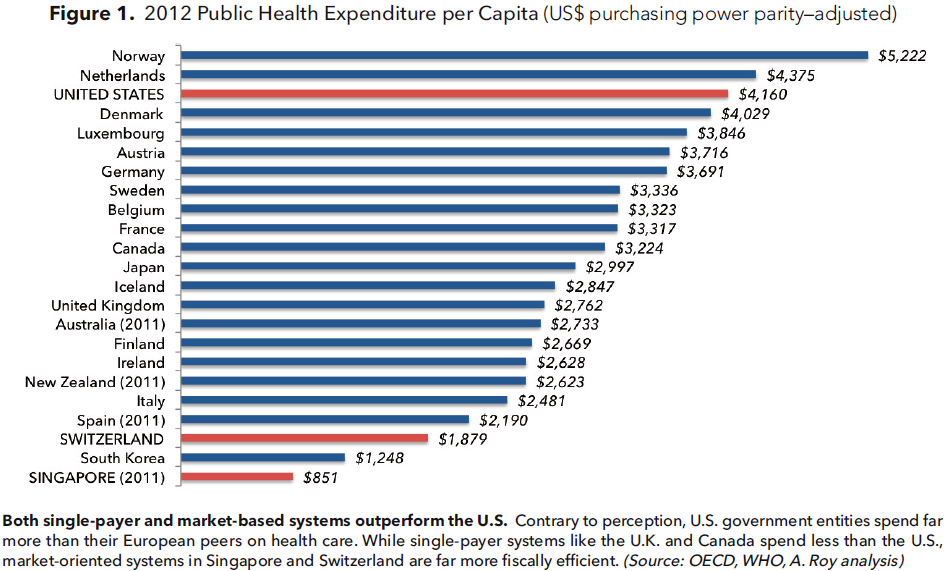
Capture1Both Switzerland and Singapore have largely free market systems with universal coverage and they operate at far less public cost, as shown above, than for other developed countries including the U.S.  The Singapore model features Catastrophic Care insurance, coupled with Health Savings Accounts, for all citizens, with subsidies for those with low-income.  The Swiss model employs exchanges, similar to our own Affordable Care Act, to subsidize, on a sliding scale, health insurance for the low income.  In Switzerland only 20% of the people receive an insurance subsidy compared to 85% in the U.S.
The Manhattan Institute’s Avik Roy has proposed a true free market system for the U.S., “Transcending Obamacare: a patient-centered plan for near-universal coverage and permanent fiscal solvency,” which is modeled on the Swiss system.  Mr. Roy’s plan sets up universal exchanges to offer insurance, subsidized if necessary, to everyone who does not receive it from their employer.
He proposes that over time Medicare and Medicaid recipients as well as Veterans would migrate into the exchange system.  This means that eventually the 30% of Americans (elderly, poor and veterans) who now receive direct government (single payer) support would become part of the exchange system. Mr. Roy’s Universal Exchange Plan is projected to reduce deficit spending by $8 trillion over the 30 year period which it will take to fully phase in the exchanges.  This will go a long way towards solving our serious fiscal problems.
Conclusion:  both Singapore and Switzerland have high quality, cost efficient free market health care systems which proves that a free market approach is possible.  Mr. Roy adapts and expands the Swiss model for the much larger and more complex American market.  It isn’t necessarily the last word in healthcare reform but it takes a big step in the right direction.

Is A Free Market Possible in Health Care?


With a total national debt of $17.8 trillion, of which close to $13 trillion is public debt (on which we pay interest), it is easily understood that the U.S. has a very serious fiscal problem. At the present time the public debt is 74% of GDP and this already high percentage is predicted by the Congressional Budget Office to keep growing indefinitely.
The biggest driver of spending growth going forward is the cost of healthcare.  For example just the three programs, Medicare ($492 billion), Medicaid ($280 billion) and Veterans Healthcare ($54 billion), cost a total of $826 billion per year in federal dollars.  And these costs are all increasing rapidly.  Of course, private healthcare spending, currently about $2 trillion per year, is also growing rapidly.  Overall, the U.S. spends 17.3% of GDP on healthcare spending, public and private, almost twice as much as any other developed country.
How are we going to address this enormous cost issue going forward? The Affordable Care Act (aka Obamacare) doesn’t do it.  What it does do is to provide healthcare to more people under our current model of employer provided health insurance with Medicare for the elderly and Medicaid for the poor.  It is this model which is broken and must be reformed. Basically we have two choices for how to do this.  Either we switch over to a “single payer” system like most of the other developed countries have or we establish a far more efficient free market system.
Capture  As the above chart shows, right now we have a composite system and it is just not cost-effective. There are plenty of experts who claim that a free market cannot work in healthcare.  For example, the tax lawyer, Edward Kleinbard, in a new book, “We Are Better than This: how government should spend our money” argues that what a free market gives us is:  unavoidable controversy for excluded pre-existing conditions, moral hazard for risky behavior, uncertain premiums for permanent insurance, fragmented healthcare markets, monopoly provider organizations leading to price opacity, very high administrative costs, etc.
Capture1The Manhattan Institute’s Avik Roy has a different point of view.  In his proposal, “Transforming Obamacare,” (http://www.manhattan-institute.org/pdf/mpr_17.pdf) he points out that there are two countries, Switzerland and Singapore, which operate highly regarded free-market healthcare systems at very low public cost. Stay tuned for further discussion!

Colorado Was “Reckless to Legalize Marijuana”


So declared incumbent Colorado governor, John Hickenlooper, in a recent re-election campaign debate.  Many states have relaxed marijuana laws, such as for medical use or by decriminalization, and two states, Colorado and Washington, have legalized its recreational use.  Furthermore, public opinion at the national level is gradually swinging over in support of legalization (see below).
CaptureThe New York Times published five lengthy editorials on this subject last summer under the heading of “High Time,” taking the position that the health risks of marijuana use are minimal (except for adolescents) and that it should be left up to the states to decide on the issue of legalization.
But now a new study has just been published by an Australian researcher, Wayne Hall, “What has research over the past two decades revealed about the adverse health effects of recreational cannabis use?” in a highly rated journal, Addiction.  Its key findings are:

  • Driving while cannabis intoxicated doubles the risk of an accident; this risk substantially increases if users are also alcohol-intoxicated.
  • Cannabis use during pregnancy slightly reduces birth weight.
  • 1 in 10 cannabis users develop a dependence syndrome; 1 in 6 for adolescents.
  • Regular cannabis users double the risk of experiencing psychotic disorders.
  • Regular adolescent cannabis users have lower educational attainment.
  • Regular adolescent cannabis users are more likely to use other illicit drugs.
  • Regular cannabis smokers have a higher risk of developing chronic bronchitis.
  • Cannabis smoking in middle age increases the risk of myocardial infarction.

These adverse effects of marijuana use are serious.  My own opinion is that Colorado and Washington probably made a mistake by legalizing the recreational use of marijuana. At any rate, an experiment is now being conducted in these two states and in a few years we will know how it works out.  Other states should be reluctant to follow suit until then.  In the meantime, I support national legislation to decriminalize marijuana use but not to legalize it.
Drug use and misuse has huge economic ramifications and so it is very important to have a sensible and rational national policy on this issue.

“Nebraska Is Not a Tea Party State”


So declares Jim Jenkins, an independent candidate for the U.S. Senate from Callaway in western Nebraska. Several weeks ago I endorsed Jim based on his common-sense centrist views on many important issues such as fixing the debt, tax reform, Obamacare, and immigration reform.  Check out his campaign website for the details.
CaptureNow Jim has come out with additional common-sense reform ideas:

                                      My 5-Point Bipartisan Reform Agenda

Nebraska doesn’t belong to a political party; Nebraska belongs to our people. Unless you can develop a framework in Congress by which you actually debate, discuss and negotiate, we’re not going to be able to move forward. Here’s my 5-point, bipartisan reform agenda to end gridlock in Washington.

  1. Fix the Debt. Debate recommendations from the bipartisan National Commission on Fiscal Responsibility and Reform, more commonly known as the Simpson-Bowles Commission that presented Congress and the President with a comprehensive plan to reduce the deficit.
  2. Biennial Budget. Congress should adopt a biennial budget process, an approach to budgeting utilized by many states, including Nebraska that allows for a more thorough evaluation of budget proposals in year one and a review of budget effectiveness in year two.
  3. No Budget, No Pay. Unless Congress passes a budget by the end of its fiscal year members of Congress will not receive pay. I also support legislation that suspends Congressional recesses until it has passed a budget. Failure to pass budgets undermines the greater economy and undermines the credibility of Congress with its citizens.
  4. Immigration Reform. President George W. Bush presented a bipartisan plan on immigration that had the backing of a significant number of Democrats. The passage of immigration reform will require a meeting in the messy middle. Both Democrats and Republicans are going to have to yield.
  5. Leadership Council. Congress should adopt a bipartisan leadership group each session that would identify the top legislative priorities.

We need leaders in Washington who will work together to find common-sense solutions to our very challenging national problems. Jim Jenkins is such a person and I hope you will consider voting for him on November 4!