Progress on Medicaid Reform


It is widely understood that the rapid increase in spending for entitlements (Social Security, Medicare and Medicaid) is the main driver of our debt problem.  Anything that can be done to get spending for these programs under control is of great value.
The problem with Medicaid is that a fixed percentage of each state’s costs is paid for by the federal government.  The more a state spends, the more that is contributed by the federal government which is a disincentive for states to control their own spending.  From 1989 to 2013, the share of state budgets devoted to Medicaid rose from 9% to 19%.  This upward trend is a problem for both state and federal government and is clearly unsustainable.
One way to change the spending incentive is to turn Medicaid into a block-grant program whereby the federal government contributes a specific amount of money to each state each year and gives states more leeway in designing their own programs.  States would then have a much bigger incentive to hold down costs and the flexibility to be able to do it.
CaptureProgress is being made in this direction with the use of waivers:

  • Rhode Island received a waiver in 2009 to try out various cost-saving measures such as wellness programs, co-payments, etc. It has been quite successful and very well received.
  • Last year Pennsylvania agreed to expand Medicaid to an additional 500,000 people along with a waiver allowing people above the poverty line to be charged premiums of up to 2% of their household income as well as being charged an $8 copayment for use of emergency rooms.
  • Now Indiana (http://www.wsj.com/articles/indiana-governor-to-expand-medicaid-coverage-1422371729) has agreed to an expansion with a waiver under which beneficiaries above the poverty level would be charged premiums of 2% of income and would be locked out of benefits for six months if they fall behind in their payments.
  • Additional states such as Idaho, Wyoming, Utah, Tennessee, Alabama and Florida are also considering Medicaid expansions and likely will be influenced by the possibility of receiving similar waivers.

Waivers are not as cost effective as block-grant funding but they are an improvement over the existing one-size-fits-all federal rules.  If more individual states are able to show that waivers really do work to reduce costs, this will increase the likelihood of implementing a block-grant system.
Status Quo on the Budget Is Not Good Enough II. Look at the Big Picture!


In my last post, “Status Quo on the Budget Is Not Good Enough,” I discussed a report from the outgoing chair of the Senate Budget Committee, Patty Murray (D-WA), and explained how it epitomizes the lack of progress made on the massive debt problem which has developed since the Great Recession of 2008 -2009.
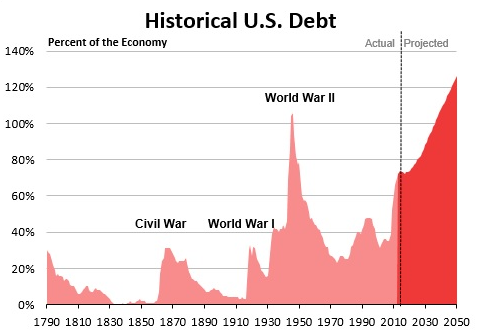
CaptureThe basic problem is that Senator Murray’s analysis simply does not recognize the seriousness of our debt problem as shown in the above chart.  Right now our public debt (on which we pay interest) is “sitting” at 74% of GDP for a year or two, before it continues its rapid increase.  This projection assumes an historically “normal” growth rate of 3% and no new recessions, neither of which assumption is assured.  It also assumes that the sequester budget cuts and new top tax rate of 39.6% stay in effect.  In other words it is a best case scenario based on current policy.
Breaking it down, the debt will continue to increase because annual deficits will continue to exceed the rate of growth of the economy.  The main driver of these increasing deficits is the cost of the health care entitlements of Medicare and Medicaid.  Medicare costs will increase rapidly because of the aging of the American people.  Medicaid costs will increase rapidly because: 1) more low-income people are being covered by the ACA and 2) since the recession there are more low-income people to be covered.  I certainly support expanded healthcare coverage but we have to figure out how to pay for it!
How do we contain the increasing costs of Medicare and Medicaid?  We do it by controlling the overall rapid growth (at twice the rate of inflation) of healthcare costs in general, i.e. for private healthcare. How do we do this?  See a couple of my recent posts either here or here.
Senator Murray, along with many other progressives, argues that we need more deficit spending in order to stimulate the economy and create new jobs.  More jobs are badly needed but more deficit spending is the wrong way to get them.  Then how?  With tax reform among other things.
Based on the outcome of the 2014 elections, I am optimistic that something along the lines of what I have just described will be tried by the next Congress.  We’ll soon find out!

How to Shrink the Deficit: Control Entitlement Spending by Fixing Obamacare


Our country faces two major fiscal and economic problems:

  • How to boost the economy in order to put more people back to work.
  • How to either increase tax revenue or better control spending in order to shrink the deficit.

My last post, “The Great Wage Slowdown and How to Fix It” makes a specific tax reform proposal to cut tax rates for all by shrinking tax deductions for the wealthy.  This would put tax savings in the hands of millions of wage earners with stagnant incomes, who would likely spend it, thereby boosting the economy.
CaptureAs the above chart clearly shows, there is only one realistic way to shrink the deficit.  We have to do a better job of controlling entitlement spending (Social Security, Medicare and Medicaid.)  As a practical matter, this means we have to cut back the cost of American healthcare in general, both public and private.
The Manhattan Institute’s Avik Roy has come up with an attractive Plan for doing just this, “Transcending Obamacare.” Mr. Roy’s proposal is to:

  • Repeal the individual mandate. Insurers are encouraged to design policies of high quality tailored to individual need. By lowering the cost of insurance for younger and healthier individuals, the Plan will expand coverage without a mandate.
  • Repeal the employer mandate, thereby offering employers a wider range of options for subsidizing employees insurance.
  • Keep the exchanges to provide broad access as well as subsidies for those with low incomes.
  • Migrate the Medicaid population onto the exchanges.
  • Raise the Medicare eligibility age by 4 months per year indefinitely. Over time this will maintain future retirees on exchange-based or employer sponsored health plans.

By gradually moving the Medicaid and Medicare recipients onto the exchanges, both of these very large populations will receive equal quality coverage to everyone else, delivered in a cost effective manner.  Mr. Roy estimates that the Plan will expand coverage by 12 million above Obamacare levels by 2025 and reduce the deficit by $8 trillion over 30 years.
This is the sort of major healthcare reform which we need to get entitlement spending under control!

Is A Free Market Possible in Health Care?


With a total national debt of $17.8 trillion, of which close to $13 trillion is public debt (on which we pay interest), it is easily understood that the U.S. has a very serious fiscal problem. At the present time the public debt is 74% of GDP and this already high percentage is predicted by the Congressional Budget Office to keep growing indefinitely.
The biggest driver of spending growth going forward is the cost of healthcare.  For example just the three programs, Medicare ($492 billion), Medicaid ($280 billion) and Veterans Healthcare ($54 billion), cost a total of $826 billion per year in federal dollars.  And these costs are all increasing rapidly.  Of course, private healthcare spending, currently about $2 trillion per year, is also growing rapidly.  Overall, the U.S. spends 17.3% of GDP on healthcare spending, public and private, almost twice as much as any other developed country.
How are we going to address this enormous cost issue going forward? The Affordable Care Act (aka Obamacare) doesn’t do it.  What it does do is to provide healthcare to more people under our current model of employer provided health insurance with Medicare for the elderly and Medicaid for the poor.  It is this model which is broken and must be reformed. Basically we have two choices for how to do this.  Either we switch over to a “single payer” system like most of the other developed countries have or we establish a far more efficient free market system.
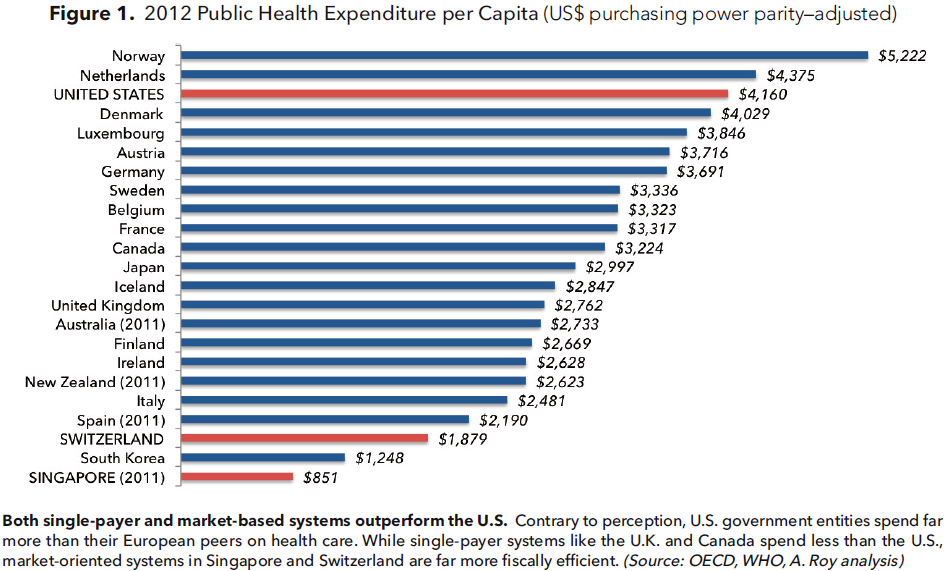
Capture  As the above chart shows, right now we have a composite system and it is just not cost-effective. There are plenty of experts who claim that a free market cannot work in healthcare.  For example, the tax lawyer, Edward Kleinbard, in a new book, “We Are Better than This: how government should spend our money” argues that what a free market gives us is:  unavoidable controversy for excluded pre-existing conditions, moral hazard for risky behavior, uncertain premiums for permanent insurance, fragmented healthcare markets, monopoly provider organizations leading to price opacity, very high administrative costs, etc.
Capture1The Manhattan Institute’s Avik Roy has a different point of view.  In his proposal, “Transforming Obamacare,” (http://www.manhattan-institute.org/pdf/mpr_17.pdf) he points out that there are two countries, Switzerland and Singapore, which operate highly regarded free-market healthcare systems at very low public cost. Stay tuned for further discussion!

Fixing Obamacare Rather Than Repealing It


The Manhattan Institute’s Avik Roy has just released a comprehensive and very impressive new study of the American healthcare system, “Transcending Obamacare: A Patient-Centered Plan for Near-Universal Coverage and Permanent Fiscal Solvency.”  By 2025 it will increase insurance coverage by 12.1 million above Affordable Care Act levels.  It will at the same time achieve a 30 year deficit reduction of $8 trillion compared to current CBO projections (see chart below).
CaptureMore specifically Mr. Roy’s new Universal Exchange Plan will

  • Expand coverage well above ACA levels without an individual mandate
  • Improve the quality of coverage and care for low-income Americans
  • Make all U.S. healthcare entitlement programs permanently solvent
  • Reduce the federal deficit without raising taxes
  • Reduce the cost of health insurance

The five core elements of Mr. Roy’s Plan are:

  • Exchange Reform. The ACA’s individual mandate is repealed. The Plan restores the primacy of state-based exchanges and insurance regulation. Insurers are encouraged to design policies of high quality tailored to individual need. By lowering the cost of insurance for younger and healthier individuals, the Plan will expand coverage without a mandate.
  • Employer-sponsored Insurance Reform. The employer mandate is repealed, thereby offering employers a wider range of options for subsidizing employees insurance.
  • Medicaid Reform. The Plan migrates the Medicaid acute-care population onto the reformed state-based exchanges with 100% federal funding. The Plan returns to the states full financial responsibility for the Medicaid long-term care population.
  • Medicare Reform. The Plan gradually raises the Medicare eligibility age by four months each year forever. The end result is to preserve Medicare for current retirees and to maintain future retirees on their exchange-based or employer sponsored health plans.
  • Other Reforms. The Plan tackles the growing problems of hospital system monopolies and malpractice litigation and also accelerates the pace of medical innovation by reforming the Food and Drug Administration.

These reform proposals are amazingly ambitious and far reaching in scope.  How can they possibly be achieved?  Stay tuned!

How to Control Federal Spending III. Reform Medicaid!


One of the many controversies involving the Affordable Care Act concerns the expansion of Medicaid to cover low income people up to 138% of the federal poverty level.  As Robert Samuelson reported in the Washington Post a few days ago, “The Real Medicaid Problem,” 24 states have refused to expand Medicaid coverage even though the federal government will pay 100% of all additional costs until 2017.
CaptureAs Mr. Samuelson points out, the underlying issue is a matter of cost:

  • The basic Medicaid program is funded with a fixed percentage of each state’s costs paid by the federal government. This means that the more a state spends, the more is contributed by the federal government. From 1989 to 2013, the share of state budgets devoted to Medicaid has risen from 9% to 19%. This upward trend is clearly unsustainable.
  • In Medicaid, children and adults up to age 65 represent three-fourths of beneficiaries, but only one-third of costs. The quarter of beneficiaries who are aged or disabled are responsible for two-thirds of costs.
  • More than 60% of nursing home residents are on Medicaid.
  • There is no assurance that the federal share of the expanded coverage will continue at the announced rate of 90% after 2017 because the federal government is in much worse financial shape than are most states.

An interesting Op Ed appeared recently in the Wall Street Journal, “The Smarter Way to Provide Health Care for the Poor,” written by Mike Pence, the Governor of Indiana.  In 2008 Indiana set up the Healthy Indiana Plan to better serve low income Indianans.  It now provides Health-Savings Accounts to 40,000 low income citizens, with very good results.  Indiana is applying for a waiver to the ACA to use Medicaid expansion funds to provide HIP to all low income families up to 138% of the poverty level ($33,000 for a family of four).
Clearly, individual states, when offered the opportunity, are quite capable of coming up with innovative solutions for difficult problems.
A good way to resolve the problem of state resistance to Medicaid expansion is to fundamentally change Medicaid into a block grant program whereby the federal government contributes a specific amount of money to each state each year.  Then the states design their own programs to meet their own needs.  Block grant funding for Medicaid is a common sense approach to address one aspect of our huge fiscal problem in an intelligent way!


Let’s Devolve Federal Programs Back to the States!


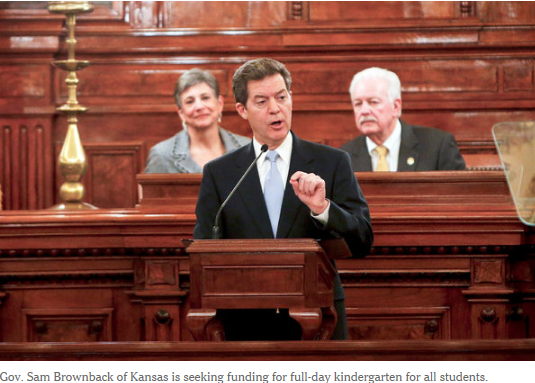
Yesterday’s New York Times has an article “Battles Looming Over Surpluses in Many States”, pointing out that “unexpectedly robust revenues from taxes and other sources are filling most state coffers, creating surpluses not seen in years and prompting statehouse battles over what to do with the money.”  For example, in Kansas, Governor Sam Brownback is calling for full day kindergarten for all students.
CaptureThis raises a larger issue.  The states are recovering from the Great Recession and have lots of money.  We know that states spend money far more efficiently than the federal government, because states have constitutional requirements to balance their budgets.  On the other hand, the federal government is hemorrhaging red ink at a frightening rate which will just keep getting worse indefinitely until strong measures are taken.  It has taken on far too many responsibilities and spends money very inefficiently.
All of this suggests an obvious course of action to turn around a very bad situation.  We should devolve as many federal programs as possible back to the states.  Here are three good ones to start with:

  • Medicaid costs the federal government about $250 billion per year with another $150 billion being paid for by the states.  The problem is that federal support is a fixed percentage of what the states spend.  This makes Medicaid a very expensive program with no limit on the cost to the federal government.  A good way to solve this problem is to “block grant” Medicaid to the states and let each state figure out the best way to spend its own federal allotment.  Annual increases in the size of federal block grants could be tied to the rate of inflation in order to limit their growth.
  • Education spending at the federal level is a $100 billion per year (not counting student loans) item.  Just at the K-12 level alone there are over 100 individual programs to which states and school districts have to apply for funds separately.  Wouldn’t it make far more sense to “block grant” education funds back to the states so that this large sum of money can be spent more effectively and efficiently by targeting it at the biggest needs in each state?
  • Job-Training costs the federal government $18 billion per year for 47 different programs.  Again it would be so much more sensible to block-grant job training funds to the states and measure effectiveness by the number of workers hired.

There really are relatively simple ways for the federal government to operate more effectively and at much lower cost.  We need national leaders who are committed to getting this done.

Controlling the Cost of Healthcare

Capture

The New York Times is running a series of articles, “Paying Till It Hurts,” giving many examples of the very high cost of healthcare in the U.S. today.  The latest article “As Hospital Prices Soar, A Single Stitch Tops $500”, focuses on the high cost of emergency room treatment around the country.
We spend 18% of GDP on healthcare, twice as much as any other country in the world.  It is specifically the cost of healthcare entitlements, Medicare and Medicaid, which is driving our huge deficits and rapidly growing national debt.  But to limit the cost of these entitlement programs, we first have to address the more fundamental problem: how to control the overall cost of healthcare in general.
Our current healthcare system, a combination of private insurance and government programs, is very inefficient. The basic problem is that the tax treatment of employer provided health insurance takes away the incentive for individuals to control the cost of their own care.   And Obamacare does not solve this problem, because it just extends the present system to more people, rather than revamping it.
There are essentially two different ways to transform our current healthcare system to make it far more efficient.  One way is to turn it into a single payer system, like what most of the rest of the world has.  This could be accomplished by simply expanding Medicare to everyone.  Costs would then be controlled by government regulation which would, of course, include rationing.  Given the unpopularity of Obamacare, with all of its mandates and uniform coverage requirements, it is unlikely that Americans would be happy with such a highly proscribed single payer system.
The alternative is to change over to a truly consumer based, market oriented system.  This could be accomplished by limiting the present tax exemption for employer provided insurance.  For example, the current system could be replaced by a (refundable) tax credit equal to the cost of catastrophic insurance (i.e. insurance with a very high deductible).  All other healthcare costs, whether paid for directly by consumers or through insurance, would be with after tax dollars.  Subsidies could be provided to lower income people through the Obamacare exchanges.  Once such a system is set up and running smoothly, it could fairly easily be extended to encompass Medicare and Medicaid.
Insurance companies selling catastrophic coverage would negotiate with hospitals and other healthcare providers to get the lowest possible prices for their customers.  In other words, both insurance companies and providers would compete in the open market to deliver healthcare products at the lowest possible cost.
Something along this line will have to be done and the sooner we get started the better!

Why Is Obamacare So Unpopular? Because It’s Too Coercive!


The individual mandate for health insurance, upheld by the Supreme Court a year and a half ago, is now leading to millions of policy cancellations in the individual insurance market.  The mandate overrides any existing policy which does not provide minimum coverage.  The employer mandate, stipulating that any business with 50 or more employees must provide health insurance for all fulltime employees, has caused many businesses to replace fulltime employees with part-timers.
But these are not the only forms of coercion under Obamacare.  As reported in yesterday’s New York Times, “Court Confronts Religious Rights of Corporations”, the Supreme Court is expected to accept a case involving the Hobby Lobby’s refusal, on religious grounds, to pay for insurance coverage for the contraceptive coverage which is required to meet minimum standards.
It would be much better to replace all of these coercive mandates with economic incentives.  This could actually be done in such a way that would also make healthcare less expensive, thereby giving a big boost to our economy.  Here is one way to do this, as I discussed in my November 14, 2013 post:

  • Provide a flat and universal tax credit for health insurance coverage which applies to everyone and not just for employer provided healthcare.  The (refundable) credit would be roughly the amount necessary for catastrophic insurance coverage.
  • Convert Medicare and Medicaid into a means-based addition to this tax credit.
  • Everyone with continuous coverage (paid for by the tax credit) would be protected from price spikes or cancellations if they get sick.  This provides a strong incentive for everyone to buy and retain coverage.

It is entitlement spending which is driving our country’s fiscal crisis.  And healthcare programs such as Medicare and Medicaid make up a big part of entitlements.  In order to get these costs under control, we need to first get the cost of private healthcare under control.  The best way to do this is with economic incentives rather than coercive mandates.
Obamacare doesn’t need to be repealed.  It could just as well be modified and improved as described above.

Beyond ObamaCare: Where Do We Go From Here?

Last Sunday’s Washington Post has an Op Ed column by Jon Kingsdale, “Beyond Healthcare.gov, Obamacare’s Other Challenges” which describes the many challenges confronting ObamaCare besides just the website problems and the millions of individual policies which will be cancelled for not meeting the minimum requirements of the Affordable Care Act.  Based on his experience setting up the Massachusetts Health Insurance Exchange from 2006-2010, there will  be huge problems in getting enrollment, billing and premium collections working smoothly for such a large government program.  For example, an estimated 27% of those who will be eligible for tax credits under the ACA do not have checking accounts.  How will their monthly premiums be paid and tracked for these people if they’re late?
Considering all of the problems involved in the implementation of ObamaCare, and the fact that it does not really reform our current very costly healthcare system but rather just extends it to cover more people, it makes much sense to move toward real healthcare reform, which will control costs.
A column in today’s Wall Street Journal by Ramesh Ponnuru and Yuval Levin, “A Conservative Alternative to ObamaCare”, lays out several basic features which should be included in a sensible, market oriented approach to healthcare reform.   The principles are:

  • A flat and universal tax credit for coverage which applies to everyone and not just for employer provided healthcare.  The (refundable) credit would be roughly the amount necessary for catastrophic coverage.
  • Medicaid could be converted into a means-based addition to this tax credit.
  • Everyone with continuous coverage (which would be provided by the tax credit) would be protected from price spikes or cancellations if they get sick.  This provides a strong incentive to buy and retain coverage without the need for a mandate.

A market oriented healthcare system like this is not only preferable to all of the mandates and restrictions of Obamacare, it also improves our current system by both expanding coverage to more people as well as controlling costs by giving health consumers (all of us) a much bigger stake in purchasing healthcare.
The United States spends 18% of GDP on healthcare, twice as much as any other country in the world.  Our fiscal stability and future prosperity depend on getting this huge and growing cost under control.  The ObamaCare fiasco provides an excellent opportunity to get started on doing this.