How to Shrink the Deficit: Control Entitlement Spending by Fixing Obamacare


Our country faces two major fiscal and economic problems:

  • How to boost the economy in order to put more people back to work.
  • How to either increase tax revenue or better control spending in order to shrink the deficit.

My last post, “The Great Wage Slowdown and How to Fix It” makes a specific tax reform proposal to cut tax rates for all by shrinking tax deductions for the wealthy.  This would put tax savings in the hands of millions of wage earners with stagnant incomes, who would likely spend it, thereby boosting the economy.
CaptureAs the above chart clearly shows, there is only one realistic way to shrink the deficit.  We have to do a better job of controlling entitlement spending (Social Security, Medicare and Medicaid.)  As a practical matter, this means we have to cut back the cost of American healthcare in general, both public and private.
The Manhattan Institute’s Avik Roy has come up with an attractive Plan for doing just this, “Transcending Obamacare.” Mr. Roy’s proposal is to:

  • Repeal the individual mandate. Insurers are encouraged to design policies of high quality tailored to individual need. By lowering the cost of insurance for younger and healthier individuals, the Plan will expand coverage without a mandate.
  • Repeal the employer mandate, thereby offering employers a wider range of options for subsidizing employees insurance.
  • Keep the exchanges to provide broad access as well as subsidies for those with low incomes.
  • Migrate the Medicaid population onto the exchanges.
  • Raise the Medicare eligibility age by 4 months per year indefinitely. Over time this will maintain future retirees on exchange-based or employer sponsored health plans.

By gradually moving the Medicaid and Medicare recipients onto the exchanges, both of these very large populations will receive equal quality coverage to everyone else, delivered in a cost effective manner.  Mr. Roy estimates that the Plan will expand coverage by 12 million above Obamacare levels by 2025 and reduce the deficit by $8 trillion over 30 years.
This is the sort of major healthcare reform which we need to get entitlement spending under control!

Is A Free Market Possible in Health Care?


With a total national debt of $17.8 trillion, of which close to $13 trillion is public debt (on which we pay interest), it is easily understood that the U.S. has a very serious fiscal problem. At the present time the public debt is 74% of GDP and this already high percentage is predicted by the Congressional Budget Office to keep growing indefinitely.
The biggest driver of spending growth going forward is the cost of healthcare.  For example just the three programs, Medicare ($492 billion), Medicaid ($280 billion) and Veterans Healthcare ($54 billion), cost a total of $826 billion per year in federal dollars.  And these costs are all increasing rapidly.  Of course, private healthcare spending, currently about $2 trillion per year, is also growing rapidly.  Overall, the U.S. spends 17.3% of GDP on healthcare spending, public and private, almost twice as much as any other developed country.
How are we going to address this enormous cost issue going forward? The Affordable Care Act (aka Obamacare) doesn’t do it.  What it does do is to provide healthcare to more people under our current model of employer provided health insurance with Medicare for the elderly and Medicaid for the poor.  It is this model which is broken and must be reformed. Basically we have two choices for how to do this.  Either we switch over to a “single payer” system like most of the other developed countries have or we establish a far more efficient free market system.
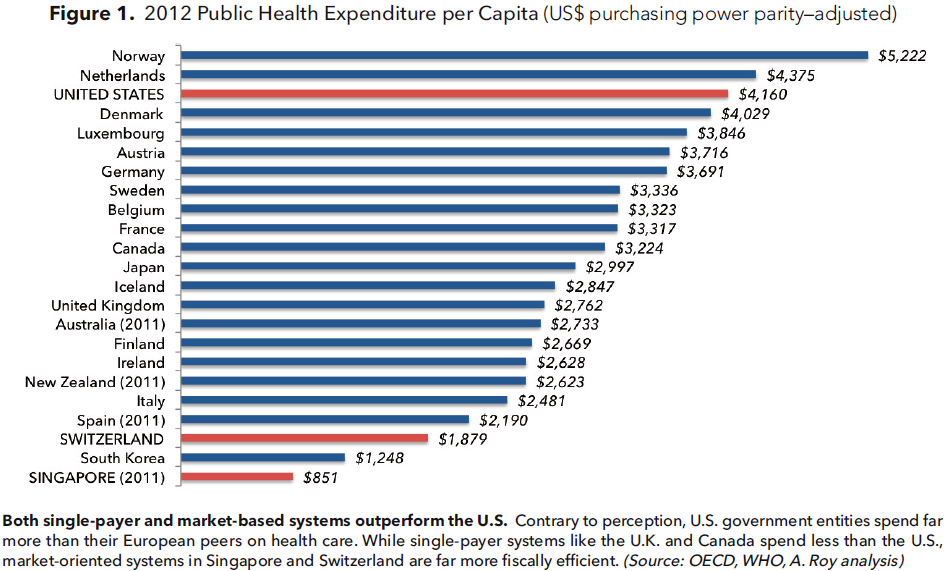
Capture  As the above chart shows, right now we have a composite system and it is just not cost-effective. There are plenty of experts who claim that a free market cannot work in healthcare.  For example, the tax lawyer, Edward Kleinbard, in a new book, “We Are Better than This: how government should spend our money” argues that what a free market gives us is:  unavoidable controversy for excluded pre-existing conditions, moral hazard for risky behavior, uncertain premiums for permanent insurance, fragmented healthcare markets, monopoly provider organizations leading to price opacity, very high administrative costs, etc.
Capture1The Manhattan Institute’s Avik Roy has a different point of view.  In his proposal, “Transforming Obamacare,” (http://www.manhattan-institute.org/pdf/mpr_17.pdf) he points out that there are two countries, Switzerland and Singapore, which operate highly regarded free-market healthcare systems at very low public cost. Stay tuned for further discussion!

Why Medicare Needs to Be Reformed and How to Do It


My last post, “Fixing Obamacare Rather Than Repealing It,”presents a comprehensive new healthcare reform proposal by Avik Roy of the Manhattan Institute.  His plan has the ambitious goal of expanding health insurance coverage beyond ACA levels and at the same time achieving a huge deficit reduction compared with current CBO projections.
Capture1Mr. Roy points out, for example, that for all of Medicare’s huge cost, $635 billion in 2014 alone, it does not provide catastrophic coverage against long-term hospitalizations.  The supplemental insurance program, “Medigap,” accelerates Medicare’s wasteful spending by wiping out cost-sharing features such as co-pays and deductibles.  Medigap has proven hard to change because it generates huge royalty fees for the AARP, $458 million in 2011, for example.  For all of these reasons and others, Medicare needs big changes.
The core Medicare reform of Mr. Roy’s Universal Exchange Plan is to increase the eligibility age by four months per year forever, beginning in 2016.  This means that current seniors can stay in the existing Medicare program but that future retirees will remain in the universal state-based exchanges for an increasing period of time.  This is estimated to save $6.5 trillion over 30 years.
Additional features of the new Medicare program are:

  • Reduce Medicare subsidies for hospital’s uncollected bills saving $4 billion per year.
  • Exempt Medicare Part C and Part D from state and local taxes.
  • Combine Part A and Part B into a single insurance product saving $30 billion per year by reforming Medigap.
  • Introduce additional means-testing into Part D premiums.
  • Reduce waste, fraud and abuse systematically, saving approximately $50 billion per year.
  • Restore the ability of seniors to opt out of Medicare.
  • Restore the pre-ACA tax subsidy for employer-sponsored retiree coverage (to encourage more employers to sponsor retiree health benefits).
  • Address the physician shortage through additional medical education funding costing $6 billion per year.

Medicare spends 30% of its overall budget on end-of-life care (for the last six months of life).  The reforms suggested by Mr. Roy will allow it to operate much more efficiently and thereby put a greater focus on the end-of-life care which is its fundamental purpose.

Fixing Obamacare Rather Than Repealing It


The Manhattan Institute’s Avik Roy has just released a comprehensive and very impressive new study of the American healthcare system, “Transcending Obamacare: A Patient-Centered Plan for Near-Universal Coverage and Permanent Fiscal Solvency.”  By 2025 it will increase insurance coverage by 12.1 million above Affordable Care Act levels.  It will at the same time achieve a 30 year deficit reduction of $8 trillion compared to current CBO projections (see chart below).
CaptureMore specifically Mr. Roy’s new Universal Exchange Plan will

  • Expand coverage well above ACA levels without an individual mandate
  • Improve the quality of coverage and care for low-income Americans
  • Make all U.S. healthcare entitlement programs permanently solvent
  • Reduce the federal deficit without raising taxes
  • Reduce the cost of health insurance

The five core elements of Mr. Roy’s Plan are:

  • Exchange Reform. The ACA’s individual mandate is repealed. The Plan restores the primacy of state-based exchanges and insurance regulation. Insurers are encouraged to design policies of high quality tailored to individual need. By lowering the cost of insurance for younger and healthier individuals, the Plan will expand coverage without a mandate.
  • Employer-sponsored Insurance Reform. The employer mandate is repealed, thereby offering employers a wider range of options for subsidizing employees insurance.
  • Medicaid Reform. The Plan migrates the Medicaid acute-care population onto the reformed state-based exchanges with 100% federal funding. The Plan returns to the states full financial responsibility for the Medicaid long-term care population.
  • Medicare Reform. The Plan gradually raises the Medicare eligibility age by four months each year forever. The end result is to preserve Medicare for current retirees and to maintain future retirees on their exchange-based or employer sponsored health plans.
  • Other Reforms. The Plan tackles the growing problems of hospital system monopolies and malpractice litigation and also accelerates the pace of medical innovation by reforming the Food and Drug Administration.

These reform proposals are amazingly ambitious and far reaching in scope.  How can they possibly be achieved?  Stay tuned!

Why Debt Matters II. “Go for the Heart”


The author and lecturer, David Horowitz, has just published a little pamphlet,”Go for The Heart: How Republicans Can Win” describing how conservatives are being outmaneuvered on the campaign trail.
Capture“Year after year the Democrats’ campaign themes are monotonously familiar. They rely on scaring the voters by accusing Republicans of the same imaginary crimes: Republicans are a party that wages war on women, minorities, and vulnerable Americans. They don’t care about the vulnerable and the poor. Their policies inflict pain on working families to benefit the wealthy few.”
“ ’Caring’ is not one among many issues in a democratic election. It is the central one. Since most issues are complex and require too much information, voters care less about policy than about the candidates themselves. Above everything else they want to know who they can trust. Far more important to voters than a particular policy, they want a candidate or party who cares about them.”
“Behind Republican campaign failures lies an attitude that reflects an administrative rather than political approach to election campaigns. Such an approach focuses on policies for running the country and fixing problems rather than the political aspect of the electoral battle.”
In other words, fiscal conservatives must make a compelling moral case why it is so important to stop spending money that we don’t have.

  • By piling up more and more debt year after year, we are creating a huge burden for future generations. Is this the legacy we want to leave for our children and grand- children?
  • If we do not control the growth of entitlement programs, we are endangering their very existence. It’s ordinary people with average incomes who will need Social Security and Medicare when they retire. It’s our moral obligation to keep these programs sound for their sake!
  • Boosting the economy with lower tax rates has nothing to do with helping the rich. In fact, it’s the rich who benefit from the tax loopholes and preferences which must be eliminated to pay for these rate cuts to benefit the people who really need them!
  • Insisting on a work requirement for welfare recipients is demonstrating the tough love that they need to gain the dignity of becoming productive citizens. We need to give them a hand as well as a handout!

These are just a few examples of ways that conservatives can address the debt and deficit issues in a positive, and non-punitive, manner. Thanks to Mr. Horowitz I will attempt to take this approach consistently from now on.

Invested in America


The Business Roundtable, an association of chief executive officers of leading U.S. companies, has just issued a new report, “Invested in America: A Growth Agenda for the U.S. Economy”, describing four actions which policymakers can take to rejuvenate the U.S. economy.
CaptureThey are:

  • Restore Fiscal Stability: constrain federal spending in a manner that reduces long-term spending growth, making both Medicare and Social Security more progressive and less expensive.
  • Enact Comprehensive Tax Reform: adopt a competitive, pro-growth tax framework that levels the playing field for U.S. companies competing in global markets.  Several studies estimate that cutting the U.S. corporate tax rate by 10 % (e.g. from 35% to 25%) would boost GDP by 1% or more.
  • Expand U.S. Trade and Investment Opportunities: pass updated Trade Promotion Authority legislation and use TPA to complete many new trade agreements which are already pending.
  • Repair America’s Broken Immigration System: increase the number of visas for higher skilled workers and provide legal status for the millions of undocumented immigrants currently living in the U.S.

These are the same “big four” policy changes which many progressive business leaders as well as evenhanded think tank experts often recommend.  They are really just common sense ideas which reasonable people should be able to come together on.
Isn’t it obvious that we’ll soon be in big trouble if we don’t get our enormous budget deficits under control?  And that controlling entitlement spending is key to getting this done?
Isn’t it just as obviously commonsensical that even U.S. based multinational corporations will try to avoid locating business operations in countries like the United States with very high corporate tax rates?
Isn’t it likewise obvious that foreign trade is just an extension of domestic trade and that the world is better off with as much trade as possible?
Finally, the secret of a vibrant, growing economy is to encourage as much initiative and innovation as possible.  Who take more initiative than the immigrants who figure out how to get here in the first place?
We don’t have to accept a sluggish economy, high unemployment and massive debt!  But we do need to take intelligent action to extricate ourselves from the predicament we are in!

Why Is It So Hard For Congress To Do Its Job?


In response to the recent budget deal which has already passed the House of Representatives, Taxpayers for Common Sense has issued a new report “Real Savings, Real Deficit Reduction: Relieving Budget Caps with Common Sense Savings in Fiscal Year 2014”, showing how $100 billion could be cut from the federal budget for fiscal 2014, completely offsetting the supposedly onerous cuts required by the sequester.  Here is a summary of what TCS has come up with:
Capture
Of course there are many ways to achieve $100 billion in savings in a single year and this is only one particular way to do it.  But it is a balanced plan making roughly comparable cuts from many different agencies and also including a significant amount of tax expenditure savings.  It would, of course, be much better to also include adjustments to entitlement spending such as Social Security and Medicare.  A big reason for keeping the sequester in place, or offsetting it with equivalent cuts, as TCS is suggesting, is to create more interest in making necessary changes in entitlement programs.
Yet another way of accomplishing the same goal would be to keep the sequester spending levels in place but to give each government agency the authority to rearrange the spending cuts within its only agency.  This is what management should be doing anyway on a routine basis.
It is very disappointing that Congress will not do the job, one way or another, that is required to operate the government on a sound financial basis.  Let’s hope that the voters make big changes in the elections coming up in 2014!

Controlling the Cost of Healthcare

Capture

The New York Times is running a series of articles, “Paying Till It Hurts,” giving many examples of the very high cost of healthcare in the U.S. today.  The latest article “As Hospital Prices Soar, A Single Stitch Tops $500”, focuses on the high cost of emergency room treatment around the country.
We spend 18% of GDP on healthcare, twice as much as any other country in the world.  It is specifically the cost of healthcare entitlements, Medicare and Medicaid, which is driving our huge deficits and rapidly growing national debt.  But to limit the cost of these entitlement programs, we first have to address the more fundamental problem: how to control the overall cost of healthcare in general.
Our current healthcare system, a combination of private insurance and government programs, is very inefficient. The basic problem is that the tax treatment of employer provided health insurance takes away the incentive for individuals to control the cost of their own care.   And Obamacare does not solve this problem, because it just extends the present system to more people, rather than revamping it.
There are essentially two different ways to transform our current healthcare system to make it far more efficient.  One way is to turn it into a single payer system, like what most of the rest of the world has.  This could be accomplished by simply expanding Medicare to everyone.  Costs would then be controlled by government regulation which would, of course, include rationing.  Given the unpopularity of Obamacare, with all of its mandates and uniform coverage requirements, it is unlikely that Americans would be happy with such a highly proscribed single payer system.
The alternative is to change over to a truly consumer based, market oriented system.  This could be accomplished by limiting the present tax exemption for employer provided insurance.  For example, the current system could be replaced by a (refundable) tax credit equal to the cost of catastrophic insurance (i.e. insurance with a very high deductible).  All other healthcare costs, whether paid for directly by consumers or through insurance, would be with after tax dollars.  Subsidies could be provided to lower income people through the Obamacare exchanges.  Once such a system is set up and running smoothly, it could fairly easily be extended to encompass Medicare and Medicaid.
Insurance companies selling catastrophic coverage would negotiate with hospitals and other healthcare providers to get the lowest possible prices for their customers.  In other words, both insurance companies and providers would compete in the open market to deliver healthcare products at the lowest possible cost.
Something along this line will have to be done and the sooner we get started the better!

The Floundering of America


In yesterday’s Wall Street Journal, columnist William Galston talks about “The Floundering of America”.  Based on recent reports from the Congressional Budget Office, Mr. Galston says that “Today we are hurtling toward a less dynamic economy, a meaner society and a riskier world.”
His argument is based on these observations:

  • For the past 40 years, 1970-2010, the labor force expanded at an average rate of 1.6% per year.  It will soon slow to only .4% annual growth, because of more retirements and a plateauing of women’s labor-force participation. This means that growth in GDP will slow down to about 2% annually from its historical average of over 3%.
  • America is aging very fast.  Today there are 57 million Social Security beneficiaries which will increase to 76 million in 2023.  Obviously this will rapidly increase entitlement spending on retirees.
  • America already spends 18% of GDP on healthcare costs and the CBO projects that this will grow to 22% by 2038.

“In sum, current trends and policies will yield lower rates of economic growth, painfully slow gains in real incomes, huge increases in outlays for expenses related to an aging population, and a health sector that devours more and more of the national product”, he says.
These trends are all contributing to an explosion of the national debt.  The only current strategy to keep this debt even roughly stable during the next decade, let alone reduce it, is to shrink discretionary spending through sequestration.  This will lead to a decline in discretionary spending to 5.3% of GDP by 2023.  This means roughly 2.6% of GDP for national defense with an equal share or all other domestic purposes.
“This is pure folly”, says Mr. Galston. “The country needs a new national strategy for a viable future.”
How do we achieve a new strategy?  Immigration reform will increase the size of the workforce.  Tax reform could boost the economy by encouraging business expansion, risk taking and entrepreneurship.  True (consumer-driven) healthcare reform could dramatically lower the cost of healthcare.  In other words there are potential policies out there that address our national floundering. We simply need leaders who are capable of going beyond partisanship in order to help create a better future!

Nowhere to Cut?

After five years of enormous deficits, our national debt now stands at over $17 trillion.  The only spending restraint that Congress has been able to achieve so far is an approximately one trillion dollar “sequester” over ten years, therefore amounting to about $100 billion per year in spending cuts.  Federal expenditures have actually dropped for two years in a row now so the sequester really does work.  Of course, almost everyone complains about cutting spending in such a “dumb” way.  Why not make intelligent budget cuts by eliminating the least effective programs instead of having to make small percentage cuts in all discretionary spending, good and bad alike?  Well, this really should not be all that difficult to do if Congress would try a little harder.
The Congressional Budget Office has just released a helpful report, “Options for Reducing the Deficit:  2014 to 2023”, which lists 103 ways for either decreasing spending or increasing revenues over the next decade.  Amazingly, enacting all of these proposals would amount to a budget savings of $13 trillion over 10 years, ten times what is required by the sequester!  Here are some examples of what could be done (along with the 10 year savings):

  • Eliminate direct payments to agricultural producers                             $25 billion
  • Increase federal insurance premiums for private pensions                    $5 billion
  • Reduce the amounts of federal pensions                                               $6 billion
  • Tighten eligibility for food stamps                                                          $50 billion
  • Use more accurate measure of inflation for all mandatory programs  $162 billion
  • Replace some military personnel with civilian employees                     $19 billion
  • Limit highway funding to expected highway revenues                           $65 billion
  • Eliminate grants to large and medium sized airports                               $8 billion
  • Eliminate subsidies for Amtrak                                                               $15 billion
  • Reduce the size of the federal workforce through attrition                     $43 billion
  • Tax carried interest as ordinary income                                                 $17 billion
  • Limit medical malpractice torts                                                               $57 billion
  • Raise the age of eligibility for Medicare to 67                                         $23 billion
  • Modify Tricare fees for working-age military retirees                              $71 billion
  • Total                                                                                                      $566 billion

Right here is more than enough to offset half of the sequester.  You don’t like these cuts?  Then replace them with others from the CBO report.  There are lots of options to choose from!