Dodd-Frank Is Hurting the Recovery!


The Federal Reserve Bank plays an important role in our economy by trying to keep inflation low and stable but also by trying to make recessions less severe by increasing the money supply when the unemployment rate is high. My last post, “What the Federal Reserve Can and Can’t Do” emphasizes that, as Ben Bernanke says, “the Fed has little or no control over long term fundamentals,” such as economic growth which depends on increases in productivity which, in turn, are heavily influenced by fiscal and regulatory policy.
Capture8The American Enterprise Institute’s Peter Wallison explains very clearly in “The slow economic recovery explained,” why, for example, the Dodd-Frank Act of 2010 is having a harmful effect on economic growth:

  • Regulatory burdens imposed by Dodd-Frank have been particularly harsh for community banks, with $10 billion or less in assets; 98.5 % of U.S. banks fall into this category. Since Dodd-Frank was enacted in 2010, community banks’ share of banking assets has shrunk by 12%.
  • According to the Small Business Administration, there were approximately 23 million small businesses (with fewer than 500 employees) in 2012, compared to 18,500 firms with more than 500 employees. Large businesses have access to capital markets whereas small businesses rely on local banks for their credit needs.
  • Regulatory costs affect small banks more than large banks because the costs are fixed, independent of size of the institution. When the Consumer Financial Protection Bureau sends out voluminous regulations on mortgage lending, for example, then extensive legal fees, compliance officers and technology retooling must be paid for up front.
    Capture
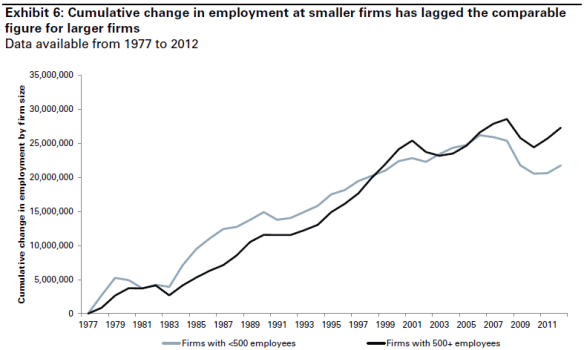
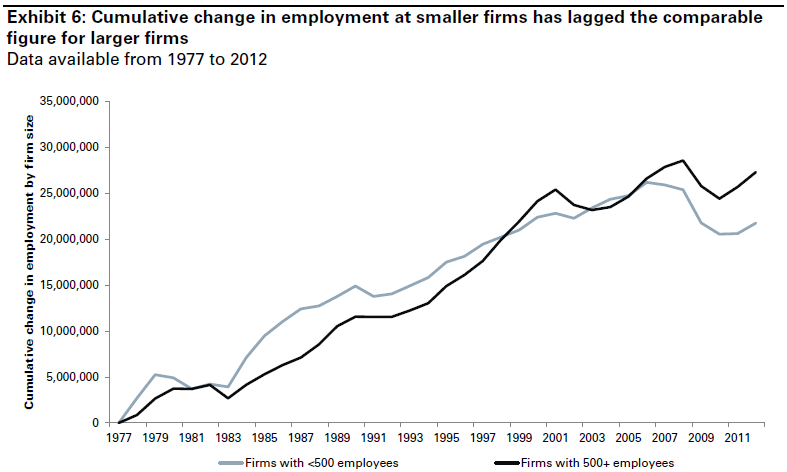
  • A recent report from Goldman Sachs, “The Two-Speed Economy,” shows that large firms have grown faster than usual after 2010 while small firms have grown much slower than usual (see chart above).
Conclusion. Monetary policy alone, as conducted by the Federal Reserve, cannot return our economy to good health. This can only be accomplished by increasing productivity which is aided by smart fiscal and regulatory policy. Dodd-Frank is an example of regulatory policy which is hurting economic growth by having a harmful effect on main street banks.                                 

Donald Trump’s Tax Plan: More Bad than Good


Republican presidential candidate Donald Trump has just released his tax plan. Some of its basic features are:

  • Lowering and consolidating seven current tax brackets into three: 10%, 20% and 25%.
  • The corporate tax rate would be cut from the current level of 35% to just 15%.
  • The income tax on all businesses would be cut to 15% as well.
  • Taxing carried interest at ordinary income tax rates instead of at the lower capital gains rate.
  • Eliminating the Alternative Minimum Tax as well as the Estate Tax.
    Capture8

The nonpartisan Tax Foundation has analyzed the Trump plan and predicts the following positive long term effects:

  • 11.5% higher GDP,
  • 29% increase in capital investment,
  • 6.5% higher wages and
  • 5.3 million more full-time equivalent jobs.

The tax Foundation also performed an analysis of Jeb Bush’s tax plan and found roughly similar economic benefits except for a lesser number, 2.7 million, of new jobs created. But the Tax Foundation also predicts that the Trump plan would cut tax revenue by $11.98 trillion over ten years on a static basis or $10.14 trillion on a dynamic basis (accounting for economic growth effects of the plan). This compares with a loss of revenue of $3.6 trillion over ten years (static) or $1.6 trillion over ten years (dynamic) for the Bush plan.
In other words, for a substantially larger growth in new jobs under the Trump plan, there is an enormous cost in additional deficit spending.
Conclusion: I have previously criticized the Bush plan for increasing deficit spending and therefore adding to the debt when we should be shrinking it. The Trump plan is much, much worse in this respect, running annual deficits of over $1 trillion per year, moving in exactly the wrong direction.
The Bush tax plan, while needing changes to make it revenue neutral, is far superior to the Trump plan, which simply blows off any concern for deficits and debt.

The President’s Budget: Stabilization of the Debt Is Not Enough!


President Obama has proposed a $3.99 trillion budget for next year, a $340 billion increase from the current 2015 budget year.  As shown in the charts below, it projects deficits of about 2.6% over the next ten years equal to its (optimistic in comparison to the CBO) growth projections for GDP.  This means that the debt would stabilize at about 73% of GDP.  And, of course, achieving his predicted stabilization of debt will require big tax increases over this ten year period.
CaptureHere are the major weaknesses in the budget:

  • Sequestration. The President declares that “I’m not going to accept a budget that locks in sequestration going forward.” Everyone deplores the mindlessness of sequestration but the only responsible alternative is to make targeted cuts throughout the budget. The President makes no attempt to do this. And he wants to add spending for various new education and research initiatives, as well as an expanded Earned Income Tax Credit for low-income workers.
  • Infrastructure. Spending over the next six years would increase by $238 billion to be raised from a 14% repatriation tax on the $2 trillion in foreign earnings held overseas by American multinational corporations. The problem is that any repatriation tax should be tied in with overall corporate and business tax reform, exchanging lower tax rates in return for closing loopholes and deductions, in order to make U.S. business taxes competitive with those of other countries. Fundamental tax reform is the key to getting our economy growing faster.
  • Entitlements. The President’s budget does not even mention the biggest threat to long-term fiscal sustainability, namely the rapidly increasing spending for Social Security, Medicare and Medicaid. It will be very difficult to make progress on this critical issue without presidential leadership.
  • Stabilization of the Debt. The President’s budget, with quite optimistic revenue and growth projections, stabilizes the debt over ten years. But this is not nearly good enough. To be satisfied with a public debt of 73% of GDP indefinitely into the future is simply too risky. What’s going to happen when we have another financial crisis, as we surely will? How are we going to cope with our growing rivalry with China with very little budget flexibility? And one can imagine any number of other possible emergencies which might occur. Putting the debt on a clear downward trajectory is the only prudent thing to do!

It’s Paul Krugman Who Is Being Irresponsible!


The New York Times columnist, Paul Krugman, writes provocatively on fiscal and economic issues and is well-known as a liberal icon.  Usually I ignore his diatribes.  But his column yesterday, “The Long-Run Cop-Out” goes way overboard.
CaptureI will refute several of the statements from this column.

  • “Think about it: Faced with mass unemployment and the enormous waste it entails, for years the beltway elite devoted all most all its energy not to promoting recovery, but to Bowles-Simpsonism – to devising “grand bargains” that would address the supposedly urgent problem of how we’ll pay for Social Security and Medicare a couple of decades from now.” Worrying about our enormous and rapidly increasing national debt, does not mean ignoring our sluggish economy and the high unemployment it causes. The way to increase economic growth is to enact broad based tax reform by lowering tax rates, offset by closing loopholes and limiting deductions. This will further boost the economy in the same way that lower gasoline prices is already doing.
  • “Many projections suggest that our major social insurance programs will face financial difficulties in the future (although the dramatic slowing of increases in health costs makes even that proposition uncertain).” Healthcare costs dropped to 4.1% in 2014 but this is still more than double the inflation rate of 1.7%. This isn’t nearly good enough.
  • “Why, exactly, is it crucial that we deal with the threat of future benefit cuts by locking in plans to cut future benefits?” The point is to protect benefits, not curtail them. If we act now, to increase revenue and/or slow down the growth of entitlement spending, then we won’t have to cut future benefits.
  • “So why the urge to change the subject (from austerity) to structural reform? The answer, I’d suggest, is intellectual laziness and lack of moral courage.” $6 trillion added to our debt in the last six years is profligacy, not austerity. It is immoral to burden future generations with such massive new debt.
  • “In today’s economic and political environment, long-termism is a cop-out.” Preparing for the future is just plain common sense. Should we ignore festering problems like global warming, illegal immigration and increasing poverty until they get much worse? Of course not. We should address these problems now and get our debt under control at the same time.  

What Will It Take to ‘Fix the Debt’?


I have recently become a volunteer for the national bipartisan organization, Fix the Debt. It is the outreach arm for the Washington think tank, Committee for a Responsible Federal Budget, which is an offshoot of the Simpson-Bowles Commission from several years ago.
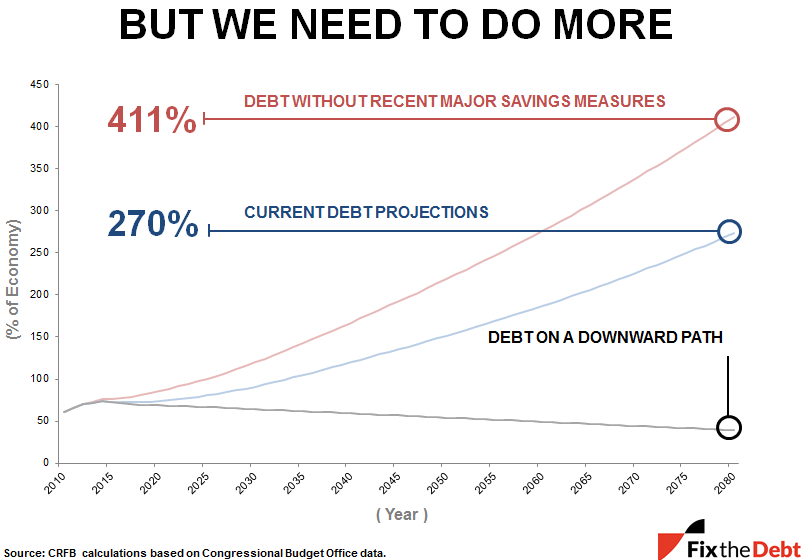
As such, I give presentations to local civic organizations about our national debt and what needs to be done to get it under control. Typically the audience will readily appreciate the seriousness of our debt problem.  What they want to talk about are practical ways to address it.  They have their own ideas and want to know what I think as well.  My first message is that we don’t have to pay off the debt or even balance the budget going forward.  Realistically we need to shrink our annual deficits in order to put the debt on a downward course as a percent of our growing economy,  as shown in the chart just below.

Capture It will be a huge challenge to accomplish even this!  Here are my ideas, in very general outline, on how to get this done:

  • Entitlements (Social Security, Medicare and Medicaid) are the biggest single problem because our population is aging so fast. Furthermore, in order to control the growth of Medicare and Medicaid, we have to do a much better job of controlling the overall cost of healthcare in the U.S. For example, even though healthcare costs slowed down to an increase of only 4.1% in 2014, this is still more than twice the rate of inflation!
  • The second thing we need to do is to make our economy grow faster than the roughly 2.3% growth we have achieved since the end of the Great Recession. The main way to get this done is through broad-based (and revenue neutral) tax reform at both the individual and corporate levels, by reducing tax rates, paid for by closing loopholes and limiting deductions.
  • Finally, there is enormous waste and inefficiency in the federal budget, with huge redundancy and overlap of programs between different federal departments. Responsibility for such programs as education, community development, transportation and social welfare, for example, should be returned to the states with block-grant funding to replace rigid federal control.

I have discussed each of these major reform ideas in much detail in previous blog posts and will continue to do so.  As large as our fiscal problems are, I remain optimistic that they can and will be successfully addressed.

Status Quo on the Budget Is Not Good Enough II. Look at the Big Picture!


In my last post, “Status Quo on the Budget Is Not Good Enough,” I discussed a report from the outgoing chair of the Senate Budget Committee, Patty Murray (D-WA), and explained how it epitomizes the lack of progress made on the massive debt problem which has developed since the Great Recession of 2008 -2009.
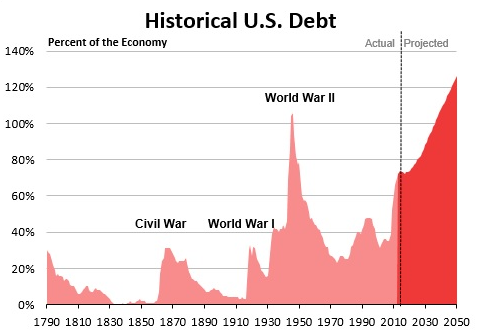
CaptureThe basic problem is that Senator Murray’s analysis simply does not recognize the seriousness of our debt problem as shown in the above chart.  Right now our public debt (on which we pay interest) is “sitting” at 74% of GDP for a year or two, before it continues its rapid increase.  This projection assumes an historically “normal” growth rate of 3% and no new recessions, neither of which assumption is assured.  It also assumes that the sequester budget cuts and new top tax rate of 39.6% stay in effect.  In other words it is a best case scenario based on current policy.
Breaking it down, the debt will continue to increase because annual deficits will continue to exceed the rate of growth of the economy.  The main driver of these increasing deficits is the cost of the health care entitlements of Medicare and Medicaid.  Medicare costs will increase rapidly because of the aging of the American people.  Medicaid costs will increase rapidly because: 1) more low-income people are being covered by the ACA and 2) since the recession there are more low-income people to be covered.  I certainly support expanded healthcare coverage but we have to figure out how to pay for it!
How do we contain the increasing costs of Medicare and Medicaid?  We do it by controlling the overall rapid growth (at twice the rate of inflation) of healthcare costs in general, i.e. for private healthcare. How do we do this?  See a couple of my recent posts either here or here.
Senator Murray, along with many other progressives, argues that we need more deficit spending in order to stimulate the economy and create new jobs.  More jobs are badly needed but more deficit spending is the wrong way to get them.  Then how?  With tax reform among other things.
Based on the outcome of the 2014 elections, I am optimistic that something along the lines of what I have just described will be tried by the next Congress.  We’ll soon find out!

“Manana Is Not a Credible Fiscal Plan”


Thus spoke George Osborne, Great Britain’s Chancellor of the Exchequer, in a recent speech to the Economic Club of New York.  “By applying a consistent and long-term economic plan, we can ensure that our best days lie ahead.  If we reduce our high debt so we can weather new shocks, and take the difficult decisions to make our economies more productive, we can provide rising living standards for our citizens.”
CaptureAccording to Mr. Osborne, any long term economic plan needs to include three elements:

  • An activist monetary policy to do whatever it takes to sustain sufficient demand in the economy.
  • A credible commitment to sustainable fiscal policy. Some have argued that fiscal consolidation is incompatible with economic recovery. But recent experience, e.g. sequestration in the U.S. and a balanced budget in the U.K., has shown the reverse.
  • An ambitious program of supply-side reform. The U.S. has a booming technology sector and the fracking revolution. The U.K. has cut its corporate tax rate to 20%, welcomes disruptive innovation and is pushing ahead on shale gas.

In the U.S. things are moving in the right direction and so the focus needs to be on keeping the momentum going.  Monetary stimulus has accomplished much but now a sound exit policy is needed.  Sequestration has slowed down the growth of government debt but has not ended it.  Further progress will require entitlement reform, especially for Medicare and Medicaid.  But first, the Affordable Care Act needs to be improved to do a better job of controlling the overall cost of healthcare.  Infrastructure improvement, tax reform and expanding trade are the supply side keys to increasing productivity and shared prosperity.
Activist monetary policy, credible fiscal policy, and ambitious supply side reform: these are the policies which will lead to future progress!

Fix the Debt


Recently I have had several posts about our national debt, for example, “Why the National Debt Is Such a Threat to the U.S.,” showing graphically that our current public debt at 74% of GDP is very high by historical standards and rising rapidly under current fiscal policies.
CaptureYesterday I attended a workshop in Washington D.C. put on by Fix the Debt.  All expenses were paid and, in return, the attendees agree to make at least three presentations to local community groups during the following year.  This means that I will soon be sending out a letter to such groups as Kiwanis and Rotary Clubs around the Omaha area where I live, offering my services as a speaker at one of their meetings.  The purpose is to build more public awareness of the threat of a huge and growing national debt to the long-term welfare of our country. Here is a summary of talking points from the workshop:

  • The deficit for the 2013-2014 fiscal year is almost $500 billion.
  • Under current fiscal policies the debt will increase to 270% of GDP by 2080.
  • Reasons for our debt problem:
  1. An aging population which means expanded Social Security spending
  2. Healthcare costs are growing for both Medicare and Medicaid
  3. Interest costs will grow rapidly as the economy recovers and interest rates rise
  • All bipartisan reform plans call for both spending cuts and revenue increases.
  • The benefits of taking action are:
  1. Increased budget flexibility
  2. Lower exposure to changes in interest rates
  3. Reduced risk of another financial crisis
  • The longer we wait:
  1. The older our population gets
  2. The higher the debt will rise
  3. The less time we have to phase in changes
  4. The slower our economy will grow
  5. The fewer tools we will have to fix it
  • How do we bring debt under control?
  1. Enact policies that grow the economy
  2. Health care cost containment
  3. Spending cuts
  4. Tax reform and tax expenditure cuts

Let me know if you’d like a speaker on this topic at your club!

Is It Feasible to Cut Tax Preferences to Pay for Lower Tax Rates?


I have been focusing lately on America’s two biggest fiscal and economic problems:

  • How to boost the economy in order to put more people back to work
  • How to either cut spending or raise revenue in order to shrink the deficit.

A few days ago in “The Great Wage Slowdown and How to Fix It,” I laid out a fairly specific proposal to make a substantial reduction in tax preferences in order to cut tax rates across the board and especially for the 64% of taxpayers who do not itemize deductions.  These are the middle- and lower-income workers with stagnant incomes who would likely spend any tax savings they received thereby giving the economy a big boost. Let’s examine whether or not this is a realistic course of action.
CaptureThe above chart from the Congressional Budget Office document, “The Distribution of Major Tax Expenditures in the Individual Income Tax System,” shows that, for example, the upper 10% of households by income receive about 40% of the total $1 trillion in individual tax expenditures per year.  Furthermore, this same top 10% of tax payers have an income of about $140,000 or more (Congressional Research Service). My basic idea is to shrink tax preferences by $250 billion per year and to lower tax rates for middle- and lower-income non-itemizers by this same amount.  If we assume that they would spend 2/3 of this new income, it would boost the economy by $170 billion per year which is 1% of GDP.
A reasonable way to achieve this savings is to expect higher income earners to contribute a greater percentage of their tax preference savings.  For example:

  • top 1% contribute $110 billion (2/3 of their total deductions).
  • top 96th % to 99th % contribute $50 billion (1/2 of their total deductions).
  • top 91st % to 95th % contribute $30 billion (1/3 of their total deductions).
  • top 81st % to 90th % contribute $30 billion (1/4 of their total deductions).
  • top 61st % to 80th % contribute $30 billion (1/5 of their total deductions).
  • this gives a total of $250 billion in tax preference savings.

This back-of-the-envelope calculation is not intended to be definitive but rather to suggest what can be done along these lines.  Those who are more well-off need to make bigger sacrifices in getting our economy back on track.

The Great Wage Slowdown and How to Fix It

With a new Congress just elected, this is a good time to reflect about what changes should be made in public policy. Our biggest economic problem is to speed up growth in order to provide more and better paying jobs.  In addition, a faster growing economy would bring in more tax revenue which would help pay our bills and reduce the deficit.
CaptureA column in today’s New York Times, “The Great Wage Slowdown, Looming over Politics,” by David Leonhardt, proposes a cut in the marginal tax rate for the middle class as a way of boosting their incomes.  As can be seen in the above chart, median household income has been flat since the year 2000, and even lower since the 2008 recession.  Mr. Leonhardt goes on to say that any tax cut for the middle class should be balanced by a tax increase for the wealthy.
It so happens that I proposed such a plan several months ago as a way of boosting the economy and reducing inequality at the same time. The idea is to enact broad-based tax reform whereby tax rates are lowered for all, offset by shrinking tax deductions.  The 64% of taxpayers who do not itemize deductions will receive a big tax cut.  But these are the very middle-class wage earners with stagnant incomes.  So they will likely spend their tax savings, thereby giving the economy a big boost.
More specifically:

  • Individual tax deductions total about $1 trillion per year.
  • Let’s suppose that these deductions are cut in half to $500 billion per year.
  • Let’s further suppose that half of this amount, or $250 billion per year, is cut from the taxes of the 64% who do not itemize deductions.
  • If these 64% spend just 2/3 of their new income (instead of saving it or paying off debt), this will total $170 billion which is 1% of GDP.
  • This would increase the rate of growth of GDP from the 2.2% average, since the end of the Great Recession, to 3.2%. This represents an enormous boost to the economy and would return average GDP growth to about its 3.3% average since 1947.

    Mr. Leonhardt suggests that presidential contenders in 2016 would greatly benefit from proposing a tax rate cut for the middle class. Here’s a specific plan they can use!