Economic Expansion Is Not Enough


The Washington Post reporter Robert Samuelson gives our economy today a B-, because the unemployment rate has inched down to 6.1%, fulltime employment is up to 105.8 million in 2013 from 99.5 million in 2010, and full-time women’s pay reached a high of 78% of men’s pay in 2013.  The big negative, of course, is that median household income was $51,939 in 2013, down from $56,436 in 2007, just before the financial crisis.
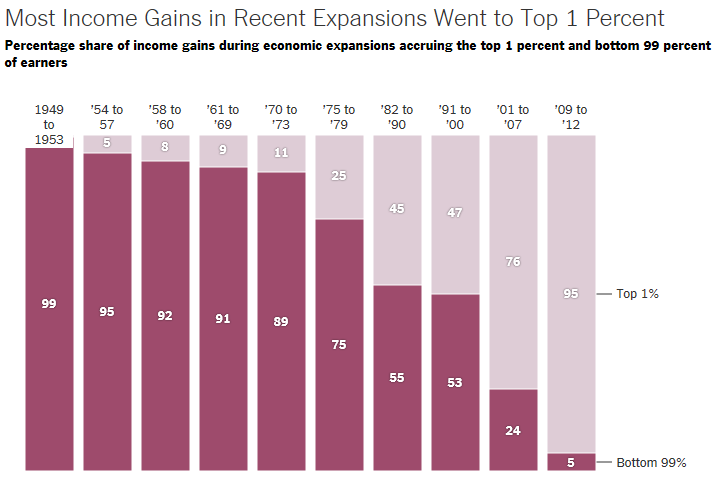
The Bard College economist Pavlina Tcherneva, as summarized by the reporter Neil Irwin in yesterday’s New York Times, shows what has gone wrong with economic and monetary policy since the end of the Great Recession in June 2009. The American Recovery and Reinvestment Act of 2009 (an $850 billion stimulus package) did boost the economy but it primarily aided “the skilled, employable, highly educated, and relatively highly-paid wage and salary workers.”
Capture2On the other hand the Federal Reserve’s quantitative easing policies have kept interest rates remarkably low and have thereby caused investors to buy stocks rather than bonds in order to get higher returns.  This has artificially boosted stock prices and has been especially advantageous to the top 10% and, even more so, the top 1%.
CaptureWhat is needed, according to Ms. Tcherneva, is a targeted, bottom-up approach to fiscal policy, which provides more and better paying jobs directly to middle- and lower-income wage earners.  Her suggestion is for public works jobs, public service employment, green jobs, etc., all of which would require large infusions of federal money thereby worsening the federal deficit.
A much better approach would be broad based tax reform, lowering tax rates across the board, paid for by closing the loopholes and deductions which primarily benefit the rich.  Since the 64% of taxpayers who do not itemize deductions would receive an effective pay boost, this would amount to a tax reform program targeted to exactly the middle- and low-income wage earners who have not yet recovered from the recession.  These folks would most likely spend their extra income, thus further boosting the economy (see my previous post).

What Happens When We All Live to 100?


This is the title of an article in the current issue of Atlantic. Of course, it is a rhetorical question, but it raises a very serious issue.  There are 43 million Americans age 65 or older today and this number is expected to reach 108 million by 2050.  How will society cope with so many more senior citizens?
CaptureThis blog is concerned with the most critical fiscal and economic problems facing our country.  The biggest fiscal problem we have is how to pay for the three major entitlement programs: Social Security, Medicare and Medicaid.  Social Security can be shored up with small adjustments to either the benefits formula or by raising taxes a little bit.  Medicaid can be kept under control by block-granting the program to the states.  But Medicare is a much bigger problem.
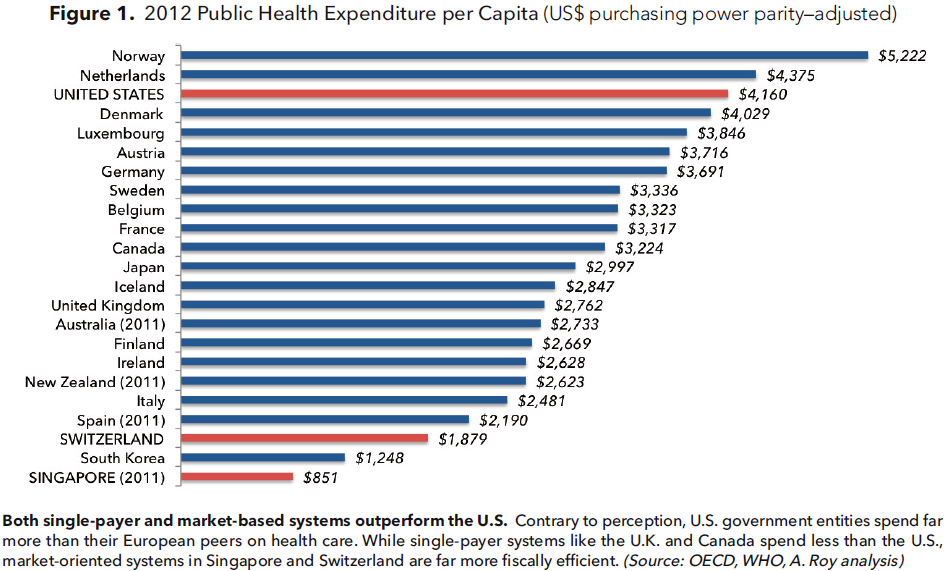
Capture1The cost of healthcare, both public and private, is rising rapidly as shown in the above chart from the New York Times.  We badly need a new approach to control costs and Avik Roy from the Manhattan Institute has given us such a plan “Transcending Obamacare: A Patient-Centered Plan for Near-Universal Coverage and Permanent Fiscal Solvency.”
The problem is that, as Mr. Roy explains, “by creating a universal, single-payer health care program for every American over 65, regardless of financial or medical need, the drafters of Medicare made the program extremely difficult to reform.”  But now we have to reform it because the costs are becoming so huge.  How do we do it?
First of all, Mr. Roy’s plan keeps the exchanges created by the Affordable Care Act and turns them all into state-based exchanges.  It also eliminates both the individual and employer mandates, replacing these mandates with financial incentives.
Mr. Roy’s core Medicare reform is very simple.  The plan increases the Medicare eligibility age by four months each year.  The result is to preserve Medicare for current retirees, and to maintain future retirees – in the early years of their retirement – on their exchange-based or employer-sponsored health plans.  In other words, retirees will gradually be migrated to the same system, with the same level of subsidy, as for working people.
Everyone, workers and retirees alike, will be treated the same. Not only is this an eminently fair system, it insures that Medicare remains affordable, for both retirees and the whole country.

Poverty and the Minimum Wage


Americans are a generous and kind-hearted people. We are more than willing to go to bat for the less fortunate among us.  The question is how to do it effectively.  A post six months ago, “A balanced and Sensible Anti-Poverty Program,” laid out four principles for an effective anti-poverty program from Robert Doar of the American Enterprise Institute.  They are:

  • work requirements for welfare recipients
  • work incentives such as the Earned Income Tax Credit
  • fostering married, two-parent families
  • business growth and investment to create more jobs

There is currently much interest in , and public support for, raising the minimum wage at both the state and national levels.  This is viewed by the general public as an effective way of addressing poverty.
CaptureHowever a new report from Mr. Doar makes clear that simply holding a real job, even with low pay, is what makes the biggest difference as to whether or not someone is able to rise above poverty.  Even though the overall poverty rate in the U.S. is about 14%, the poverty rate for fulltime workers is only 3% and even for part-time workers it is just 7% (see the above chart).
Capture1Furthermore, as detailed in the second above chart, the total income (including selected benefits) of a low-income earner, at $8/hour, with two dependent children, and working fulltime, is $30,204, well above the poverty line.
Conclusion: yes, poor people need public assistance but it is equally important to work with them to find and hold a job, regardless of hourly wage.  Not only will this meet their basic material needs, it will also put them on track to become self-supporting, productive citizens.

A Rational Approach to a National Minimum Wage


In my last post I endorsed raising Nebraska’s minimum wage from $7.25/hour to $9.00/hour because Nebraska’s unemployment rate is only 3.6% and so a minimum wage boost is unlikely to put very many people out of work.  I also stated opposition to President Obama’s proposal for a raise in the national minimum wage to $10.10/hour because it would likely put at least 500,000 people out of work.
CaptureA recent article in National Affairs by Charles Lane, “A Grand Bargain on the Minimum Wage,”suggests an approach to end a perennial controversy over how to set a minimum wage at the national level.  It is based on the following observations:

  • Increasing the minimum wage has broad public support. A recent Gallop poll found that 76% of Americans support an increase to $9.00/hour.
  • However, just 4% of minimum-wage workers are single parents. Only 11.3% of workers who would benefit from an increase in the minimum wage come from poor households. The majority of minimum-wage workers do not live in poverty.
  • A more efficient, better targeted support program for the working poor is the Earned Income Tax Credit which provides a refundable tax credit as high as $6,143 for an adult worker with three children.
  • Since 1959 the average income for a full time worker earning the minimum wage has equaled two-thirds of the poverty line for a family of four. The current poverty line for such a family is $23,850. This equates to a minimum wage set at $8.00/hour.
  • Another option would be to set the minimum wage at 45% of today’s average private sector wage of $20/hour. This would make it $9.00/hour. The CBO has estimated that a $9.00/hour minimum wage would put “only” 100,000 people out of work.
  • Once a new minimum wage level is determined, it should be automatically adjusted for inflation using the Consumer Price Index.
  • The EITC is not cheap; it currently gives $63 billion in benefits to 27 million workers. However the EITC’s improper-payments rate regularly exceeds 20% per year.
  • An expansion of the EITC to single, childless workers could be paid for by tightening up EITC’s payment methods.

All of these considerations suggest a way forward to end a long-standing political controversy in a productive manner. The national minimum wage should be raised to somewhere between $8.00 and $9.00/hour and then indexed to the CPI.  At the same time the EITC should be tightened up and expanded to single, childless adults.  Such a program combines fairness with a strong work incentive and should have broad appeal.

Let’s Raise Nebraska’s Minimum-Wage but Not the Whole Country’s


In his State of the Union address last January, President Obama proposed raising the national minimum wage to $10.10 per hour from its current level of $7.25 per hour. The Congressional Budget Office has estimated that this would raise the wages of 16.5 million workers but also put at least 500,000 out of work. At a time of high unemployment, with an estimated 24 million people either unemployed or underemployed, this would be a bad tradeoff.
CaptureThe Wall Street Journal reports, “Some Republicans Back State Minimum-Wage Increases,” that five states, including Nebraska where I live, have minimum-wage proposals on the ballot this year. In Nebraska the minimum-wage would increase in two steps to $9.00/hour from $7.25.  Nebraska’s unemployment rate is currently 3.6%, and it is estimated that there are only 27,000 people in the state being paid the minimum wage.  In other words, Nebraska actually has a labor shortage and it is unlikely that a mild increase in the minimum wage will put very many people out of work.
Capture2A minimum wage contributes to fairness but not to growth.  Both are important but growth is the more important of the two.  A minimum-wage increase in Nebraska will increase fairness without hurting economic growth and so I support this.
At the national level, an increase in the minimum wage would increase fairness but also hurt economic growth (by causing substantial unemployment) and so I oppose it.

A Glaring Example of the Need for Tax Reform


Nowadays there are many advocates for both individual and corporate tax reform. I have had several posts recently on this issue. A new report from the Tax Foundation “Is the Tax Code the Proper Tool for Making Higher Education More Affordable?” make a compelling argument that it is futile to try to do this.
CaptureFor example:

  • Education tax credits have grown from a $4.5 billion program for 4.7 million taxpayers in 1998 to a $17.4 billion program claimed by over 7 million taxpayers in 2011.
  • Education tax credits are not well targeted toward low- and middle-income families; almost 50% of the benefits accrue to taxpayers earning more than $75,000, often much more. A much more sensible way to target low income students would be to increase Pell grants.
  • The overuse of tax credits by the federal government has turned the IRS into a spending agency, with refundable tax credits projected to double to nearly $200 billion in the next five years.
  • Trading the elimination of education tax credits for lower marginal tax rates would grow the economy by $19 billion per year and create 121,000 new jobs.

Capture2

The authors go on to say: “It is likely that instead of helping, tax credits may be contributing to the rising cost of college education. Colleges are what economists call price discriminators because they can maximize the price that each student can pay.  Because of the Free Application for Federal Student Aid (FAFSA), the college has intimate knowledge of each student’s (or family’s) income and if they are eligible for tax credits, loans, or other financial aid.  This information allows the college to simply adjust its financial aid package in order to capture the maximum value of the tax credit.  Instead of being a helping hand for students, tax credits have turned into a windfall for universities.”
There are many, many reasons to reform the tax code.  The education tax credit is just one very good example!

Why I Support Jim Jenkins for the U.S. Senate from Nebraska


I have been writing this blog for almost two years because of my great concern about the direction our country is headed on fundamental fiscal and economic issues. Federal spending has been out of control for over thirty years and the situation is getting progressively worse.  Our national debt is over $17 trillion and growing at a rate of $500 billion per year.  And it will soon be growing much faster than this if we don’t make big changes.  Economic growth has been stuck at the anemic rate of 2.2% of GDP ever since the end of the Great Recession over five years ago.
Our national leaders are simply not doing the job they were elected for.  Democrats blame the Republicans and Republicans blame the Democrats but excuses are not good enough.  We need people in Washington who can figure out how to navigate within the system and actually find solutions to our very serious problems.
CaptureI believe that Jim Jenkins, a registered independent from Callaway, is the best qualified candidate to do what needs to be done.  Check out his website, Jenkins for Senate, and decide for yourself.  Here are a few of his views on important issues:

  • Fixing the Debt. Jim supports the recommendations of the Simpson-Bowles Commission which calls for dramatically cutting federal spending especially for entitlements and also raising taxes if necessary in order to drastically shrink our annual deficits.
  • Tax Reform. Jim supports lower tax rates achieved by eliminating many of the tax expenditures (credits, deductions and exclusions) embedded in the code. This is what is needed to boost economic growth.
  • Affordable Care Act. Jim believes that the ACA has many rough edges but that it is possible to fix them rather than repealing it and starting over.
  • Immigration Reform. Jim supports comprehensive immigration reform which includes securing our borders but at the same time expanding the number of guest worker visas to meet the needs of business and agriculture.
  • Veterans Administration. Jim supports setting up a plan to enable veterans to obtain medical care from health professionals within their own communities.

Compare these common sense views with the far more ideological positions of the other candidates in this race. I think that you will agree with me that Jim Jenkins is the person we want representing us in Washington!

Which Is More Important: Increasing Growth or Decreasing Inequality?


The progressive Global Strategy Group has recently released a new survey report “Focus on Growth to Frame Priorities” with a valuable message for all political candidates, left, right and center.
CaptureGSG surveyed 3000 registered voters earlier this year and discovered that they overwhelmingly rate economic growth as a higher priority than economic fairness, economic justice, expanding the middle class, increasing wages or decreasing income inequality.  In fact, economic growth trumped all of these alternative policy strategies by wide margins as shown below.
Capture1GSG then goes on to list various possible growth strategies in order of voter popularity such as making college more affordable, modernizing infrastructure, improving K-12 education and others (see below). This list of possible growth strategies is made up mostly of new spending programs.  The less costly might be doable by reforming existing spending programs.  But expensive new programs simply will not fly in today’s high deficit environment.
Capture2What is needed is a growth strategy which does not require new spending.  The obvious choice is tax reform.  For example, the fourth item in the above chart, reduce outsourcing by American companies, could be addressed by reforming corporate taxes.
But an even better growth strategy is individual tax reform whereby tax rates are lowered across the board, paid for by shrinking the many loopholes and deductions which primarily benefit the wealthy.
I described such a plan in detail in a previous post, but here is a brief summary: 64% of taxpayers do not itemize their deductions.  This means that any reduction in tax rates will put money in their pockets.  Since these are primarily the same middle- and lower-income workers with stagnant incomes, they will likely spend most of their increased pay, thus giving the economy a big boost.
In summary, the GSG report provides ammunition for political candidates of all ideological stripes.  Let’s have a contest to see which party can be the most pro-growth.  The winner will be the American people!

An Economy Doing Half Its Job


The Harvard Business School has just conducted its third alumni survey on U.S. competitiveness and finds “An Economy Doing Half Its Job.”  “Our report on the findings focuses on a troubling divergence in the American economy: large and midsize firms have rallied strongly from the Great Recession, and highly skilled individuals are prospering.  But middle- and working-class citizens are struggling, as are small businesses.  We argue that such a divergence is unsustainable.”
CaptureHighlights of the survey are:

  • Survey respondents were pessimistic on balance, although less so than in previous surveys. By a ratio of three to two, those who foresaw a decline in U.S. competitiveness in the next three years outnumbered those who predicted an improvement. Respondents were much more hopeful about the future competitive success of America’s firms than they were about the future pay of America’s workers.
  • Respondents saw weaknesses in those aspects of the U.S. business environment that drive the prospects of middle- and working-class citizens, for instance, the education system, the quality of workplace skills, and the effectiveness of the political system.
  • Alumni working in small businesses had more negative views of virtually every aspect of the U.S. business environment. This finding echoes growing evidence from other sources that small businesses are disadvantaged in America.

Capture1The authors of the report “see a need for business leaders to move toward strategic, collaborative efforts that make the average American productive enough to command higher wages even in competitive global labor markets.  Without such actions, the U.S. economy will continue to do only half its job, with many citizens struggling.” What’s interesting about this report is that it describes the problems of the American economy in a straightforward and practical way with no apparent ideological slant.  Of course, addressing these issues requires political action with all of its messy, partisan overtones. Nevertheless perhaps all parties can at least agree on what the basic problem is.

Three Cheers for Blue Cross Blue Shield Nebraska!


As I reported in my last post healthcare costs in the U.S. are expected to start climbing rapidly in next few years as the economy continues to recover and insurance coverage expands.
The Manhattan Institute’s Avik Roy has proposed a comprehensive new plan, ”Transforming Obamacare” to achieve, at the same time, both near-universal coverage and stringent cost control for healthcare.  Mr. Roy emphasizes the need to regulate hospital system consolidation which is especially responsible for driving up the cost of healthcare.
CaptureIn Omaha NE, where I live, there are three hospital systems: Catholic Health Initiatives, the Nebraska Medical Center and the Methodist Hospital System.  According to the insurance company, Blue Cross Blue Shield Nebraska (OWH 9/6/14), “CHI prices are 10 to 30 percent higher than for the Nebraska Medical Center and Methodist Hospital System.”  BCBS insists that CHI cut its prices.  As of September 1, CHI hospitals are out of network for BCBS and so patients who are insured by BCBS have to pay higher hospital rates.
“We are ready and willing to meet with them when they propose an agreement that gets serious about the cost issue,” said Lee Handke, a senior vice-president for Blue Cross Blue Shield.
Reports the OWH  “Blue Cross’ biggest customers are the region’s employers, whose 560,000 workers and family members supply 80% of Blue Cross’ revenue each year.  A big share of these people are CHI customers, too. … Blue Cross has told us (an insurance benefits broker) they understand that they might lose some business over this deal, but they feel that the point they have to make on the cost disparity is more important.”
For one hospital system to charge 30% more than two others for the same services is totally unacceptable.  It means that customers for the other two systems are paying higher insurance costs in order to subsidize the system with the higher prices.
In the Omaha market, Blue Cross has the clout and the will to force CHI to lower its prices.  But many other communities may not be as fortunate.