Is Health Care Spending Really Under Control?


The New York Times has two recent articles about health care spending, “Good News inside the Health Spending Numbers” and “The Battle over Douglas Elmendorf – and the Inability to See Good News.”  These two articles focus on the fact, clearly evident in the chart just below, that the rate of increase in overall health care spending has slowed down since 2009.  In fact health care spending has been a constant 17.4% of GDP for the past four years, while it increased by 1.9% of GDP in the four years before that.  More precisely, health care spending rose by 3.6% in 2013, down from 4.1% in 2012.
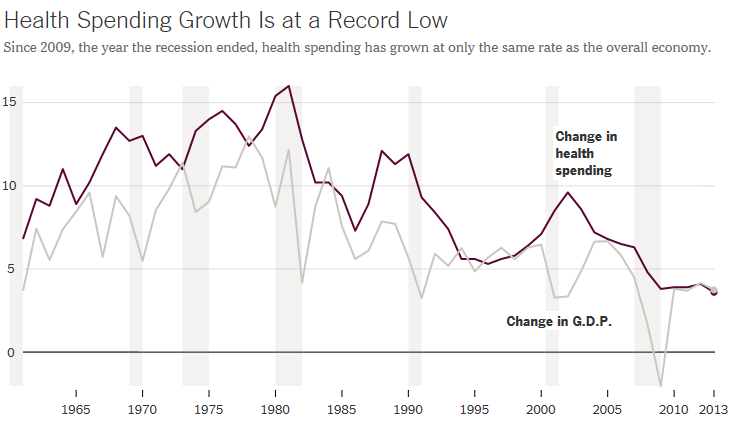
CaptureIt is, of course, very good news that increases in health care spending have dropped dramatically since the recession in 2007-2009, but is it really surprising that this has happened in the midst of so much economic pain, with a very high rate of unemployment as well as stagnant incomes for most Americans?  In fact, even in these circumstances, health care spending is still growing at twice the rate of inflation, which has been under 2% during this same time period.
A more realistic view of health care spending has just been presented to the Health Subcommittee of the House Committee on Energy and Commerce by Marc Goldwein, from the non-partisan Committee for a Responsible Federal Budget, a Washington D.C. think tank focused on fiscal responsibility.  Mr. Goldwein makes the following points:

  • Despite the recent slowdown in health care spending, it remains incredibly important that policymakers pursue reforms to reduce future projected health care costs.
  • Policymakers should focus first and foremost on health care “benders” that would improve incentives in order to slow the overall growth of health care spending.
  • Policymakers should next look to health cost “savers” which reduce federal costs by better allocating resources within the federal health programs.
  • Given the aging of the population, health reforms will be necessary but not sufficient to put the debt on a sustainable long-term track.

Slowing down the rate of growth of health care is going to be a huge challenge for our national leaders.  I will elaborate on how to do this in forthcoming blog posts.
Let’s Keep the Economic Momentum Going


There has been lots of good economic news lately:

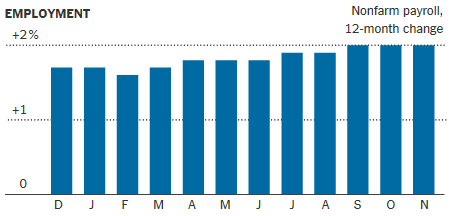
  • The economy added 321,000 jobs in November, the most in one month since January 2012.
  • The unemployment rate of 5.8% remains steady and is down from 7% in November 2013.
  • The average hourly earnings for workers is up by 2.1% from a year earlier.
  • Economic growth for the third quarter is up 3.9% from the previous quarter.
  • The deficit for the 2014-2015 fiscal year was “only” 2.8% of GDP and is predicted by the Congressional Budget Office to drop to 2.6% for the current year.
  • The price of a gallon of gasoline has dropped to $2.71 on average, its lowest level since 2010 and is still dropping.

CaptureThe New York Times predicts that the “Brighter Economy Raises Odds of Action in Congress.”  Jason Furman, Chairman of the White House Council of Economic Advisors, is quoted as saying that “At least there will be less of a philosophical debate on infrastructure, tax reforms and expanding exports.  You can have that agenda because the economy is not in free fall.” These three items would make a great agenda for the 114th Congress in the following way:

  • Infrastructure. The continuing drop in the price of gasoline offers the opportunity to replenish the inadequately funded Highway Trust Fund in a fiscally responsible manner. Congress should raise the federal gasoline tax above its current 18 cents per gallon to a level which is sufficient to fund the entire federal share of highway construction and repair.
  • Tax reform. Individual and corporate tax reform will give the economy a huge boost. The idea here is to lower tax rates in a revenue neutral way by closing loopholes and deductions.
  • Expanding Exports. What’s needed here is to give the President fast track negotiating authority so that Congress has to vote any trade agreement up or down without modification. This is the only way to get other countries to make concessions.


Of course there are many other issues which need to be seriously addressed by the new Congress.  But relatively quick action on just these three less controversial items would be a great start!

Nebraska Will Benefit From Immigration Reform


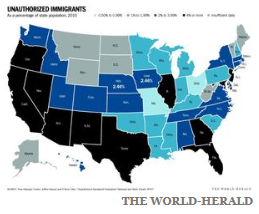
Several months ago the Omaha World Herald reported that Nebraska has approximately 45,000 illegal immigrants, or about 2.5% of the state’s population.  Nebraska’s unemployment rate has now dropped to 3.4%, the third lowest in the nation behind only North Dakota and South Dakota.  Such a low unemployment rate represents a labor shortage.  There simply aren’t enough Nebraskans to perform all of the physically demanding, low skill work needed in the agriculture, meatpacking and construction industries.  It is this labor shortage which is attracting such a large number of illegal immigrants to Nebraska.
CaptureAccording to the New York Times, the Tea Party has recently changed its focus from “curtailing the reach of the federal government, cutting the deficit and countering the Wall Street wing of the Republican Party to becoming largely an anti-immigration overhaul movement.”  This is a very unfortunate development.
Why would it be so difficult to solve our illegal immigration problem in the following manner:

  • Give all businesses a limited period of time, perhaps six months, to present a list of current employees who are illegal. Everyone on this list without a criminal record would receive a guest worker visa.
  • Going forward, businesses would be authorized to hire additional foreign workers as needed with guest worker visas issued in their home country. This would eliminate the need for illegal entry into the U.S.
  • As of a certain date in the near future, all businesses would be required to periodically demonstrate the legal status of all workers on their payroll.
  • Guest workers would be eligible to apply for citizenship after a lengthy period of time, perhaps ten years.

Once an adequate guest worker visa program has been set up and is operating efficiently, security on our southern border with Mexico would hardly be more of a problem than is security on our northern border with Canada. Illegal immigration should be considered as an economic problem, not a law-enforcement problem.
If it were handled correctly in this way, the problem would disappear in short order!

The Great Wage Slowdown and How to Fix It

With a new Congress just elected, this is a good time to reflect about what changes should be made in public policy. Our biggest economic problem is to speed up growth in order to provide more and better paying jobs.  In addition, a faster growing economy would bring in more tax revenue which would help pay our bills and reduce the deficit.
CaptureA column in today’s New York Times, “The Great Wage Slowdown, Looming over Politics,” by David Leonhardt, proposes a cut in the marginal tax rate for the middle class as a way of boosting their incomes.  As can be seen in the above chart, median household income has been flat since the year 2000, and even lower since the 2008 recession.  Mr. Leonhardt goes on to say that any tax cut for the middle class should be balanced by a tax increase for the wealthy.
It so happens that I proposed such a plan several months ago as a way of boosting the economy and reducing inequality at the same time. The idea is to enact broad-based tax reform whereby tax rates are lowered for all, offset by shrinking tax deductions.  The 64% of taxpayers who do not itemize deductions will receive a big tax cut.  But these are the very middle-class wage earners with stagnant incomes.  So they will likely spend their tax savings, thereby giving the economy a big boost.
More specifically:

  • Individual tax deductions total about $1 trillion per year.
  • Let’s suppose that these deductions are cut in half to $500 billion per year.
  • Let’s further suppose that half of this amount, or $250 billion per year, is cut from the taxes of the 64% who do not itemize deductions.
  • If these 64% spend just 2/3 of their new income (instead of saving it or paying off debt), this will total $170 billion which is 1% of GDP.
  • This would increase the rate of growth of GDP from the 2.2% average, since the end of the Great Recession, to 3.2%. This represents an enormous boost to the economy and would return average GDP growth to about its 3.3% average since 1947.

    Mr. Leonhardt suggests that presidential contenders in 2016 would greatly benefit from proposing a tax rate cut for the middle class. Here’s a specific plan they can use!

The Problem of Soaring World Population


As I remind readers from time to time, this blog is focused on the fiscal and economic problems of the U.S. Our biggest fiscal problem is not having enough tax revenue to pay our bills.  Our biggest economic problem is a stagnant economy which leaves too many people unemployed or underemployed.
My last three post have been on the subject of climate change. This is a worldwide problem which has a huge effect on the U.S.  There’s going to be a cost in cutting way back on carbon emissions.  But there will soon be a much greater cost if we don’t cut back and therefore suffer the growing adverse environmental effects.
Now there is another looming problem.  The journal Science has just published the article “World population stabilization unlikely this century,” reporting that world population, now 7.2 billion, is likely to reach 9.6 billion by 2050 and 10.9 billion by 2100.  Much of the increase will take place in Africa due to higher fertility rates because of a recent slowdown in the pace of fertility decline.
CaptureThe implications of a growing world population are huge:

  • First of all, it will add even more stress to an environment which is already being increasingly stressed by global warming.
  • Secondly, it will aggravate a slowdown in middle-income wage growth throughout the developed world. This is very evident in the above chart. What is happening is that the force of globalization is shifting lower skilled work to lower paid workers in the developing world. A larger population in the developing world will simply exacerbate this trend.

The noted economist, Tyler Cowen, has a different perspective on this problem, “A Strategy for Rich Countries: Absorb More Immigrants,” in today’s New York Times.  But Mr. Cowen’s approach is untenable for the long run.  The idea that you can offset an increase in the elderly population with an even bigger increase in the younger population will lead to an ever-growing overall population.
What then is the answer to over-population?  It is either more birth control or less sex.  Take your pick!

The Reality of Today’s Healthcare: Cost Is Critical


My last two posts have been devoted to discussing the prospects for a true free-market healthcare system in the U.S.  Let’s bring this discussion down to earth with two specific examples.
CaptureIn Omaha NE, where I live, there are three major hospital systems and one of them, Catholic Health Initiatives, is 30% more expensive than the other two.  The major insurer, Blue Cross Blue Shield, has reacted by canceling its contract with CHI, making it out-of-network for Blue Cross policy holders.
As reported in today’s Omaha World Herald, “Non-CHI health clinics, hospitals handling influx,” the Nebraska Medical Center and Methodist Hospital System are seeing a large influx of Blue Cross insured patients.  This is exactly what has been expected to happen and will eventually put pressure on CHI to lower its prices in line with the other two hospital systems.
The second example, “Unable to Meet the Deductible or the Doctor” is the title of an article in yesterday’s New York Times.  The article reports that 7.3 million Americans are now enrolled in insurance coverage through the Affordable Care Act.  However the average deductible for a bronze plan on the exchange – the least expensive coverage – is $5,081 for an individual.  This compares to the average deductible of $1,217 for individual coverage in employer-sponsored plans.
Not surprisingly, relatively low-income people obtaining subsidized coverage through an exchange are likely to want a low cost policy.  But with a high deductible they will then be hard-pressed to have to pay the full price of routine care out of there possibly meager budgets.  This is going to be a larger and larger problem as more and more people obtain coverage through the exchanges.
Since all of an individual’s medical bills should go through the insurer for processing, insurance companies are in a position to, and should be expected to, help control costs by bargaining with providers to make sure that prices are not excessive.
Conclusion: here are two examples of price competition in today’s healthcare market place.  This is the reality that more and more Americans are going to have to learn to live with.  It is the only way that our excessive healthcare costs can be brought under control.

Colorado Was “Reckless to Legalize Marijuana”


So declared incumbent Colorado governor, John Hickenlooper, in a recent re-election campaign debate.  Many states have relaxed marijuana laws, such as for medical use or by decriminalization, and two states, Colorado and Washington, have legalized its recreational use.  Furthermore, public opinion at the national level is gradually swinging over in support of legalization (see below).
CaptureThe New York Times published five lengthy editorials on this subject last summer under the heading of “High Time,” taking the position that the health risks of marijuana use are minimal (except for adolescents) and that it should be left up to the states to decide on the issue of legalization.
But now a new study has just been published by an Australian researcher, Wayne Hall, “What has research over the past two decades revealed about the adverse health effects of recreational cannabis use?” in a highly rated journal, Addiction.  Its key findings are:

  • Driving while cannabis intoxicated doubles the risk of an accident; this risk substantially increases if users are also alcohol-intoxicated.
  • Cannabis use during pregnancy slightly reduces birth weight.
  • 1 in 10 cannabis users develop a dependence syndrome; 1 in 6 for adolescents.
  • Regular cannabis users double the risk of experiencing psychotic disorders.
  • Regular adolescent cannabis users have lower educational attainment.
  • Regular adolescent cannabis users are more likely to use other illicit drugs.
  • Regular cannabis smokers have a higher risk of developing chronic bronchitis.
  • Cannabis smoking in middle age increases the risk of myocardial infarction.

These adverse effects of marijuana use are serious.  My own opinion is that Colorado and Washington probably made a mistake by legalizing the recreational use of marijuana. At any rate, an experiment is now being conducted in these two states and in a few years we will know how it works out.  Other states should be reluctant to follow suit until then.  In the meantime, I support national legislation to decriminalize marijuana use but not to legalize it.
Drug use and misuse has huge economic ramifications and so it is very important to have a sensible and rational national policy on this issue.

Income Inequality and Rising Health-Care Costs


There seems to be a general consensus on the reality of increasing income inequality in the U.S. and even some agreement on its two main causes: globalization and the rapid spread of technology. The slow growth of the economy since the end of the recession has made the inequality problem that much worse.
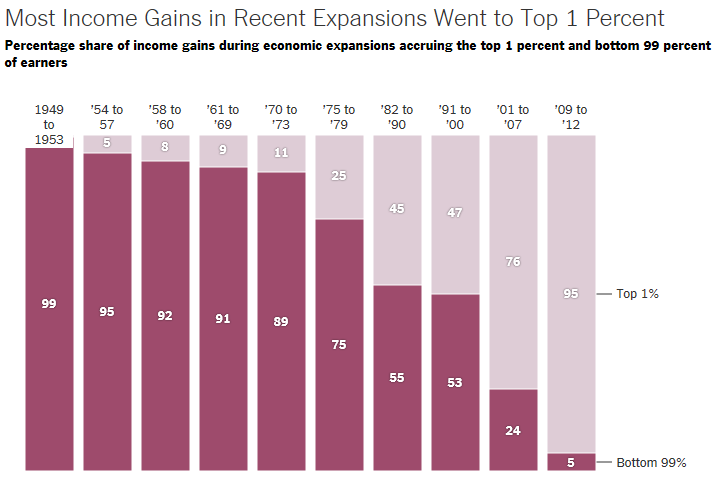
CaptureNot surprisingly, slow economic growth in the past five years has led to stagnant wages for many workers.  My last post addressed this problem.  The above chart from the New York Times shows that incomes for top wage earners have been rising in recent years while they have been stagnant for middle- and lower-income workers.
But there is more to it than this.  In yesterday’s Wall Street Journal, Mark Warshawsky and Andrew Biggs point out that, “Income Inequality and Rising Health-Care Costs,” in the years 1999 – 2006, total pay and benefits for low income workers rose by 41% while wages rose by only 28%, barely outpacing inflation.  For workers making $250,000 or more total compensation rose by a lesser 36% while wages grew by a greater 35%.  This apparent anomaly is explained by the fact that health insurance costs are relatively flat across all income categories, thus comprising a much larger percentage of the total pay package of low-income workers than for high-income workers.
Capture1In fact, the Kaiser Foundation has shown that low-wage workers tend to pay higher health insurance premiums, as well as receiving lower insurance benefits, than higher paid workers (see the above chart).
Overall, what this means is that employer provided healthcare is taking a huge chunk out of the earnings of low-income workers which makes income inequality much worse than it would be otherwise. Of course, the cost of healthcare is a huge burden for the entire U.S. economy, currently eating up 17.3% of GDP, twice as much as for any other developed country.
For both of these reasons it is an urgent matter for the U.S. to get healthcare costs under control.  Avik Roy of the Manhattan Institute has an excellent plan to do just this as I have discussed in several recent posts.

Economic Expansion Is Not Enough


The Washington Post reporter Robert Samuelson gives our economy today a B-, because the unemployment rate has inched down to 6.1%, fulltime employment is up to 105.8 million in 2013 from 99.5 million in 2010, and full-time women’s pay reached a high of 78% of men’s pay in 2013.  The big negative, of course, is that median household income was $51,939 in 2013, down from $56,436 in 2007, just before the financial crisis.
The Bard College economist Pavlina Tcherneva, as summarized by the reporter Neil Irwin in yesterday’s New York Times, shows what has gone wrong with economic and monetary policy since the end of the Great Recession in June 2009. The American Recovery and Reinvestment Act of 2009 (an $850 billion stimulus package) did boost the economy but it primarily aided “the skilled, employable, highly educated, and relatively highly-paid wage and salary workers.”
Capture2On the other hand the Federal Reserve’s quantitative easing policies have kept interest rates remarkably low and have thereby caused investors to buy stocks rather than bonds in order to get higher returns.  This has artificially boosted stock prices and has been especially advantageous to the top 10% and, even more so, the top 1%.
CaptureWhat is needed, according to Ms. Tcherneva, is a targeted, bottom-up approach to fiscal policy, which provides more and better paying jobs directly to middle- and lower-income wage earners.  Her suggestion is for public works jobs, public service employment, green jobs, etc., all of which would require large infusions of federal money thereby worsening the federal deficit.
A much better approach would be broad based tax reform, lowering tax rates across the board, paid for by closing the loopholes and deductions which primarily benefit the rich.  Since the 64% of taxpayers who do not itemize deductions would receive an effective pay boost, this would amount to a tax reform program targeted to exactly the middle- and low-income wage earners who have not yet recovered from the recession.  These folks would most likely spend their extra income, thus further boosting the economy (see my previous post).

What Happens When We All Live to 100?


This is the title of an article in the current issue of Atlantic. Of course, it is a rhetorical question, but it raises a very serious issue.  There are 43 million Americans age 65 or older today and this number is expected to reach 108 million by 2050.  How will society cope with so many more senior citizens?
CaptureThis blog is concerned with the most critical fiscal and economic problems facing our country.  The biggest fiscal problem we have is how to pay for the three major entitlement programs: Social Security, Medicare and Medicaid.  Social Security can be shored up with small adjustments to either the benefits formula or by raising taxes a little bit.  Medicaid can be kept under control by block-granting the program to the states.  But Medicare is a much bigger problem.
Capture1The cost of healthcare, both public and private, is rising rapidly as shown in the above chart from the New York Times.  We badly need a new approach to control costs and Avik Roy from the Manhattan Institute has given us such a plan “Transcending Obamacare: A Patient-Centered Plan for Near-Universal Coverage and Permanent Fiscal Solvency.”
The problem is that, as Mr. Roy explains, “by creating a universal, single-payer health care program for every American over 65, regardless of financial or medical need, the drafters of Medicare made the program extremely difficult to reform.”  But now we have to reform it because the costs are becoming so huge.  How do we do it?
First of all, Mr. Roy’s plan keeps the exchanges created by the Affordable Care Act and turns them all into state-based exchanges.  It also eliminates both the individual and employer mandates, replacing these mandates with financial incentives.
Mr. Roy’s core Medicare reform is very simple.  The plan increases the Medicare eligibility age by four months each year.  The result is to preserve Medicare for current retirees, and to maintain future retirees – in the early years of their retirement – on their exchange-based or employer-sponsored health plans.  In other words, retirees will gradually be migrated to the same system, with the same level of subsidy, as for working people.
Everyone, workers and retirees alike, will be treated the same. Not only is this an eminently fair system, it insures that Medicare remains affordable, for both retirees and the whole country.