The Big Picture on Debt Part IV The Full Model


For the past week I have been discussing different aspects of our alarming debt problem as vividly illustrated in a recent report from the Congressional Budget Office  (see chart below).  My last post discusses what I call the Buffett Model:  G > D, meaning that as long as nominal growth G (real growth plus inflation) is greater than the deficit D, then the accumulated debt will decrease as a percentage of GDP and the debt is said to be “stabilized”.  This, of course, is what has happened in the U.S. historically after all of our major wars and especially after WWII (see below).  The problem is that our current situation in 2014 appears much bleaker going forward because the debt is projected (by CBO) to just keep on growing indefinitely.
CaptureToday I look at a broader model, the so-called BRITS model:  R + I > (S – T) + B   where

  • B = borrowing costs
  • R = real growth
  • I = inflation
  • T = taxes
  • S = spending.

The BRITS model reduces to the Buffett model by letting G = R + I and D = (S – T) + B.  The value of this more general model is to show the relationship between all five of these important variables.  To meet the objective of stabilizing debt, according to this intuitive model, we should increase both R and I and decrease S – T and B.
The Federal Reserve is involved by keeping B as low as possible and making sure that I is large enough (but not too large or other problems will occur).  Congress can help by cutting spending or raising taxes but, of course, both of these actions are hard to do politically.
If real growth R is high enough then the desired inequality will hold and debt will be stabilized.  But how is this accomplished?  The Fed has been trying to increase growth through quantitative easing but it’s not working very well.  Many economists think that it would be more helpful for Congress to implement broad based tax reform, whereby tax rates are lowered and loopholes and deductions are closed in a revenue neutral manner so that overall tax revenue remains the same.  But nobody wants to lose their own deductions so this is hard to do.
CaptureAs much as faster growth will help, it is still critical for Congress to get spending under control.  The above chart from the Heritage Foundation shows that under current trends by 2030 federal spending will have increased so much that all federal tax revenue will be spent on just entitlements and interest payments alone!  Since this is unrealistic, some sort of a major new crisis is likely to occur before 2030!
Conclusion: The BRITS model helps to understand the complexity of our debt problem and some of the steps that need to be taken to alleviate it.  I will return to it in the future.
The Big Picture on Debt Part III. The Oracle of Omaha Speaks


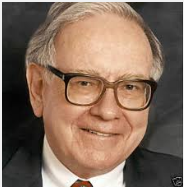
“I could end the deficit in 5 minutes.  You just pass a law that says anytime there is a deficit of more than 3% of GDP, all sitting members of Congress are ineligible for re-election.”                                                                                                                                                                       Warren Buffett, 1930 –

Mr. Buffett made this quip in a recent interview with CNBC.  Since the economy has historically grown at a rate of about 3%, Mr. Buffett is saying that we’ll be alright as long as economic growth exceeds deficit spending.  This is generally correct but, as Mr. Buffett well knows, the situation is more complicated than this.
CaptureA very good, and nontechnical, discussion of this whole subject can be found in the newly published book, “The Death of Money: the coming collapse of the international monetary system” by the financier James Rickards.  Look at Chapter 7, “Debt, Deficits and the Dollar.”
Simplifying Mr. Rickards’ approach a little bit, and keeping it in Mr. Buffett’s framework, for a stable economy we need to have
G > D
where the nominal growth G = real GDP + I (I is the rate of inflation) and the deficit D = S – T  (S is spending and T is tax revenue).  I have included interest paid on the debt as part of total spending.  As long as the left hand side is greater than the right hand side, the economy is growing faster than the deficit and the accumulated debt will shrink as a percentage of GDP. Notice that the rate of inflation affects the left hand side of the inequality while the interest rate is part of the right hand side.
Negative inflation is deflation which is clearly undesirable.  The Federal Reserve’s current target for inflation is 2%.  The challenge for the Fed is 1) to keep inflation high enough and interest rates low enough so that G > D, while at the same time, 2) to make sure that inflation does not grow so high as to destabilize the markets.
Given our underperforming economy with low real GDP growth, and huge deficits, Mr. Rickards is pessimistic that the Fed can continue successfully “in the position of a tightrope walker with no net … exuding confidence while having no idea whether its policies will work or when they might end.”
Thus the gloomy title for his book.

The Big Picture on Debt II. Why It Is So Alarming


My last post, “The Big Picture on Debt,” used a chart from a recent Congressional Budget Office report (pictured  below) to look at the history of U.S. debt.  It is worse now than at any other time except at the end of World War II.  But after 1945 massive military spending ended rapidly, the economy started growing briskly and debt as a percentage of GDP shrunk rapidly.
CaptureThe light purple section at the right hand side of the chart portrays CBO’s debt projection for the next 25 years.  As the report itself makes clear, CBO is using favorable economic assumptions in this projection.  Without these favorable assumptions, our future debt will be much worse than this.  And the same trends continue indefinitely into the future beyond the 25 year window.
Right now our huge debt is almost “free” money because interest rates are so low.  But this situation cannot last much longer without setting off an inflationary spiral.  As interest rates eventually resume their historical average of about 5%, interest payments on our accumulated debt will skyrocket and therefore increase the size of the annual deficits.
There are only three ways to shrink debt as a percentage of GDP: 1) cut spending, 2) achieve faster growth and 3) raise tax revenue.  Let’s look at each in turn:

  • Government spending as a percentage of GDP is not shrinking but actually growing. Primarily this is because of the massive growth of the big three entitlement programs: Social Security, Medicare and Medicaid. All other government spending is subject to Sequester limits. This is a crude and insufficient way to control discretionary spending.
  • GDP growth, averaging 2.2% annually since the end of the Great Recession five years ago, is much slower than the overall average growth of 3.3% since the end of WW II. Major tax reform at both the individual and corporate levels, with lower tax rates offset by closing loopholes and shrinking deductions, would give a big boost to economic growth. But there is resistance to cutting tax deductions.
  • Raising taxes will in principle decrease deficit spending but the trick is to do it without hurting economic growth. Both individual and corporate tax reform could accomplish this if done in the right way. See here and here for specific proposals.

Conclusion:  there are concrete ways to find solutions to get our massive accumulation of debt under control and shrinking as a percentage of GDP.  But the prospects for action are gloomy.

The Big Picture on Debt


Most observers agree that the Congressional Budget Office is a reliable source for detailed, objective and nonpartisan information about the federal budget.  Its frequent reports are cited by all sides in budget debates.  Today I refer to the recent CBO publication, “The 2014 Long-Term Budget Outlook in 26 Slides.”  In particular, one of its graphs entitled “Federal Debt Held by the Public” (pictured here) has a striking message.
CaptureThroughout history, the U.S. has had relatively large debt following each of its major wars, especially after World War II.  But the debt has always declined relatively quickly, as a percentage of GDP, as the economy recovered and grew briskly. But now, in 2014, we are stuck with a huge debt which is projected (by CBO) to not shrink but rather to keep getting much worse.  And furthermore, the so-called “Extended Baseline Projection” in the graph, is an optimistic projection which disregards several long-term trends such as mortality decline, possibly slower productivity growth, higher interest payments and likely growth of federal healthcare spending.
How in the world will this huge debt problem be resolved in a favorable manner?  Republicans don’t want to raise taxes and Democrats don’t want to cut spending, especially on entitlements.  The only action taken in the last few years, under threat of not lifting the federal debt limit, was to implement a Sequester on discretionary spending.  This helps but not nearly enough.
Recent budget agreements are not auspicious for future progress.  A five year farm bill was passed last spring without significant cuts to either farm subsidies or food stamps.  Highway spending was extended for a few months with a gimmick when what we really need to do is increase the federal gasoline tax.  A $17 billion (over three years) increase for veteran’s health has just been approved when what we really need is an extensive overhaul of the Veterans Administration.
There are deficit hawks in Congress, on both sides of the aisle, but their numbers are too small to be effective.  It is just very hard to vote no on spending measures when the pressure coming from special interest groups on all sides is to vote yes.
I am an eternal optimist by nature but I have a hard time visualizing a favorable outcome to our fiscal dilemma.  I am arranging my own affairs accordingly.

How to Control Federal Spending: The Highway Trust Fund


The federal Highway Trust Fund is almost out of money.  It takes in $35 billion per year from the 18.4 cents per gallon federal gas tax, which has not been raised since 1993.  Sometime this summer the government will have to cut back on payments to state highway departments unless Congress acts.
CaptureAs the above chart from the Economist  shows, the U.S. spends much less of GDP on roads than many other developed nations.  Something clearly needs to be done because we need many improvements in infrastructure.  But there are better ways and poorer ways to solve this problem.  Here are two good ways as described by Thomas Donlan in a recent issue of Barron’s:

  • A bill to raise the gas tax by 12 cents per gallon over two years has been introduced in the Senate by Bob Corker (R, Tenn.) and Chris Murphy (D, Conn.). Each penny added to the federal gas tax rate will raise $1.3 billion and this would solve the problem.
  • Repeal the federal gas tax and turn federal highway construction entirely over to the states. Each state could then increase its own gas tax and/or pay for construction with tolls on bridges and roads.

Here are two examples of poor ways to replenish the Highway Trust Fund:

  • Continue adding to the Fund with borrowed money. $54 billion has been borrowed since 2008 for this purpose. Presumably the Sequester will make it much harder to continue such deficit financing.
  • Rep John Delaney (D, Mary.) has proposed a tax break for repatriated foreign profits by multinational American companies if part of the money brought back was spent on infrastructure bonds. This would interfere with the urgent need to reform corporate taxes with significantly lower rates offset by lowering deductions, in order to make our corporate tax internationally competitive.

Conclusion: There is a good chance that the Budget Sequester established by Congress in 2011 to control discretionary spending, as well as the widely recognized urgent need for corporate tax reform, will lead to a “good” rather than “bad” solution to the shortfall in the Highway Trust Fund. This is just one specific example of the challenge to sensible budgeting by Congress.
A much broader approach is needed to really shrink the deficit.  Stay tuned!

Escaping the Student Debt Trap


Student debt in the U.S. now tops $1.2 trillion with 37 million borrows, 5.4 million of whom have already defaulted.  President Obama has proposed to expand a program which allows students to repay debt based on what they earn, eventually forgiving the balance.  Massachusetts Senator Warren has proposed taxing millionaires to pay for student loan refinancing.  Small scale free market proposals abound.  What is badly needed is a sensible broad-based public program approved by Congress.
CaptureThe Brookings Institution has recently proposed just such a model for student loan repayment “Loans for Educational Opportunity: Making Borrowing Work for Today’s Students”.  It is based on four observations:

  • Moderate debt for the typical student borrower. 69% of students have borrowed $10,000 or less.
  • The high payoff of a college education. Over a lifetime the holder of a bachelor’s degree earns several hundred thousand dollars more than a high school graduate. Even those who attend college but do not graduate will experience an income gain of about $100,000.  Postsecondary education should be encouraged as widely as possible.
  • The highest rates of default are on typical loan balances. The average loan balance in default is $14,000 while the average loan balance in good standing is $22,000.
  • The highest rates of default are among young borrowers. For borrowers under age 21, 28% have defaulted, for borrowers between ages 30 and 44, 18% have defaulted and it is 12% for borrowers aged 45 and older.

The Brookings’ authors propose that student loan payments be deducted from pay by the employer, in the same way as for income taxes and Social Security.  The payment rate would be only 3% of the first $10,000 in annual earnings and would rise with higher earnings topping out at 10%.  Loan payments will stop when the loan is repaid or after 25 years, whichever comes first.  Various measures can be adopted to protect against deadbeats.  See the Brookings report for details.
The fairest system would be for all students, past and present, to be put into a program like this.  Nobody would be expected to pay during periods of unemployment. Interest rates could be adjusted from year to year to make the program self-supporting. Something along these lines is badly needed!

Privatize Veteran’s Health Care

The current Veterans Administration waitlist scandal is an unfortunate symptom of a much bigger problem, namely the very high and rapidly increasing cost of providing healthcare to our nation’s veterans.  Especially at a time of huge budget deficits and exploding national debt, all branches of government, including our VA system, must operate more efficiently.
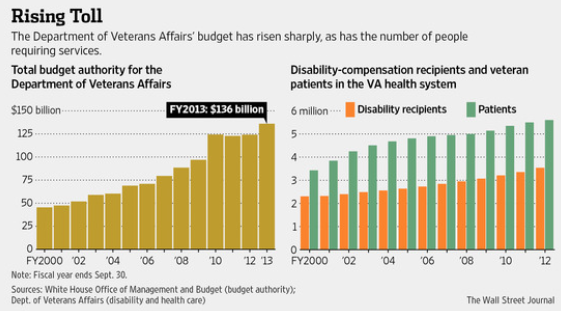
CaptureAs we celebrate Memorial Day and the 70th anniversary of the Normandy Invasion in WWII, this is a good time to contemplate a major restructuring of the VA.  As pointed out two days ago in the Wall Street Journal, “VA’s Budget, and Rolls, Have Boomed”, not only has the number of VA healthcare patient visits increased dramatically from 3.4 million in 2000 to 5.6 million in 2012, but the average annual expenditure per patient has also risen by 62% over the same time period.
The purpose of having a separate healthcare system for veterans is to give them better care than they would otherwise receive.  But the scarcity of resources means that their healthcare is being effectively rationed with longer waiting times.
The situation for veteran’s healthcare is a harbinger of what awaits us for our big government entitlement problems: Social Security, Medicare and Medicaid.  For the sake of all recipients, present and future, the rapidly growing costs of these programs must be contained.  There are lots of possible ways to do this.  Our national leaders simply need to take the problem seriously and insist on action.
At the same time it makes no sense to maintain a separate health care system for our nation’s 22 million veterans, only 7% of our total population.  The VA has lots of other responsibilities to take care of anyway: providing life-insurance, mortgage, and housing programs, managing cemeteries, and providing job training, for example.  Veteran’s healthcare could and should be privatized with a voucher system administered by the VA.  It will save billions of dollars for taxpayers and provide better, and timelier, healthcare for our nation’s veterans.

Redistribution, Inequality and Growth


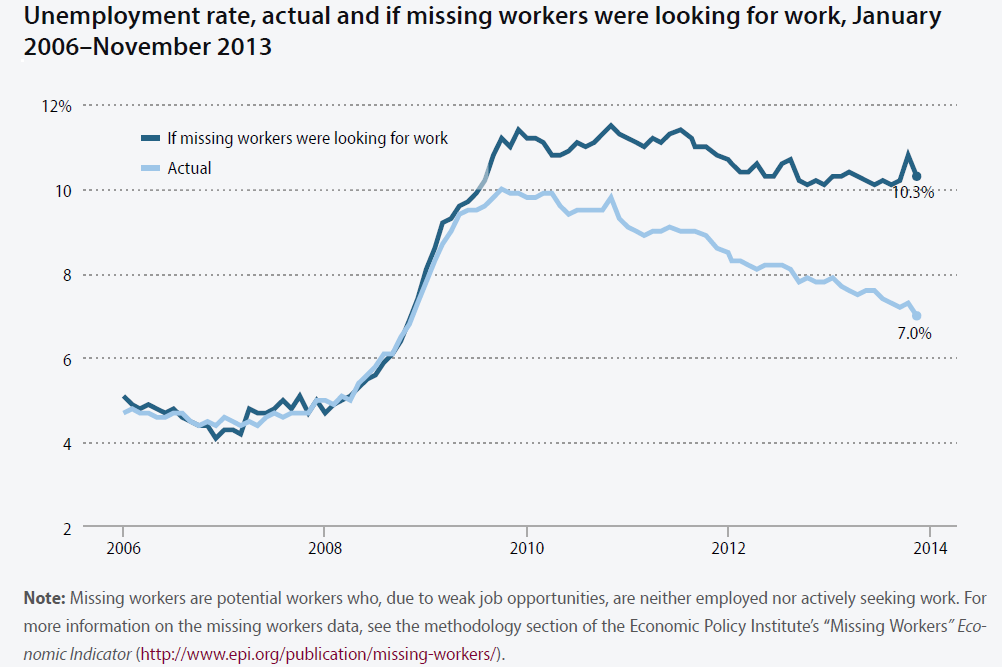
Most people agree that income inequality and wealth inequality are increasing in the U.S. Likewise anyone who’s paying attention is aware of our slow rate of GDP growth, averaging 2.2% per year, since the end of the recession five years ago.  Is there a connection between inequality and slow growth?  Maybe!
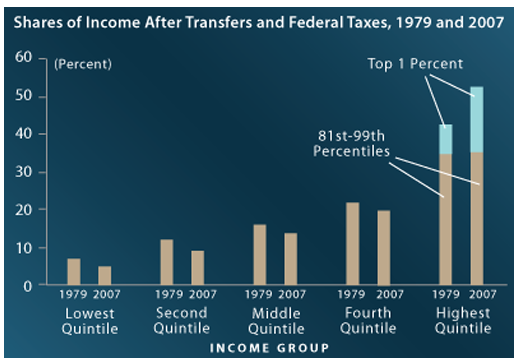
CaptureFirst of all, it is important to note that income inequality in the past 30 years has been greatly offset by federal taxes and transfer programs as shown in the October 2011 chart (above) from the Congressional Budget Office.
Capture1Secondly, the Economist discusses this situation in the article “Inequality v growth”.  The economists Jonathan Ostry, Andrew Berg and Charalambos Tasangarides have shown (see above chart) that a large amount of redistribution affects growth more negatively than a smaller amount of redistribution.
Economists generally agree that the recovery has been slowed down by a lack of demand by consumers for more goods.  So the recovery should speed up as less affluent consumers feel secure enough to spend more money.  Two things, to start with, can make this happen.  One is a restoration of the housing market so that homeowners have more equity (which can be borrowed and spent).  Another way to accomplish this is with government redistribution programs, such as food stamps and Medicaid, for low income people.
But there is an even better way to put money in the hands of people who will spend it, and at no cost to the government.  I am talking about broad based tax reform, whereby tax rates are lowered for everyone, offset by closing tax loopholes and shrinking deductions, which primarily benefit the wealthy.  For the two-thirds of taxpayers who do not itemize deductions, and who tend to be the less affluent, such a tax rate cut will put money in their pockets, most of which they will spend.
Such a tax program as this would be a direct shift of resources from the wealthy to everyone else, thereby lessening inequality.  It would stimulate the economy, creating millions of new and higher paying jobs, and thereby increasing tax revenue and lowering the deficit.  Win, win, win, win!

What Is the Best Way to Boost the Economy and Create More Jobs?


The publication of two new books is causing a reevaluation of the financial rescue and its aftermath, e.g. “The Case Against the Bernanke-Obama Financial Rescue”.  The two books are “Stress Test” by Timothy Geithner, former Treasury Secretary, and “House of Debt” by the economists Atif Mian and Amir Sufi.
CaptureMr. Mian and Mr. Sufi maintain that the government’s response to the financial crisis should have focused less on saving the banking system and more on the problem of excessive household debt.  They discovered in their research that, during the housing bubble, less affluent people were spending as much as 25 – 30 cents for every dollar of increase in housing equity.  When the bubble burst, and housing prices started to fall, these borrowers cut way back on spending which caused many businesses to lay off employees.  The authors propose setting up a government program to help borrowers decrease what they owe in underwater mortgages.
Five years after the end of the Great Recession it would still be very helpful to speed up our lagging economy.  Here are three different possible ways to do this:

  • The Keynesians say the best way to stimulate the economy is with more government (deficit) spending. For example, spending several hundred billion dollars a year on infra-structure would create hundreds of thousands, if not millions, of new construction jobs. I think this is a good idea, but only if it’s paid for with a new tax (e.g. a carbon tax or a wealth tax).
  • The Mian/Sufi plan, as described above, would alleviate mortgage debt problems for millions of middle class homeowners who are still under water, encouraging them to spend more money which would in turn boost the economy. The problem is that the M/S plan creates a moral hazard for mortgage holders unless it’s paid for by mortgage insurance which would raise costs for borrowers.
  • Broad-based tax reform, with lower tax rates for everyone, paid for by closing loopholes and limiting tax deductions for the wealthy, would automatically put more income in the hands of the two-thirds of tax payers who do not itemize deductions. These middle class wage earners would tend to spend this extra money thereby boosting the economy.

The point is that there very definitely are ways to boost the economy, some better than others, and it should be a top priority of Congress and the President to get this done.

The Government We Deserve II. How Do We Make It Better?


“When the Athenians finally wanted not to give to society but for society to give to them, when the freedom they wished for most was freedom from responsibility, then Athens ceased to be free.”
Edward Gibbon, 1737 – 1794, The Decline and Fall of the Roman Empire

In my last blog, “The Government We Deserve,” I reported on a new book “Dead Men Ruling” by Eugene Steuerle, which shows how “Dead and retired policymakers have put America on a budget path in which spending will grow faster than any conceivable growth in revenues.”
CaptureOur country is clearly in a huge predicament.  We can get out of this jam by:

  • Restoring Balance: our legislators should only appropriate spending for one year at a time.
  • Investing in our future: i) opportunity is a more optimistic goal than adequacy ii) policies to assure adequacy often reduce opportunity by creating negative incentives    (e.g. food stamps, disability programs, housing vouchers) iii) means-tested programs are often anti-family (i.e. discourage marriage)
  • Building a Better Government: our main goal today should be to restore fiscal freedom by allowing future generations to create the government they need and want. i)   constrain the automatic growth in big federal tax subsidy, health and retirement      programs ii) reorient government towards investment, children, opportunity and leanness

“Both parties talk the talk about deficit reduction but fail to see that the deficit is but a symptom of a much broader disease – the extent to which both have tried to legislate far too much of what future government should look like.”
Here are the kinds of fixes which are needed:

  • Eschew Constitutional Fixes (i.e. a balanced budget amendment, term limits).
  • Require Presidents to propose budgets which balance over a business cycle.
  • A True Grand Compromise (end automatic growth of entitlements, generate revenues needed to pay current bills).

As Mr. Steuerle says, “If the obstacles to progress are considerable, the payoffs are enormous.”