The Big Picture on Debt


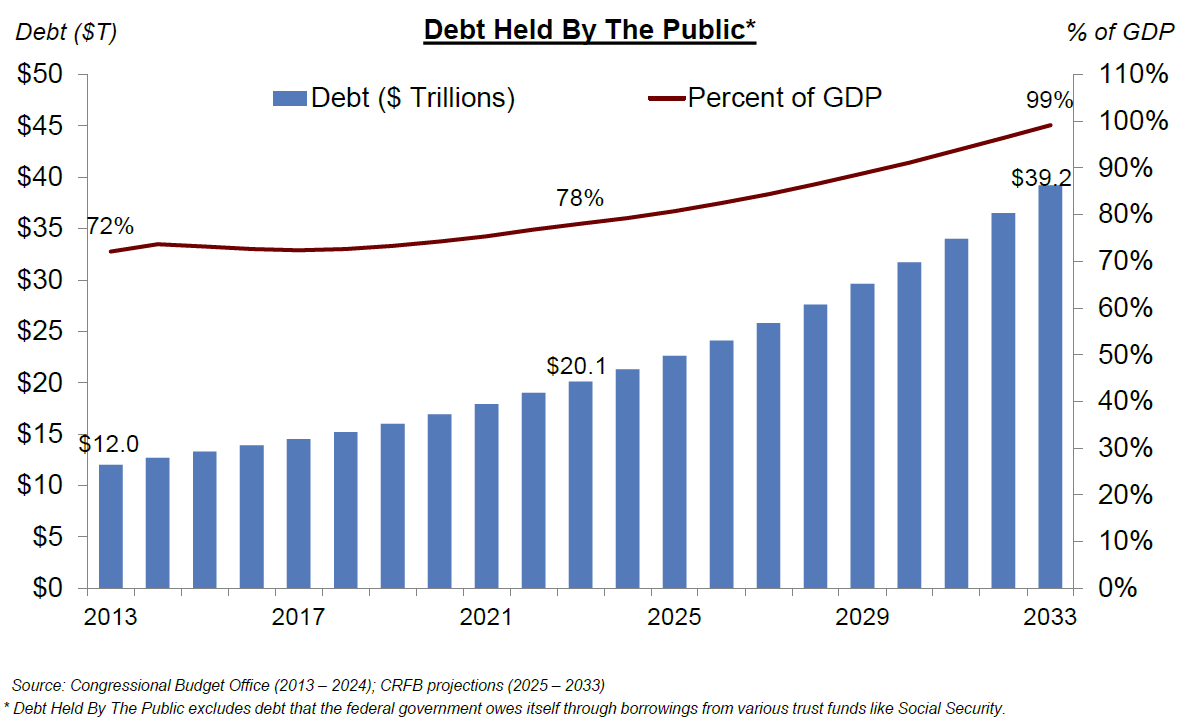
Most observers agree that the Congressional Budget Office is a reliable source for detailed, objective and nonpartisan information about the federal budget.  Its frequent reports are cited by all sides in budget debates.  Today I refer to the recent CBO publication, “The 2014 Long-Term Budget Outlook in 26 Slides.”  In particular, one of its graphs entitled “Federal Debt Held by the Public” (pictured here) has a striking message.
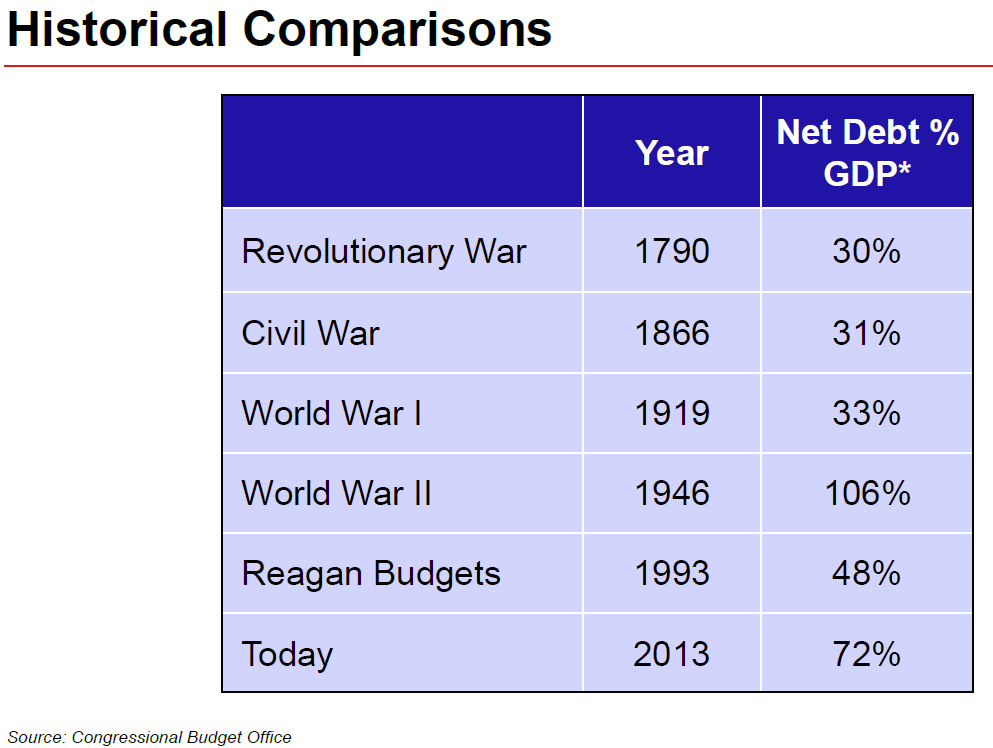
CaptureThroughout history, the U.S. has had relatively large debt following each of its major wars, especially after World War II.  But the debt has always declined relatively quickly, as a percentage of GDP, as the economy recovered and grew briskly. But now, in 2014, we are stuck with a huge debt which is projected (by CBO) to not shrink but rather to keep getting much worse.  And furthermore, the so-called “Extended Baseline Projection” in the graph, is an optimistic projection which disregards several long-term trends such as mortality decline, possibly slower productivity growth, higher interest payments and likely growth of federal healthcare spending.
How in the world will this huge debt problem be resolved in a favorable manner?  Republicans don’t want to raise taxes and Democrats don’t want to cut spending, especially on entitlements.  The only action taken in the last few years, under threat of not lifting the federal debt limit, was to implement a Sequester on discretionary spending.  This helps but not nearly enough.
Recent budget agreements are not auspicious for future progress.  A five year farm bill was passed last spring without significant cuts to either farm subsidies or food stamps.  Highway spending was extended for a few months with a gimmick when what we really need to do is increase the federal gasoline tax.  A $17 billion (over three years) increase for veteran’s health has just been approved when what we really need is an extensive overhaul of the Veterans Administration.
There are deficit hawks in Congress, on both sides of the aisle, but their numbers are too small to be effective.  It is just very hard to vote no on spending measures when the pressure coming from special interest groups on all sides is to vote yes.
I am an eternal optimist by nature but I have a hard time visualizing a favorable outcome to our fiscal dilemma.  I am arranging my own affairs accordingly.

How to Control Federal Spending: The Highway Trust Fund


The federal Highway Trust Fund is almost out of money.  It takes in $35 billion per year from the 18.4 cents per gallon federal gas tax, which has not been raised since 1993.  Sometime this summer the government will have to cut back on payments to state highway departments unless Congress acts.
CaptureAs the above chart from the Economist  shows, the U.S. spends much less of GDP on roads than many other developed nations.  Something clearly needs to be done because we need many improvements in infrastructure.  But there are better ways and poorer ways to solve this problem.  Here are two good ways as described by Thomas Donlan in a recent issue of Barron’s:

  • A bill to raise the gas tax by 12 cents per gallon over two years has been introduced in the Senate by Bob Corker (R, Tenn.) and Chris Murphy (D, Conn.). Each penny added to the federal gas tax rate will raise $1.3 billion and this would solve the problem.
  • Repeal the federal gas tax and turn federal highway construction entirely over to the states. Each state could then increase its own gas tax and/or pay for construction with tolls on bridges and roads.

Here are two examples of poor ways to replenish the Highway Trust Fund:

  • Continue adding to the Fund with borrowed money. $54 billion has been borrowed since 2008 for this purpose. Presumably the Sequester will make it much harder to continue such deficit financing.
  • Rep John Delaney (D, Mary.) has proposed a tax break for repatriated foreign profits by multinational American companies if part of the money brought back was spent on infrastructure bonds. This would interfere with the urgent need to reform corporate taxes with significantly lower rates offset by lowering deductions, in order to make our corporate tax internationally competitive.

Conclusion: There is a good chance that the Budget Sequester established by Congress in 2011 to control discretionary spending, as well as the widely recognized urgent need for corporate tax reform, will lead to a “good” rather than “bad” solution to the shortfall in the Highway Trust Fund. This is just one specific example of the challenge to sensible budgeting by Congress.
A much broader approach is needed to really shrink the deficit.  Stay tuned!

The President Plays Small Ball


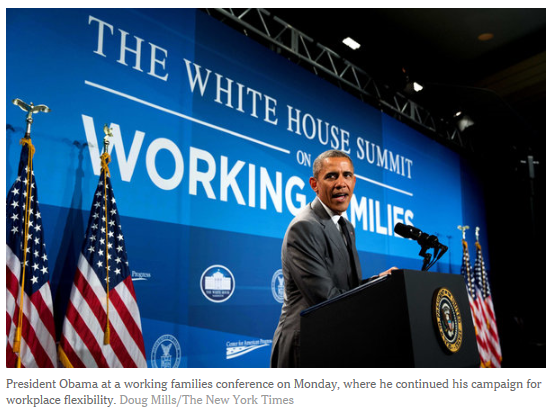
As reported in today’s New York Times, ”Personal Tack by Obama in an Effort to Aid Parents”, the President held an all-day conference yesterday for working families, saying that

  • “Family leave, child care, workplace flexibility, a decent wage – these are not frills – they are basic needs.”
  • “There is only one developed country in the world that does not offer paid maternity leave. And that is us. And that is not the list you want to be on by your lonesome.”
  • “We need you to tell Congress, don’t talk about how you support families: actually support families.”

Capture

The economic journalist, Robert Samuelson, pointed out in the Washington Post a few days ago, ”The Jobs Mystery”, that even though our unemployment rate has now dropped to 6.3%, there are still 9.8 million officially unemployed people, plus an additional 7 million who would like a job but are not looking.  There are also 7.3 million part-time workers who would like longer hours.  This gives a really quite shocking total of 24.1 million unemployed or underemployed workers.
Granted we had a bad recession which was not the President’s fault, but it ended in June 2009, a full five years ago.  In the meantime his administration has done much to retard economic growth (passing ObamaCare and the Dodd-Frank Act) and little, besides huge deficit spending, to boost it.  He and the Democratic Party should be held responsible for this neglect and they probably will be.
One thing which would do a lot to boost economic growth is apparently contrary to liberal ideology and therefore off the discussion table.  I am referring to fundamental, broad-based tax reform whereby individual tax rates would be lowered across the board, but in a revenue neutral manner, by closing or greatly shrinking the loopholes and deductions which primarily benefit the wealthy.  The two-thirds of Americans who do not itemize their tax deductions would get a big boost in take home pay.  Since they are primarily middle and lower income workers whose wages have been stagnant since the recession began, they will tend to spend this extra income, thereby giving the economy a big boost.
If the President were to sincerely ask the House Republican leadership to work with the Democratic Party to boost economic growth, something along this line could be acted upon.  This is the way to really aid families.  Why doesn’t he do it?

The Government We Deserve


“As for the future, your task is not to foresee it, but to enable it.”
Antoine de Saint-Exupery, 1900 – 1944

An important new book, “Dead Men Ruling,” by the Urban Institute’s C. Eugene Steuerle, has just been published.  Here is the flavor of its message:
Capture“Dead and retired policymakers have put America on a budget path in which spending will grow faster than any conceivable growth in revenues. … The same policy makers also cut taxes so much below spending that they created huge deficits, which have now compounded the problem with additional debt.”
“Both sides have largely achieved their central policy goals – liberals have expanded social welfare programs, conservatives have delivered lower taxes.  Both now cling tenaciously to their victories.”
In short, “our central problem is the loss of fiscal freedom.” There are “four deadly economic consequences of this disease:

  • rising and unsustainable levels of debt,
  • shrinking ability of policymakers to fight recession or address other emergencies,
  • a budget that invests ever less in our future and is now a blueprint for a declining nation, and
  • a broken government, as reflected in antiquated tax and social welfare systems.”

In addition there are “three deadly political consequences:

  • a decline of ‘fiscal democracy’ depriving current and future voters of the right to control their own budget,
  • a classic ‘prisoner’s dilemma’ where both left and right leaning elected officials conclude that they will suffer politically if they lead efforts to impose either spending cuts or tax hikes, and
  • rising hurdles to changing our fiscal course because, to do anything new, requires reneging on past promises of rising benefits and low taxes, that voters have come to expect.”

In other words the U.S. is in a very difficult predicament.  Mr. Steuerle thinks it will take a major “fiscal turning point” to escape from the present danger.  Both sides will have to make big concessions in order for us to get out of this jam.  But how is this possibly ever going to happen?  More next time!

Wealth Inequality vs Income Inequality


The Yale Economist and Nobel Prize winner, Robert Shiller, has an article in today’s New York Times, “Better Insurance Against Inequality”, proposing that “taxes should be indexed to income inequality so that they automatically become more progressive – meaning that the marginal tax rate for the highest income people will rise – if income equality becomes much worse.”
CaptureWe do know, of course, that income inequality is steadily increasing in the U.S. It is in fact essentially folklore that the top 1% of Americans is collecting a larger and larger share of the national income. Furthermore the French economist, Thomas Piketty, has recently shown that there is also “a relentless widening of disparity in wealth”.
Our democratic political system will surely respond in some way to this increasing gap between the rich and the poor. It is important to our future wellbeing to respond in a constructive manner. Today’s top tax rate of 39.6% is already very high and Mr. Shiller admits that the top rate would have to rise well over 75% in his plan.
Our biggest economic problem today is a stagnant economy. We badly need faster economic growth, in order to put people back to work and to bring in more revenue to shrink the deficit. Today what we need is lower tax rates, to put more money in the hands of people who will spend it, including potential entrepreneurs who will invest it in new businesses. Raising tax rates to address rising income inequality is therefore self-defeating as an economic strategy.
Rather let’s tax people’s financial assets after they have earned their money. A 1% wealth tax with a relatively high $10,000,000 personal exemption would bring in approximately $200 billion per year.  $200 billion per year would enable us to pay down our deficit at a much faster rate as well as having a lot left over to begin an extensive infrastructure renewal program (for example)!

Why Debt Matters


The House Committee on Financial Services recently held a hearing on the topic “Why Debt Matters.” One of the speakers was David Cote, CEO of Honeywell International. He pointed out that the percentage of world GDP generated by the developed countries (the U.S., Western Europe, Canada and Japan) is predicted to decline from 41% in 2010 to 29% by 2030. High growth developing economies are expected to grow in GDP from 33% in 2010 to 47% in 2030. In order to compete in this new world we need an “American Competitiveness Agenda.”
Mr.Cote suggests eight components: debt reduction, infrastructure development, better math and science education, immigration reform, tort reform, stronger patent support, more energy generation and efficiency, and trade expansion. “To compete effectively on the increasingly competitive world stage, we have to have a strong balance sheet. We don’t have a strong balance sheet today and it will worsen over time with our current plan. … In 2025, just 11 years from now, we will be spending a trillion dollars a year just in interest.” And this is assuming no more recessions in the meantime!
CaptureOur public debt level today, at 72% of GDP, is higher than at any time in our nation’s past, except for during World War II when the survival of the free world was at stake. And while public debt will be 78% of GDP in 2023, which might not sound much worse than today, it is also projected to be much higher, 99% of GDP, by 2033. Is this really the legacy that we want to leave for our children and grandchildren?
Capture1Some people say that we should run even bigger deficits right now until we are fully recovered from the Great Recession. But this is what we’ve been doing for the past five years and it’s not working. How much longer do we wait until we change course?
It’s possible to shrink our deficits and speed up the growth of our economy both at the same time. This is what Mr. Cote is saying and what I am constantly talking about on this website!

Trash Talk from the New York Times


The Budget Committee of the House of Representatives has just issued a report “The War on Poverty: 50 Years Later”, providing an excellent summary of federal antipoverty programs and their cost at the present time (budget year 2012).  Highlights are:

  • The federal government spent $799 billion on 92 different programs to combat poverty
  • Over $100 billion was spent for 15 different food aid programs
  • Over $200 billion was spent on cash aid
  • Over $90 billion spent on education and job training (over 20 programs)
  • Nearly $300 billion spent on healthcare
  • Almost $50 billion spent on housing assistance

The report also points out that many low-income households face very high effective marginal tax rates, approaching 100%, if any members are employed, because making more money means losing welfare benefits.  This discourages low-income individuals from working at a time when the labor-force participation rate has fallen to a 36-year low of 62.8%.
CaptureHere’s the situation: we have a rapidly growing federal budget with huge deficit spending (see above chart), a stalled economy with low labor-force participation, and an inefficient welfare system which encourages people not to work. Surely our goal should be to motivate welfare recipients to become productive citizens by returning to the workforce.  So doesn’t it make sense to revamp our welfare system to be more efficient as well as to create more incentives for recipients to get and hold a job?
Apparently this does not make sense to the New York Times.  Two days ago they ran an editorial “Mr. Ryan’s Small Ideas on Poverty”, castigating Paul Ryan for “providing polished intellectual cover for his party to mow down as many antipoverty programs as it can see.”  The editorial goes on to say that “it’s easy to find flaws or waste in any government program, but the proper response is to fix those flaws, not throw entire programs away as Mr. Ryan and his Party have repeatedly proposed. . . . For all their glossy reports, Republicans have shown no interest in making these or any other social programs work better.”
Putting it as charitably as possible, the NYT is being unhelpful.  It is a beacon of progressive thought for millions of Americans.  But it is apparently unwilling to give any credence to a sincere effort by fiscal conservatives to reform a major government program to make it operate more efficiently and effectively.

The Economic Outlook: 2014 – 2024 I. The Basic Data


The Congressional Budget Office has just issued the report ”The Budget and Economic Outlook: 2014 to 2024”, giving its usual objective and nonpartisan look at our prospects for the next ten years.  My purpose today is to give a simple interpretation of its basic data.  In my next post I will address the implications of this interpretation.
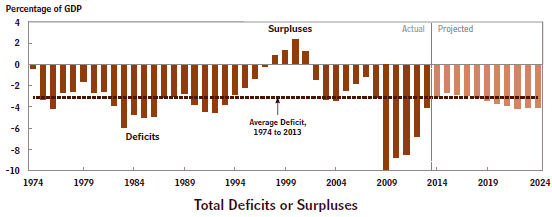
CaptureCapture1The first chart above shows a forty year history of government deficit spending.  The average deficit for this time period is 3% of GDP.  From 1982 – 1987 the deficits were worse than this and from 2009 – 2013 they were much worse.  The real problem is the accumulated deficits, i.e. the debt.  The second chart above shows the public debt (what we pay interest on) all the way back to 1940 as a percent of GDP.  As recently as 2008, the public debt was below 40% of GDP.  Now it is 73% and climbing.  This is very serious for two reasons.  Right now our public debt is almost free money because interest rates are so low.  But when interest rates return to their normal level of about 5%, interest payments will explode and be a huge drain on the economy.  In addition, these CBO predictions assume continued steady growth of the economy.  If and when we have a new recession or some other financial crisis, there will be much less flexibility available for dealing with it.
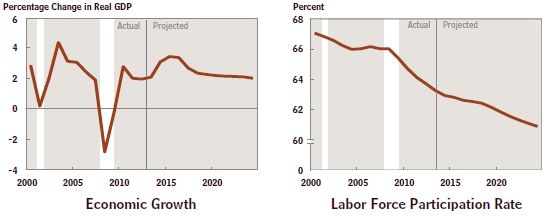
Capture2Now look at the last two charts.  The first one shows the rate of GDP growth since 2000 which has averaged about 2% since the end of the recession in June 2009 and is projected by the CBO to level off at this same rate over the next 10 years.  This is an historically low rate of growth for our economy. The final chart shows the gradual decrease of the labor force participation rate over this same time period.  These two graphs are related!  When fewer people are working, the economy simply will not grow as fast.
High debt and slow growth are big problems for an economy.  We’re falling more deeply into this perilous state of affairs all the time.  We need to take strong measures to break out of this dangerous trap!

Fundamental Tax Reform Is the Key to Solving Our Economic and Fiscal Problems I. Why Change Is Needed

I have been writing this blog for just over a year.  It addresses what I consider to be the two biggest problems faced by our country at the present time.  First is our enormous national debt, now over $17 trillion, and the huge annual budget deficits which are continuing to make it worse.  The second problem, of equal magnitude, is our slow rate of economic growth, about 2% of GDP annually, ever since the Great Recession ended in June 2009.
CaptureThese two problems are closely related.  If the economy grew faster, federal tax revenue would grow faster and the annual deficit would shrink faster.  Not to mention that a faster growing economy would create more jobs and lower the unemployment rate, which is still a high 7%.
The impediments to solving these problems are huge.  Our public debt, on which we pay interest, is now over $12 trillion or 73% of GDP.  Although it may stabilize at this level for a few years, it will soon begin climbing much higher, without major changes in current policy.  This is primarily because of exploding entitlement spending for retirees (Social Security and Medicare) who will increase in number from about 50 million today to over 70 million in just 20 years.  As interest rates return to normal higher levels, just paying interest on the national debt will become, all by itself, a larger and larger drain on the economy.
The impediments to faster economic growth are increasing global competition, such as inexpensive foreign labor, as well as rapid advances in technology, such as electronics and robotics.  Both of these trends reduce the need for unskilled workers in America which in turn holds down wages and slows down economic growth.
At the same time we have an antiquated tax code to raise the huge sums of money necessary to pay for a large and complex national government.  It worked fine through the post-World War II period, as long as the U.S. had the dominant world economy with little significant competition from others.  But this situation no longer exists.  We now have a tax system which doesn’t raise enough money to pay our bills and at the same time is so progressive that the highest rates (39.6% on individuals and 35% for corporations) are not sufficiently competitive with other countries.  This discourages the entrepreneurship and business investment we need to grow the economy faster and create more jobs.
We have an enormous problem on our hands!  Is it possible to fundamentally change our tax system to turn things around?  My next post will answer this question in the affirmative!

Is Expanding The Social Safety Net Compatible With Fiscal Restraint?

Yesterday’s New York Times addresses this issue with an article “Ohio Governor Defies G.O.P. With Defense of Social Safety Net”.  It describes how Republican Governor John Kasich has maneuvered to expand Medicaid coverage in Ohio to 275,000 low income Ohioans under the new healthcare law, over the objections of his own Republican dominated state legislature.
Mr. Kasich is a former congressional deficit hawk and there is little doubt about his fiscal conservatism.  He recently balanced his state budget by cutting revenues to local government by $720 million.  But he has also expanded state aid for the mentally ill and supported efforts to raise local taxes for improving education.  He says “for those who live in the shadows of life, for those who are the least among us, I will not accept the fact that the most vulnerable in our state should be ignored.”
Especially after the disastrous debt ceiling debate, with Tea Party Republicans willing to default on our national debt in order to defund Obama Care, it is critical for fiscal conservatives to publicly demonstrate that they are not opposed to helping the poor in a reasonable manner, as long as it is cost effective.
To be in favor of controlling entitlement spending is not the same thing as wanting to abolish entitlement programs.  In fact, it is just the opposite.  We must control their costs so that the government will have the means to continue to support them.  It is just plain ordinary common sense.  If our national debt continues to grow unchecked, we risk not only entitlement programs but our entire way of life.
Take Medicaid as a concrete example.  Right now the federal government pays a percentage of the costs incurred by state governments in running the program.  The more a state spends for Medicaid, the greater the reimbursement from the federal government. This increases spending for both the states and the federal government.  A more cost effective approach is to give each state a block grant from the federal government and enough leeway to operate its own program as efficiently as it can.  Exactly this approach is being used in Rhode Island and is working very well at a much lower overall cost.
Being a fiscal conservative is not the same thing as being mean spirited!  The future of our country depends on getting this crucial message out far and wide!