“Manana Is Not a Credible Fiscal Plan”


Thus spoke George Osborne, Great Britain’s Chancellor of the Exchequer, in a recent speech to the Economic Club of New York.  “By applying a consistent and long-term economic plan, we can ensure that our best days lie ahead.  If we reduce our high debt so we can weather new shocks, and take the difficult decisions to make our economies more productive, we can provide rising living standards for our citizens.”

CaptureAccording to Mr. Osborne, any long term economic plan needs to include three elements:

  • An activist monetary policy to do whatever it takes to sustain sufficient demand in the economy.
  • A credible commitment to sustainable fiscal policy. Some have argued that fiscal consolidation is incompatible with economic recovery. But recent experience, e.g. sequestration in the U.S. and a balanced budget in the U.K., has shown the reverse.
  • An ambitious program of supply-side reform. The U.S. has a booming technology sector and the fracking revolution. The U.K. has cut its corporate tax rate to 20%, welcomes disruptive innovation and is pushing ahead on shale gas.

In the U.S. things are moving in the right direction and so the focus needs to be on keeping the momentum going.  Monetary stimulus has accomplished much but now a sound exit policy is needed.  Sequestration has slowed down the growth of government debt but has not ended it.  Further progress will require entitlement reform, especially for Medicare and Medicaid.  But first, the Affordable Care Act needs to be improved to do a better job of controlling the overall cost of healthcare.  Infrastructure improvement, tax reform and expanding trade are the supply side keys to increasing productivity and shared prosperity.
Activist monetary policy, credible fiscal policy, and ambitious supply side reform: these are the policies which will lead to future progress!

Is Health Care Spending Really Under Control?


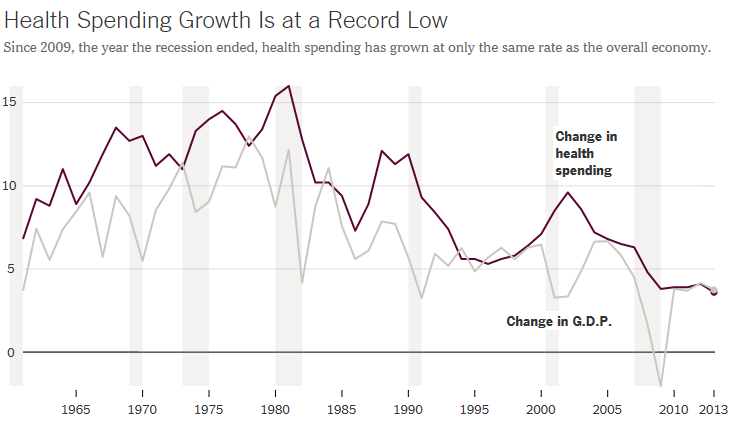
The New York Times has two recent articles about health care spending, “Good News inside the Health Spending Numbers” and “The Battle over Douglas Elmendorf – and the Inability to See Good News.”  These two articles focus on the fact, clearly evident in the chart just below, that the rate of increase in overall health care spending has slowed down since 2009.  In fact health care spending has been a constant 17.4% of GDP for the past four years, while it increased by 1.9% of GDP in the four years before that.  More precisely, health care spending rose by 3.6% in 2013, down from 4.1% in 2012.
CaptureIt is, of course, very good news that increases in health care spending have dropped dramatically since the recession in 2007-2009, but is it really surprising that this has happened in the midst of so much economic pain, with a very high rate of unemployment as well as stagnant incomes for most Americans?  In fact, even in these circumstances, health care spending is still growing at twice the rate of inflation, which has been under 2% during this same time period.
A more realistic view of health care spending has just been presented to the Health Subcommittee of the House Committee on Energy and Commerce by Marc Goldwein, from the non-partisan Committee for a Responsible Federal Budget, a Washington D.C. think tank focused on fiscal responsibility.  Mr. Goldwein makes the following points:

  • Despite the recent slowdown in health care spending, it remains incredibly important that policymakers pursue reforms to reduce future projected health care costs.
  • Policymakers should focus first and foremost on health care “benders” that would improve incentives in order to slow the overall growth of health care spending.
  • Policymakers should next look to health cost “savers” which reduce federal costs by better allocating resources within the federal health programs.
  • Given the aging of the population, health reforms will be necessary but not sufficient to put the debt on a sustainable long-term track.

Slowing down the rate of growth of health care is going to be a huge challenge for our national leaders.  I will elaborate on how to do this in forthcoming blog posts.

Fix the Debt


Recently I have had several posts about our national debt, for example, “Why the National Debt Is Such a Threat to the U.S.,” showing graphically that our current public debt at 74% of GDP is very high by historical standards and rising rapidly under current fiscal policies.
CaptureYesterday I attended a workshop in Washington D.C. put on by Fix the Debt.  All expenses were paid and, in return, the attendees agree to make at least three presentations to local community groups during the following year.  This means that I will soon be sending out a letter to such groups as Kiwanis and Rotary Clubs around the Omaha area where I live, offering my services as a speaker at one of their meetings.  The purpose is to build more public awareness of the threat of a huge and growing national debt to the long-term welfare of our country. Here is a summary of talking points from the workshop:

  • The deficit for the 2013-2014 fiscal year is almost $500 billion.
  • Under current fiscal policies the debt will increase to 270% of GDP by 2080.
  • Reasons for our debt problem:
  1. An aging population which means expanded Social Security spending
  2. Healthcare costs are growing for both Medicare and Medicaid
  3. Interest costs will grow rapidly as the economy recovers and interest rates rise
  • All bipartisan reform plans call for both spending cuts and revenue increases.
  • The benefits of taking action are:
  1. Increased budget flexibility
  2. Lower exposure to changes in interest rates
  3. Reduced risk of another financial crisis
  • The longer we wait:
  1. The older our population gets
  2. The higher the debt will rise
  3. The less time we have to phase in changes
  4. The slower our economy will grow
  5. The fewer tools we will have to fix it
  • How do we bring debt under control?
  1. Enact policies that grow the economy
  2. Health care cost containment
  3. Spending cuts
  4. Tax reform and tax expenditure cuts

Let me know if you’d like a speaker on this topic at your club!

How to Shrink the Deficit: Control Entitlement Spending by Fixing Obamacare


Our country faces two major fiscal and economic problems:

  • How to boost the economy in order to put more people back to work.
  • How to either increase tax revenue or better control spending in order to shrink the deficit.

My last post, “The Great Wage Slowdown and How to Fix It” makes a specific tax reform proposal to cut tax rates for all by shrinking tax deductions for the wealthy.  This would put tax savings in the hands of millions of wage earners with stagnant incomes, who would likely spend it, thereby boosting the economy.
CaptureAs the above chart clearly shows, there is only one realistic way to shrink the deficit.  We have to do a better job of controlling entitlement spending (Social Security, Medicare and Medicaid.)  As a practical matter, this means we have to cut back the cost of American healthcare in general, both public and private.
The Manhattan Institute’s Avik Roy has come up with an attractive Plan for doing just this, “Transcending Obamacare.” Mr. Roy’s proposal is to:

  • Repeal the individual mandate. Insurers are encouraged to design policies of high quality tailored to individual need. By lowering the cost of insurance for younger and healthier individuals, the Plan will expand coverage without a mandate.
  • Repeal the employer mandate, thereby offering employers a wider range of options for subsidizing employees insurance.
  • Keep the exchanges to provide broad access as well as subsidies for those with low incomes.
  • Migrate the Medicaid population onto the exchanges.
  • Raise the Medicare eligibility age by 4 months per year indefinitely. Over time this will maintain future retirees on exchange-based or employer sponsored health plans.

By gradually moving the Medicaid and Medicare recipients onto the exchanges, both of these very large populations will receive equal quality coverage to everyone else, delivered in a cost effective manner.  Mr. Roy estimates that the Plan will expand coverage by 12 million above Obamacare levels by 2025 and reduce the deficit by $8 trillion over 30 years.
This is the sort of major healthcare reform which we need to get entitlement spending under control!

Which Nebraska Senate Candidate Is Most Serious about the National Debt?


“The single biggest threat to our national security is our debt”
Admiral Mike Mullen, former Chairman of the Joint Chiefs of Staff

My last blog, “Why the National Debt Is Such a Threat to the U.S.” observes that our debt is very large by historical standards and will just keep getting worse under current policies now in effect.  This has many severe consequences for the well-being of our country.
What do we do about it?  We have to shrink the size of our annual deficits which are continuing to make the debt bigger and bigger.  The deficit for the 2014-2015 budget year just ended is $483 billion which is 2.8% of GDP.  Since our economy has been growing at a rate of only 2.2% for the past five years, this means that the debt is still growing faster than the economy.  We have to do better than this.
CaptureThe above chart from the Congressional Budget Office shows that the main contributors to the deficit, and therefore also the debt, over the next 20 years, will be entitlements (Social Security, Medicare and Medicaid) and interest payments on the debt.  All other programs, i.e. almost all of traditional federal spending, will decrease as a percentage of GDP.
This means that there are just two basic ways to solve our debt problem: trim entitlement spending and/or increase government revenue.  We’ll need to do both.  Furthermore, it is unrealistic to expect middle-income and lower-income people to pay higher taxes when their wages have been stagnant for many years.  New tax revenue will have to come from the wealthy including upper-income wage earners.  The best way to do this is by cutting back on the annual $1.2 trillion in loopholes and deductions built into the tax code.
CaptureOnly one Senate candidate from Nebraska is willing to both trim entitlement spending and raise additional tax revenue: Jim Jenkins, a registered independent from Calloway.  The Democratic candidate, David Domina, will not support any significant reining in of entitlement spending.  The Republican candidate, Ben Sasse, is too beholden to wealthy contributors to be willing to raise their taxes by cutting back on their tax deductions.
We badly need elected representatives in Washington who will make it their top priority to “fix the debt.”  Jim Jenkins is such a person.  I hope you will vote for him!

How Do We Establish A Free Market Healthcare System in the U.S.?


As I discussed in my last post, it is critical and urgent for the U.S. to sharply reduce the cost of healthcare, both public and private.  There are basically two different ways to do this: with either a “single payer” system like most of the rest of the developed world has, or with a more nearly free market system than we have at the present time.
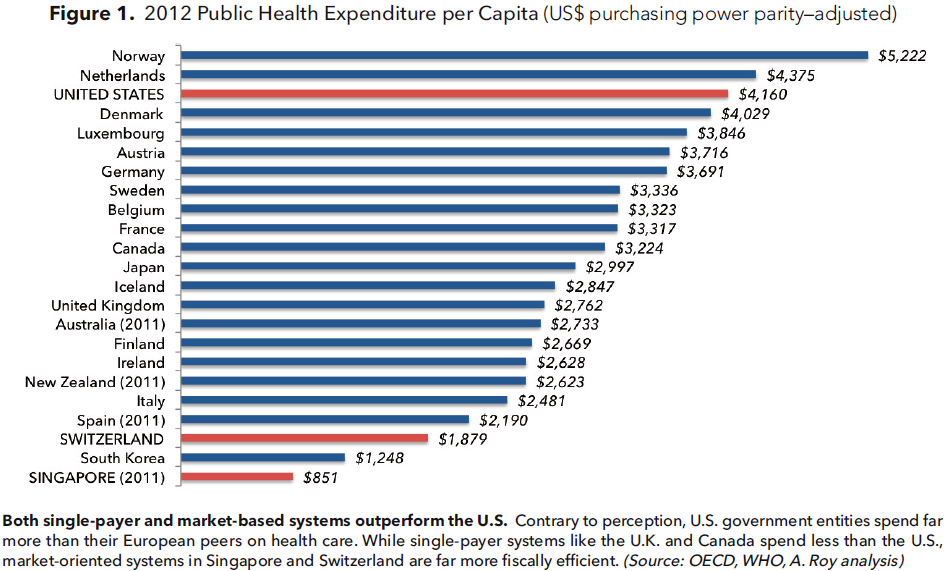
Capture1Both Switzerland and Singapore have largely free market systems with universal coverage and they operate at far less public cost, as shown above, than for other developed countries including the U.S.  The Singapore model features Catastrophic Care insurance, coupled with Health Savings Accounts, for all citizens, with subsidies for those with low-income.  The Swiss model employs exchanges, similar to our own Affordable Care Act, to subsidize, on a sliding scale, health insurance for the low income.  In Switzerland only 20% of the people receive an insurance subsidy compared to 85% in the U.S.
The Manhattan Institute’s Avik Roy has proposed a true free market system for the U.S., “Transcending Obamacare: a patient-centered plan for near-universal coverage and permanent fiscal solvency,” which is modeled on the Swiss system.  Mr. Roy’s plan sets up universal exchanges to offer insurance, subsidized if necessary, to everyone who does not receive it from their employer.
He proposes that over time Medicare and Medicaid recipients as well as Veterans would migrate into the exchange system.  This means that eventually the 30% of Americans (elderly, poor and veterans) who now receive direct government (single payer) support would become part of the exchange system. Mr. Roy’s Universal Exchange Plan is projected to reduce deficit spending by $8 trillion over the 30 year period which it will take to fully phase in the exchanges.  This will go a long way towards solving our serious fiscal problems.
Conclusion:  both Singapore and Switzerland have high quality, cost efficient free market health care systems which proves that a free market approach is possible.  Mr. Roy adapts and expands the Swiss model for the much larger and more complex American market.  It isn’t necessarily the last word in healthcare reform but it takes a big step in the right direction.

Fixing Obamacare Rather Than Repealing It


The Manhattan Institute’s Avik Roy has just released a comprehensive and very impressive new study of the American healthcare system, “Transcending Obamacare: A Patient-Centered Plan for Near-Universal Coverage and Permanent Fiscal Solvency.”  By 2025 it will increase insurance coverage by 12.1 million above Affordable Care Act levels.  It will at the same time achieve a 30 year deficit reduction of $8 trillion compared to current CBO projections (see chart below).
CaptureMore specifically Mr. Roy’s new Universal Exchange Plan will

  • Expand coverage well above ACA levels without an individual mandate
  • Improve the quality of coverage and care for low-income Americans
  • Make all U.S. healthcare entitlement programs permanently solvent
  • Reduce the federal deficit without raising taxes
  • Reduce the cost of health insurance

The five core elements of Mr. Roy’s Plan are:

  • Exchange Reform. The ACA’s individual mandate is repealed. The Plan restores the primacy of state-based exchanges and insurance regulation. Insurers are encouraged to design policies of high quality tailored to individual need. By lowering the cost of insurance for younger and healthier individuals, the Plan will expand coverage without a mandate.
  • Employer-sponsored Insurance Reform. The employer mandate is repealed, thereby offering employers a wider range of options for subsidizing employees insurance.
  • Medicaid Reform. The Plan migrates the Medicaid acute-care population onto the reformed state-based exchanges with 100% federal funding. The Plan returns to the states full financial responsibility for the Medicaid long-term care population.
  • Medicare Reform. The Plan gradually raises the Medicare eligibility age by four months each year forever. The end result is to preserve Medicare for current retirees and to maintain future retirees on their exchange-based or employer sponsored health plans.
  • Other Reforms. The Plan tackles the growing problems of hospital system monopolies and malpractice litigation and also accelerates the pace of medical innovation by reforming the Food and Drug Administration.

These reform proposals are amazingly ambitious and far reaching in scope.  How can they possibly be achieved?  Stay tuned!

The Big Picture on Debt II. Why It Is So Alarming


My last post, “The Big Picture on Debt,” used a chart from a recent Congressional Budget Office report (pictured  below) to look at the history of U.S. debt.  It is worse now than at any other time except at the end of World War II.  But after 1945 massive military spending ended rapidly, the economy started growing briskly and debt as a percentage of GDP shrunk rapidly.
CaptureThe light purple section at the right hand side of the chart portrays CBO’s debt projection for the next 25 years.  As the report itself makes clear, CBO is using favorable economic assumptions in this projection.  Without these favorable assumptions, our future debt will be much worse than this.  And the same trends continue indefinitely into the future beyond the 25 year window.
Right now our huge debt is almost “free” money because interest rates are so low.  But this situation cannot last much longer without setting off an inflationary spiral.  As interest rates eventually resume their historical average of about 5%, interest payments on our accumulated debt will skyrocket and therefore increase the size of the annual deficits.
There are only three ways to shrink debt as a percentage of GDP: 1) cut spending, 2) achieve faster growth and 3) raise tax revenue.  Let’s look at each in turn:

  • Government spending as a percentage of GDP is not shrinking but actually growing. Primarily this is because of the massive growth of the big three entitlement programs: Social Security, Medicare and Medicaid. All other government spending is subject to Sequester limits. This is a crude and insufficient way to control discretionary spending.
  • GDP growth, averaging 2.2% annually since the end of the Great Recession five years ago, is much slower than the overall average growth of 3.3% since the end of WW II. Major tax reform at both the individual and corporate levels, with lower tax rates offset by closing loopholes and shrinking deductions, would give a big boost to economic growth. But there is resistance to cutting tax deductions.
  • Raising taxes will in principle decrease deficit spending but the trick is to do it without hurting economic growth. Both individual and corporate tax reform could accomplish this if done in the right way. See here and here for specific proposals.

Conclusion:  there are concrete ways to find solutions to get our massive accumulation of debt under control and shrinking as a percentage of GDP.  But the prospects for action are gloomy.

The Big Picture on Debt


Most observers agree that the Congressional Budget Office is a reliable source for detailed, objective and nonpartisan information about the federal budget.  Its frequent reports are cited by all sides in budget debates.  Today I refer to the recent CBO publication, “The 2014 Long-Term Budget Outlook in 26 Slides.”  In particular, one of its graphs entitled “Federal Debt Held by the Public” (pictured here) has a striking message.
CaptureThroughout history, the U.S. has had relatively large debt following each of its major wars, especially after World War II.  But the debt has always declined relatively quickly, as a percentage of GDP, as the economy recovered and grew briskly. But now, in 2014, we are stuck with a huge debt which is projected (by CBO) to not shrink but rather to keep getting much worse.  And furthermore, the so-called “Extended Baseline Projection” in the graph, is an optimistic projection which disregards several long-term trends such as mortality decline, possibly slower productivity growth, higher interest payments and likely growth of federal healthcare spending.
How in the world will this huge debt problem be resolved in a favorable manner?  Republicans don’t want to raise taxes and Democrats don’t want to cut spending, especially on entitlements.  The only action taken in the last few years, under threat of not lifting the federal debt limit, was to implement a Sequester on discretionary spending.  This helps but not nearly enough.
Recent budget agreements are not auspicious for future progress.  A five year farm bill was passed last spring without significant cuts to either farm subsidies or food stamps.  Highway spending was extended for a few months with a gimmick when what we really need to do is increase the federal gasoline tax.  A $17 billion (over three years) increase for veteran’s health has just been approved when what we really need is an extensive overhaul of the Veterans Administration.
There are deficit hawks in Congress, on both sides of the aisle, but their numbers are too small to be effective.  It is just very hard to vote no on spending measures when the pressure coming from special interest groups on all sides is to vote yes.
I am an eternal optimist by nature but I have a hard time visualizing a favorable outcome to our fiscal dilemma.  I am arranging my own affairs accordingly.

How to Control Federal Spending III. Reform Medicaid!


One of the many controversies involving the Affordable Care Act concerns the expansion of Medicaid to cover low income people up to 138% of the federal poverty level.  As Robert Samuelson reported in the Washington Post a few days ago, “The Real Medicaid Problem,” 24 states have refused to expand Medicaid coverage even though the federal government will pay 100% of all additional costs until 2017.
CaptureAs Mr. Samuelson points out, the underlying issue is a matter of cost:

  • The basic Medicaid program is funded with a fixed percentage of each state’s costs paid by the federal government. This means that the more a state spends, the more is contributed by the federal government. From 1989 to 2013, the share of state budgets devoted to Medicaid has risen from 9% to 19%. This upward trend is clearly unsustainable.
  • In Medicaid, children and adults up to age 65 represent three-fourths of beneficiaries, but only one-third of costs. The quarter of beneficiaries who are aged or disabled are responsible for two-thirds of costs.
  • More than 60% of nursing home residents are on Medicaid.
  • There is no assurance that the federal share of the expanded coverage will continue at the announced rate of 90% after 2017 because the federal government is in much worse financial shape than are most states.

An interesting Op Ed appeared recently in the Wall Street Journal, “The Smarter Way to Provide Health Care for the Poor,” written by Mike Pence, the Governor of Indiana.  In 2008 Indiana set up the Healthy Indiana Plan to better serve low income Indianans.  It now provides Health-Savings Accounts to 40,000 low income citizens, with very good results.  Indiana is applying for a waiver to the ACA to use Medicaid expansion funds to provide HIP to all low income families up to 138% of the poverty level ($33,000 for a family of four).
Clearly, individual states, when offered the opportunity, are quite capable of coming up with innovative solutions for difficult problems.
A good way to resolve the problem of state resistance to Medicaid expansion is to fundamentally change Medicaid into a block grant program whereby the federal government contributes a specific amount of money to each state each year.  Then the states design their own programs to meet their own needs.  Block grant funding for Medicaid is a common sense approach to address one aspect of our huge fiscal problem in an intelligent way!