How Do We Establish A Free Market Healthcare System in the U.S.?


As I discussed in my last post, it is critical and urgent for the U.S. to sharply reduce the cost of healthcare, both public and private.  There are basically two different ways to do this: with either a “single payer” system like most of the rest of the developed world has, or with a more nearly free market system than we have at the present time.
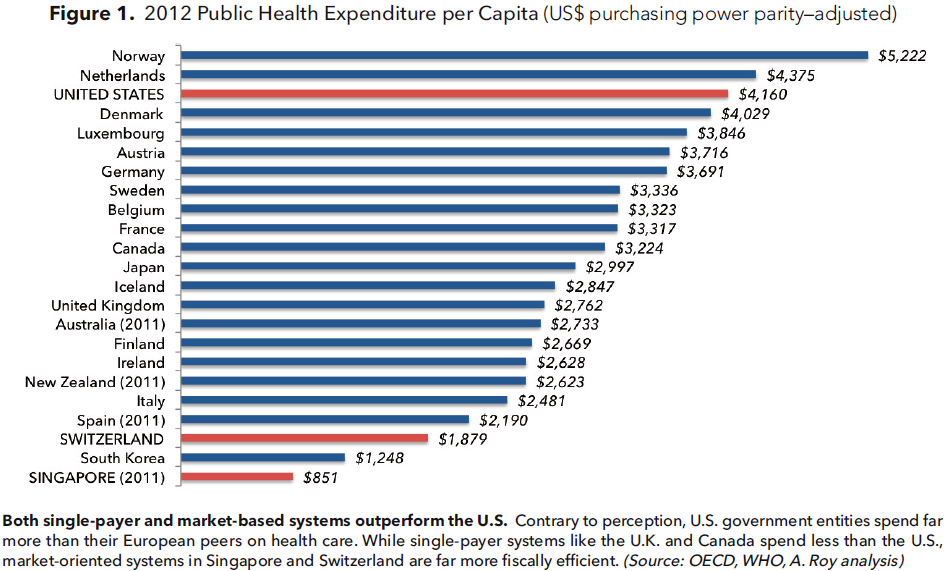
Capture1Both Switzerland and Singapore have largely free market systems with universal coverage and they operate at far less public cost, as shown above, than for other developed countries including the U.S.  The Singapore model features Catastrophic Care insurance, coupled with Health Savings Accounts, for all citizens, with subsidies for those with low-income.  The Swiss model employs exchanges, similar to our own Affordable Care Act, to subsidize, on a sliding scale, health insurance for the low income.  In Switzerland only 20% of the people receive an insurance subsidy compared to 85% in the U.S.
The Manhattan Institute’s Avik Roy has proposed a true free market system for the U.S., “Transcending Obamacare: a patient-centered plan for near-universal coverage and permanent fiscal solvency,” which is modeled on the Swiss system.  Mr. Roy’s plan sets up universal exchanges to offer insurance, subsidized if necessary, to everyone who does not receive it from their employer.
He proposes that over time Medicare and Medicaid recipients as well as Veterans would migrate into the exchange system.  This means that eventually the 30% of Americans (elderly, poor and veterans) who now receive direct government (single payer) support would become part of the exchange system. Mr. Roy’s Universal Exchange Plan is projected to reduce deficit spending by $8 trillion over the 30 year period which it will take to fully phase in the exchanges.  This will go a long way towards solving our serious fiscal problems.
Conclusion:  both Singapore and Switzerland have high quality, cost efficient free market health care systems which proves that a free market approach is possible.  Mr. Roy adapts and expands the Swiss model for the much larger and more complex American market.  It isn’t necessarily the last word in healthcare reform but it takes a big step in the right direction.

Income Inequality and Rising Health-Care Costs


There seems to be a general consensus on the reality of increasing income inequality in the U.S. and even some agreement on its two main causes: globalization and the rapid spread of technology. The slow growth of the economy since the end of the recession has made the inequality problem that much worse.
CaptureNot surprisingly, slow economic growth in the past five years has led to stagnant wages for many workers.  My last post addressed this problem.  The above chart from the New York Times shows that incomes for top wage earners have been rising in recent years while they have been stagnant for middle- and lower-income workers.
But there is more to it than this.  In yesterday’s Wall Street Journal, Mark Warshawsky and Andrew Biggs point out that, “Income Inequality and Rising Health-Care Costs,” in the years 1999 – 2006, total pay and benefits for low income workers rose by 41% while wages rose by only 28%, barely outpacing inflation.  For workers making $250,000 or more total compensation rose by a lesser 36% while wages grew by a greater 35%.  This apparent anomaly is explained by the fact that health insurance costs are relatively flat across all income categories, thus comprising a much larger percentage of the total pay package of low-income workers than for high-income workers.
Capture1In fact, the Kaiser Foundation has shown that low-wage workers tend to pay higher health insurance premiums, as well as receiving lower insurance benefits, than higher paid workers (see the above chart).
Overall, what this means is that employer provided healthcare is taking a huge chunk out of the earnings of low-income workers which makes income inequality much worse than it would be otherwise. Of course, the cost of healthcare is a huge burden for the entire U.S. economy, currently eating up 17.3% of GDP, twice as much as for any other developed country.
For both of these reasons it is an urgent matter for the U.S. to get healthcare costs under control.  Avik Roy of the Manhattan Institute has an excellent plan to do just this as I have discussed in several recent posts.

What Happens When We All Live to 100?


This is the title of an article in the current issue of Atlantic. Of course, it is a rhetorical question, but it raises a very serious issue.  There are 43 million Americans age 65 or older today and this number is expected to reach 108 million by 2050.  How will society cope with so many more senior citizens?
CaptureThis blog is concerned with the most critical fiscal and economic problems facing our country.  The biggest fiscal problem we have is how to pay for the three major entitlement programs: Social Security, Medicare and Medicaid.  Social Security can be shored up with small adjustments to either the benefits formula or by raising taxes a little bit.  Medicaid can be kept under control by block-granting the program to the states.  But Medicare is a much bigger problem.
Capture1The cost of healthcare, both public and private, is rising rapidly as shown in the above chart from the New York Times.  We badly need a new approach to control costs and Avik Roy from the Manhattan Institute has given us such a plan “Transcending Obamacare: A Patient-Centered Plan for Near-Universal Coverage and Permanent Fiscal Solvency.”
The problem is that, as Mr. Roy explains, “by creating a universal, single-payer health care program for every American over 65, regardless of financial or medical need, the drafters of Medicare made the program extremely difficult to reform.”  But now we have to reform it because the costs are becoming so huge.  How do we do it?
First of all, Mr. Roy’s plan keeps the exchanges created by the Affordable Care Act and turns them all into state-based exchanges.  It also eliminates both the individual and employer mandates, replacing these mandates with financial incentives.
Mr. Roy’s core Medicare reform is very simple.  The plan increases the Medicare eligibility age by four months each year.  The result is to preserve Medicare for current retirees, and to maintain future retirees – in the early years of their retirement – on their exchange-based or employer-sponsored health plans.  In other words, retirees will gradually be migrated to the same system, with the same level of subsidy, as for working people.
Everyone, workers and retirees alike, will be treated the same. Not only is this an eminently fair system, it insures that Medicare remains affordable, for both retirees and the whole country.

Three Cheers for Blue Cross Blue Shield Nebraska!


As I reported in my last post healthcare costs in the U.S. are expected to start climbing rapidly in next few years as the economy continues to recover and insurance coverage expands.
The Manhattan Institute’s Avik Roy has proposed a comprehensive new plan, ”Transforming Obamacare” to achieve, at the same time, both near-universal coverage and stringent cost control for healthcare.  Mr. Roy emphasizes the need to regulate hospital system consolidation which is especially responsible for driving up the cost of healthcare.
CaptureIn Omaha NE, where I live, there are three hospital systems: Catholic Health Initiatives, the Nebraska Medical Center and the Methodist Hospital System.  According to the insurance company, Blue Cross Blue Shield Nebraska (OWH 9/6/14), “CHI prices are 10 to 30 percent higher than for the Nebraska Medical Center and Methodist Hospital System.”  BCBS insists that CHI cut its prices.  As of September 1, CHI hospitals are out of network for BCBS and so patients who are insured by BCBS have to pay higher hospital rates.
“We are ready and willing to meet with them when they propose an agreement that gets serious about the cost issue,” said Lee Handke, a senior vice-president for Blue Cross Blue Shield.
Reports the OWH  “Blue Cross’ biggest customers are the region’s employers, whose 560,000 workers and family members supply 80% of Blue Cross’ revenue each year.  A big share of these people are CHI customers, too. … Blue Cross has told us (an insurance benefits broker) they understand that they might lose some business over this deal, but they feel that the point they have to make on the cost disparity is more important.”
For one hospital system to charge 30% more than two others for the same services is totally unacceptable.  It means that customers for the other two systems are paying higher insurance costs in order to subsidize the system with the higher prices.
In the Omaha market, Blue Cross has the clout and the will to force CHI to lower its prices.  But many other communities may not be as fortunate.

The High Cost of U.S. Health Care and What To Do About It


The United States spends 17.2% of GDP on healthcare costs, public and private, almost twice as much as any other developed country, and this percentage is gradually increasing.  In today’s New York Times there is a good discussion about these rising costs (see below).
Capture1My recent post, “Fixing Obamacare Rather Than Replacing It,” discusses a comprehensive new healthcare reform proposal by Avik Roy of the Manhattan Institute.  Mr. Roy’s plan both expands health insurance coverage beyond ACA levels as well as reining in the huge costs of healthcare. As Mr. Roy says “Among the industrialized member countries of the OECD, the average hospital stay cost $6,222 and lasted 7.7 days in 2009.  In the United States, the average hospital stay cost $18,142, despite lasting only 4.9 days.  In other words, the average daily cost of a hospital stay in the U.S. was 4.6 times the OECD average.”  Mr. Roy goes on to show that it is hospital system consolidation which is especially responsible for driving up the cost of health insurance.
CaptureThere is a clear example of this situation in Omaha NE where I live.  There are three hospital systems here: Catholic Health Initiatives, the Nebraska Health System and the Methodist Health System.  As stated by the CEO of Blue Cross and Blue Shield of Nebraska in the Omaha World Herald on August 28, 2014, “Our experience in addressing health care costs is precisely what led us to our current negotiations with Denver-based Catholic Health Initiatives.  CHI’s Alegent Creighton Health network of hospitals and physicians charges our members up to 30 percent more than other providers in Omaha for the same services. … These numbers reinforce a simple truth: We cannot allow one provider group to charge our members more for the same services they can receive elsewhere.”
We are fortunate in Omaha to have a choice of three different hospital systems and an insurance company with sufficient clout and integrity to fight price gouging by one of these systems.  But not every community is as fortunate as Omaha in this respect.  This is just one simple example of why cost control needs to be at the center of healthcare reform.

Controlling the Cost of Healthcare

Capture

The New York Times is running a series of articles, “Paying Till It Hurts,” giving many examples of the very high cost of healthcare in the U.S. today.  The latest article “As Hospital Prices Soar, A Single Stitch Tops $500”, focuses on the high cost of emergency room treatment around the country.
We spend 18% of GDP on healthcare, twice as much as any other country in the world.  It is specifically the cost of healthcare entitlements, Medicare and Medicaid, which is driving our huge deficits and rapidly growing national debt.  But to limit the cost of these entitlement programs, we first have to address the more fundamental problem: how to control the overall cost of healthcare in general.
Our current healthcare system, a combination of private insurance and government programs, is very inefficient. The basic problem is that the tax treatment of employer provided health insurance takes away the incentive for individuals to control the cost of their own care.   And Obamacare does not solve this problem, because it just extends the present system to more people, rather than revamping it.
There are essentially two different ways to transform our current healthcare system to make it far more efficient.  One way is to turn it into a single payer system, like what most of the rest of the world has.  This could be accomplished by simply expanding Medicare to everyone.  Costs would then be controlled by government regulation which would, of course, include rationing.  Given the unpopularity of Obamacare, with all of its mandates and uniform coverage requirements, it is unlikely that Americans would be happy with such a highly proscribed single payer system.
The alternative is to change over to a truly consumer based, market oriented system.  This could be accomplished by limiting the present tax exemption for employer provided insurance.  For example, the current system could be replaced by a (refundable) tax credit equal to the cost of catastrophic insurance (i.e. insurance with a very high deductible).  All other healthcare costs, whether paid for directly by consumers or through insurance, would be with after tax dollars.  Subsidies could be provided to lower income people through the Obamacare exchanges.  Once such a system is set up and running smoothly, it could fairly easily be extended to encompass Medicare and Medicaid.
Insurance companies selling catastrophic coverage would negotiate with hospitals and other healthcare providers to get the lowest possible prices for their customers.  In other words, both insurance companies and providers would compete in the open market to deliver healthcare products at the lowest possible cost.
Something along this line will have to be done and the sooner we get started the better!

The Floundering of America


In yesterday’s Wall Street Journal, columnist William Galston talks about “The Floundering of America”.  Based on recent reports from the Congressional Budget Office, Mr. Galston says that “Today we are hurtling toward a less dynamic economy, a meaner society and a riskier world.”
His argument is based on these observations:

  • For the past 40 years, 1970-2010, the labor force expanded at an average rate of 1.6% per year.  It will soon slow to only .4% annual growth, because of more retirements and a plateauing of women’s labor-force participation. This means that growth in GDP will slow down to about 2% annually from its historical average of over 3%.
  • America is aging very fast.  Today there are 57 million Social Security beneficiaries which will increase to 76 million in 2023.  Obviously this will rapidly increase entitlement spending on retirees.
  • America already spends 18% of GDP on healthcare costs and the CBO projects that this will grow to 22% by 2038.

“In sum, current trends and policies will yield lower rates of economic growth, painfully slow gains in real incomes, huge increases in outlays for expenses related to an aging population, and a health sector that devours more and more of the national product”, he says.
These trends are all contributing to an explosion of the national debt.  The only current strategy to keep this debt even roughly stable during the next decade, let alone reduce it, is to shrink discretionary spending through sequestration.  This will lead to a decline in discretionary spending to 5.3% of GDP by 2023.  This means roughly 2.6% of GDP for national defense with an equal share or all other domestic purposes.
“This is pure folly”, says Mr. Galston. “The country needs a new national strategy for a viable future.”
How do we achieve a new strategy?  Immigration reform will increase the size of the workforce.  Tax reform could boost the economy by encouraging business expansion, risk taking and entrepreneurship.  True (consumer-driven) healthcare reform could dramatically lower the cost of healthcare.  In other words there are potential policies out there that address our national floundering. We simply need leaders who are capable of going beyond partisanship in order to help create a better future!

Beyond ObamaCare: Where Do We Go From Here?

Last Sunday’s Washington Post has an Op Ed column by Jon Kingsdale, “Beyond Healthcare.gov, Obamacare’s Other Challenges” which describes the many challenges confronting ObamaCare besides just the website problems and the millions of individual policies which will be cancelled for not meeting the minimum requirements of the Affordable Care Act.  Based on his experience setting up the Massachusetts Health Insurance Exchange from 2006-2010, there will  be huge problems in getting enrollment, billing and premium collections working smoothly for such a large government program.  For example, an estimated 27% of those who will be eligible for tax credits under the ACA do not have checking accounts.  How will their monthly premiums be paid and tracked for these people if they’re late?
Considering all of the problems involved in the implementation of ObamaCare, and the fact that it does not really reform our current very costly healthcare system but rather just extends it to cover more people, it makes much sense to move toward real healthcare reform, which will control costs.
A column in today’s Wall Street Journal by Ramesh Ponnuru and Yuval Levin, “A Conservative Alternative to ObamaCare”, lays out several basic features which should be included in a sensible, market oriented approach to healthcare reform.   The principles are:

  • A flat and universal tax credit for coverage which applies to everyone and not just for employer provided healthcare.  The (refundable) credit would be roughly the amount necessary for catastrophic coverage.
  • Medicaid could be converted into a means-based addition to this tax credit.
  • Everyone with continuous coverage (which would be provided by the tax credit) would be protected from price spikes or cancellations if they get sick.  This provides a strong incentive to buy and retain coverage without the need for a mandate.

A market oriented healthcare system like this is not only preferable to all of the mandates and restrictions of Obamacare, it also improves our current system by both expanding coverage to more people as well as controlling costs by giving health consumers (all of us) a much bigger stake in purchasing healthcare.
The United States spends 18% of GDP on healthcare, twice as much as any other country in the world.  Our fiscal stability and future prosperity depend on getting this huge and growing cost under control.  The ObamaCare fiasco provides an excellent opportunity to get started on doing this.

A Much Better Republican Strategy for Obama Care


On the eve of its implementation, the Affordable Care Act (aka Obama Care) is more unpopular than ever amongst the general public.  But the House Republican strategy of trying to defund the ACA as part of a continuing resolution to fund the government for the new fiscal year is a very poor idea.  It will never pass both houses of Congress and be signed by the President.  All it can possibly do is lead to a temporary shutdown of the government and therefore cause mass confusion.
The Wall Street Journal recently suggested a much more effective way for the House Republicans to proceed in “Carve-0uts for Congress”.  The legislation establishing the ACA contains a provision requiring all members of Congress and their staffs (11,000 people in all) to purchase their own health insurance on the new exchanges which are being set up to enroll uninsured Americans.  The idea behind this provision is to insure that members of Congress and their staffs and their families will obtain their insurance just like everyone else so that they will fully experience how healthcare reform actually works in practice.
But just a month ago the Administration personnel team issued a regulation exempting all Members and aides from the requirement to use the exchanges.  A recent poll taken by Independent Women’s Voice shows that 92% of likely voters, regardless of their views of the ACA, think that this exemption is unfair.
The implication is clear.  Republicans should show their dissatisfaction with the ACA by attaching the repeal of this exemption, which is contrary to law, as well as highly unpopular, to the continuing resolution to fund the government for the next fiscal year.  Let the Democratic Senate defend this exemption if it wants too.  It’s an opportunity for the House Republicans to do the right thing and also to stand with the “little guy” against the Washington elite.

Our Dire Fiscal Situation II A Promising Solution


As I discussed in my last post, the Congressional Budget Office has shown very clearly that the U.S. is on an unsustainable fiscal path which must be reversed in order to avoid calamity.  We are spending too much money and not taking in enough tax revenue.  In a recent Wall Street Journal Op Ed column, the economist Martin Feldstein describes “How to Create a Real Economic Stimulus”.  “A successful growth and employment strategy would combine substantial reductions in the relative size of the future national debt with immediate permanent tax rate cuts and a multiyear program of infrastructure spending…….The only way to reduce future deficits without weakening incentives and growth is by cutting future government spending.”
Mr. Feldstein proposes slowing the growth of benefits of middleclass retirees by gradually raising the full benefit retirement age for Social Security from 67 to 70 and also raising the age of Medicare eligibility to the same level.  This would create a budget savings of 1% of GDP, or $200 billion, by 2020.   Rather than eliminating such popular tax deductions as the one for mortgage interest or the exclusion of employer payments for health insurance, he recommends limiting the amount by which individuals can reduce their tax liabilities to 2% of adjusted gross income.  This single change to the tax code would, for example, reduce the 2013 deficit by $140 billion.
In addition to lowering tax rates for individuals, corporate tax rates should be cut from 35% to about 25% in order to be competitive with other industrial countries.  We should also adopt the internationally common “territorial” system which doesn’t tax foreign earnings brought back home.
In short, we decrease spending and raise revenue with entitlement reforms and a limit on tax expenditures thereby creating a framework for tax rate reductions and infrastructure spending.  These are the sorts of bold measures needed to produce a real stimulus and thereby get our economy back on track!